The Black Sheep of the Solar System
Space is quiet. Too quiet. For decades, we looked at the darkness between Mars and Jupiter and saw nothing but rocks. Just a junkyard of debris left over from the violent birth of our solar system. We call it the Asteroid Belt. It’s supposed to be dead, silent, and boring.
But then we looked closer.
We sent a machine to check it out. A robotic scout named Dawn. And what it found on the dwarf planet Ceres didn’t just break the rules of geology; it shattered them. We aren’t talking about a few weird rocks here. We are talking about things that shouldn’t exist. Bright, blinding lights in the middle of nowhere. And something even stranger.
A pyramid.

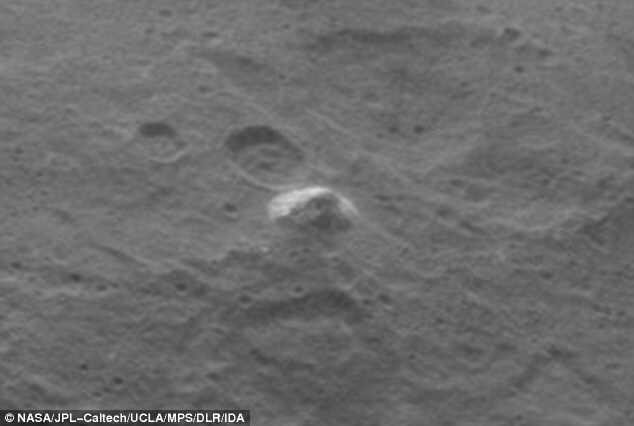
Look at that. Really look at it. That isn’t a random formation. That is geometry.
First, NASA’s Dawn probe spotted curiously sparkly bright spots on the surface of Ceres, the dwarf planet that lies in the asteroid belt between Mars and Jupiter. That was the first clue that something was wrong. The scientists were stumped. Beats us, the scientists said about the light. It could be ice reflection or even an alien base! Usually, they have a boring answer ready to go immediately. “It’s just gas.” “It’s just dust.” But this time? They hesitated.
The Impossible Structure: Ahuna Mons
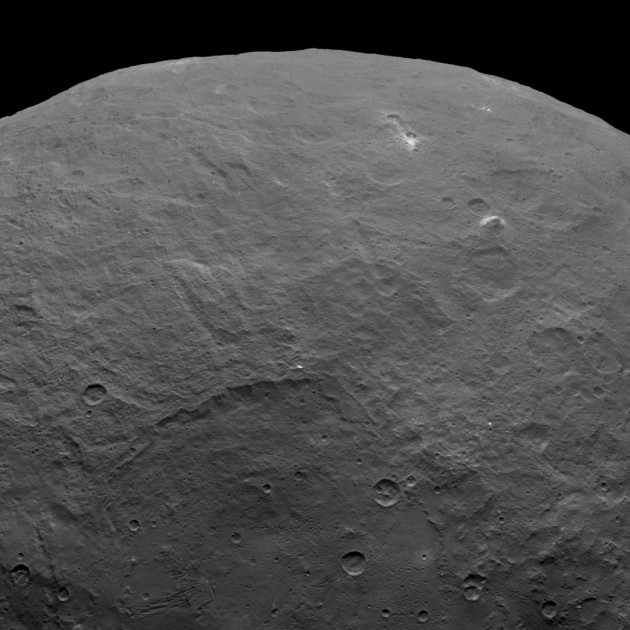
Now, cameras on the Dawn mission spacecraft have captured a baffling pyramid structure rising 3 miles above the planet’s cratered surface. NASA calls it “Ahuna Mons.” We call it the smoking gun.
The new image, released Sunday by NASA, was taken June 14 from a distance of about 2,700 miles, the agency said. But let’s step back and think about the scale here. Three miles high. That is taller than Mount Rainier. It rivals the biggest peaks in the Alps. But on Earth, mountains happen in ranges. They are pushed up by tectonic plates smashing together over millions of years. You get a chain of peaks.
On Ceres? This thing stands alone.
It is a solitary giant sitting in the middle of a relatively flat, scarred landscape. Why? How? Nature rarely builds perfect solitary pyramids on flat ground. ET researchers have been fascinated with the tiny planet since the US space agency’s unmanned probe Dawn began getting close-up images of its surface which revealed mysterious bright spots. But the spots were just the appetizer. The pyramid is the main course.
Now the discovery of a solitary “pyramid-shaped” peak on an otherwise flat part of Ceres has led to further speculation, with some claiming it could hold the key to the origins of mankind. It screams “artificial.” It looks placed. It looks like a marker.
The “Ancient Astronaut” Alarm
The internet exploded the moment these images hit the public servers. You can’t hide a three-mile-high monolith.
One UFO hunter posted online: “Ancient astronaut alert! More weird features have been spotted by NASA’s Dawn spacecraft on Ceres.” And they are right to be suspicious. When you look at the history of space anomalies, there is a pattern. We see shapes that remind us of home. We see geometry where there should be chaos.
NASA itself has estimated the object to be about three-miles high, which would make it around the height of Mount Blanc – the tallest mountain in the Alps. Imagine standing at the base of that. On a world with barely any gravity, looking up at a sheer wall of rock (or metal, or ice) rising into the vacuum of space. It’s terrifying. And beautiful.
Connecting the Dots: Mars, Earth, and Beyond
This isn’t an isolated incident. This is part of a puzzle that spans the entire solar system.
On Monday, www.express.co.uk revealed alien hunters had found a much smaller pyramid in NASA pictures of Mars. We have the famous “Face on Mars.” We have the pyramids of Giza on Earth. We have ziggurats in South America. And now, a massive pyramid in the asteroid belt?
A prolific paranormal YouTube channel posted videos about both. The connections are getting harder to ignore. Are we looking at a trail of breadcrumbs? A cosmic road map left behind by someone who was here long before us?
In the Ceres film, the narrator said: “A possible ancient pyramid has been found on the Dwarf planet Ceres.”
“Many researchers who have viewed the new pic have suggested it is an ancient pyramid very similar to those found on Mars, the Moon and of course on Earth.”
The Theory: A Galactic Outpost?
Let’s play “What If” for a second. Let’s strip away the “safe” scientific explanations and look at the possibilities.
Ceres is in the perfect spot. It sits right between the inner planets (Mercury, Venus, Earth, Mars) and the gas giants (Jupiter, Saturn). If you were an advanced civilization traveling through our system, Ceres is your truck stop. It has water (ice). It has low gravity, making it easy to land and take off. It is the perfect place for a base.
The narrator said it may confirm a “highly advanced” alien civilisation had left the monuments scattered through the cosmos. Think about it. We leave flags. We leave rovers. A civilization a million years ahead of us wouldn’t leave a flag made of nylon that rots away. They would leave a mountain. They would reshape the geology of the world itself.
They added: “I would theorise an ancient civilisation, possibly billions of years old, have purposely built these monuments for humans to find.”
This is the “Time Capsule” theory. Maybe they knew we were coming. Maybe they knew we would eventually build ships like Dawn. So they left a beacon. “Here we are. Come find us.”
“Maybe the answer to man’s quest for knowledge and meaning lies within these and ancient structures and maybe one day when the veil of secrecy is finally lifted we may actually find out just where in the Universe the human species originated from.”
NASA’s Explanation: The “Cryovolcano” Narrative
Of course, the official story is different. It always is. The suits at NASA aren’t going to come out and say “aliens.” They would lose their funding overnight. They need a safe, boring answer.
But NASA is convinced a more scientific answer will be found. Their best guess? A cryovolcano.
What is a cryovolcano? It’s an ice volcano. Instead of spewing molten lava like volcanoes on Earth, this thing supposedly spews salty mud and ice water from deep underground. The water freezes instantly on the surface, building up a mountain over millions of years. It sounds plausible on paper. But does it explain the sharp edges? Does it explain why there is only one massive one?
It shows what NASA described in its classically understated and totally non-freaked-out tones as “a mountain with steep slopes protruding from a relatively smooth area of the dwarf planet’s surface.” Notice the language. “Relatively smooth.” That means the area around it is flat. Geologically, if pressure is pushing up a volcano, the ground around it usually buckles. Here? It looks like someone dropped a pyramid onto a parking lot.
The Mystery of the Lights (Occator Crater)
We can’t talk about the pyramid without talking about the lights. The Ceres mystery has now deepened with the most recent batch of images showing the pyramid as well as even more bright spots alongside the largest one, which NASA said looks to stretch some 6 miles.
Six miles of glowing material. When Dawn first approached, these lights were so bright they saturated the camera sensors. They looked like electric city lights turned on at full blast. NASA eventually settled on the explanation that it is “highly reflective salt deposits.” Sodium carbonate, to be exact.
But here is the kicker: For that salt to be there, water had to come to the surface and boil away, leaving the shiny residue. That means Ceres is active. It’s alive, in a geological sense. If there is water, and heat, and organic chemicals (which Dawn also found nearby), you have the recipe for life. Or, you have the resources for a colony.
The “lights” are located inside the Occator Crater. Some theorists believe the crater isn’t a natural impact site at all, but an excavation. A strip mine. And the lights? The reflection off a glass dome? Or the remnants of a mining operation that packed up and left eons ago?

The Broken Planet Hypothesis
There is another theory that makes the hair on the back of your neck stand up. It’s called the Phaeton Hypothesis. It suggests that the Asteroid Belt isn’t just leftover debris. It is a crime scene.
Some astronomers and alternative historians believe a planet once existed between Mars and Jupiter. A super-Earth. Let’s call it Phaeton. The theory goes that this planet was destroyed—either by a cosmic collision or a war. Ceres isn’t just a dwarf planet; it’s a chunk of that dead world. A lifeboat.
If Phaeton was inhabited, and the planet was blown apart, maybe the survivors dug into the largest remaining chunks. Maybe they built the pyramid on Ceres as a memorial. A tombstone for a lost world.
When you look at the lonely pyramid of Ahuna Mons, you aren’t just looking at ice and rock. You might be looking at the last remnant of a civilization that died before dinosaurs even walked the Earth.
The Ghost Ship
The Dawn mission ended in 2018. The spacecraft ran out of fuel. But NASA didn’t crash it into the surface. They left it there.
Right now, the Dawn probe is a silent ghost ship, orbiting Ceres in a stable parking orbit. It will stay there for decades, maybe centuries. A human artifact circling an alien artifact. It watches the pyramid. It watches the lights. It waits.
NASA says this is to protect the surface from “contamination.” They don’t want Earth bacteria messing up the environment. Why? Because you only protect an environment if you think there is something down there worth saving. Or something down there you don’t want to wake up.
Keep Looking Up
We may never get a straight answer. The photos will get archived. The reports will get filed under “geological anomalies.” The scientists will move on to the next rock. But for those of us who pay attention, Ceres remains a giant question mark spinning in the dark.
Is it a natural formation of salty ice? Maybe. Nature is strange. But nature is rarely this dramatic. A three-mile-high pyramid on a flat plain? Blinding lights that look like a city grid? It pushes the boundaries of coincidence.
The universe is vast. We are young. And we are just waking up to the fact that our backyard is full of secrets. The pyramid on Ceres is calling out to us. The question is: Are we brave enough to go back and knock on the door?
Originally posted 2015-07-20 06:18:43. Republished by Blog Post Promoter