Wait. We Are Not the First.
History is wrong. Everything you were taught in school? It’s a safe, comfortable bedtime story. It tells us that civilization is a straight line—from cavemen banging rocks together to us, the pinnacle of technology, holding smartphones. But what if that line isn’t straight? What if it’s a circle?
What if we have been here before?
Look at the evidence piling up in the corners of the world that archaeologists are too scared to touch. We aren’t talking about pottery shards or arrowheads. We are talking about something much darker. Something radioactive. Specifically, we need to talk about India, the Rama Empire, and the terrifying possibility that humanity wiped itself out with nuclear weapons thousands of years before the Manhattan Project was even a glimmer in Oppenheimer’s eye.
The evidence is there. It’s in the dirt. It’s in the ancient texts. And it is setting Geiger counters off right now.
The Radioactive Ghost Town of Rajasthan
Let’s start with the hard science. We are going to the Thar Desert. Specifically, a spot about ten miles west of Jodhpur, Rajasthan. You see, the government wanted to build there. A simple housing development. It was supposed to be routine.
But then people started getting sick.
We aren’t talking about a flu. We are talking about birth defects. Weird cancers. The kind of biological breakdown you only see in places like Chernobyl or the outskirts of Fukushima. The doctors were baffled. The builders were confused. So, they called in the guys with the heavy equipment.
When the investigators turned on their gauges, the needles didn’t just flicker. They screamed.
The site was hot. Extremely radioactive. They found a heavy layer of radioactive ash covering a three-square-mile area. This wasn’t a small spill. This was a blanket of death. The radiation was so intense, so undeniable, that the Indian government didn’t issue a press release. They did something much more telling.
They cordoned off the region. Do not enter.
Digging Up the Apocalypse
Why is there radioactive ash in the middle of a desert? Critics will try to sell you swamp gas theories or natural geological hiccups. Don’t buy it. The pattern doesn’t fit. The levels of radiation found in the soil are consistent with the fallout from a nuclear detonation.
Scientists started digging deeper. Underneath the sands of the Thar Desert, they found something that shouldn’t exist. An ancient city. But not just a ruined city. A murdered city.
The evidence suggests an atomic blast occurred here between 8,000 and 12,000 years ago. Think about that timeline. We are told humans were barely figuring out agriculture then. Yet, the debris field tells a different story. It says that a weapon of mass destruction wiped out most of the buildings and instantly vaporized half a million people.
One researcher, analyzing the blast radius and the density of the destruction, dropped a bombshell estimate: The nuclear bomb used was roughly the size of the “Fat Man” or “Little Boy” dropped on Japan in 1945. Same yield. Same destruction. Just thousands of years too early.
The Glass Fields: When Sand Turns to Green
You need to understand the physics of a nuclear explosion to get why this is so huge. When an atomic bomb goes off, the heat is incredible. We are talking millions of degrees. It hits the ground so hard and so fast that it doesn’t just burn the sand. It melts it.
It turns the silica in the sand into glass.
In 1945, at the Trinity test site in New Mexico, the sand turned into a greenish glass substance we call “Trinitite.” It’s the signature of a nuclear event. You don’t get that from a forest fire. You don’t get that from a conventional war.
Guess what they find in India?
Fused glass. Whole fields of it. In the Indus Valley, specifically at sites like Mohenjo-Daro (which literally translates to “Mound of the Dead”), archaeologists have found vitrified rock. Stones fused together. Clay pots melted into black glass. The heat required to do that is upwards of 1,500 degrees Celsius. Volcanoes can do that, sure. But there are no volcanoes there.
So, what cooked the city?
The Skeletons That Are Still Radioactive
This is where it gets chilling. When they excavated Mohenjo-Daro and Harappa, the street levels revealed a horror show. Scattered throughout the cities were skeletons. Not buried in graves. Not lying in beds. They were in the streets.
They were sprawling, holding hands, as if walking and talking one moment and dead the next. Instantaneous death.
There was no sign of a struggle. No sword cuts. No smashed skulls from clubs. Just people, frozen in time. And the strangest part? Scavengers didn’t touch them. No animals dragged the bones away. Why? Because animals have an instinct for danger. They knew the bodies were tainted.
Decades later, Soviet scholars analyzed these remains. They found the skeletons had a radioactivity level 50 times higher than normal. That is not background radiation. That is the signature of someone who absorbed a lethal dose of gamma rays.
The Mystery of the Lonar Crater
If you think the ash is the only smoking gun, you need to look at the ground itself. Giant scars on the Earth do not lie.
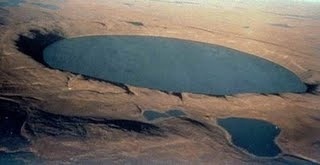
Look at the image above. That is the Lonar crater. It is nearly circular, 2,154 meters in diameter, sitting 400 kilometers northeast of Mumbai. It’s baffling geologists to this day.
Here is the mainstream story: A meteor hit the earth about 50,000 years ago. Case closed, right? Wrong.
If a meteor that big hits the ground, you find things. You find fragments of the meteorite. You find nickel. You find rare earth elements that belong in space, not in India. Scientists have scoured the Lonar site. They have filtered the dirt. They have checked every inch.
No trace of meteoric material has ever been found at the site or in the vicinity.
Zero. None. So, what made the hole? It is the world’s only known “impact” crater in basalt rock. To crack basalt like that, you need pressure exceeding 600,000 atmospheres. You need a shockwave that defies imagination. And you need heat. Intense, abrupt heat.
Researchers have found “basalt glass spherules” at the site. Again, we are back to glass. These spherules only form when rock is instantly boiled into liquid and flung into the air, cooling into tiny balls before they hit the ground. It happens in two scenarios: hyper-velocity space impacts, or nuclear detonations.
If there is no space rock, what are we left with?
The Mahabharata: History, Not Myth?
Skeptics hate this part. They want to ignore the written records because they sound “too religious.” But you have to listen to what the ancients were actually saying. The Mahabharata and the Ramayana are the great epics of India. We treat them like fantasy novels. But what if they are survivor accounts?
These texts describe battles in the sky. They talk about “Vimanas”—flying machines that could travel to the stars. And they describe weapons that sound suspiciously like ICBMs.
Listen to this passage from the Mahabharata describing the weapon of the “Gurkha”:
“A single projectile charged with all the power of the Universe. An incandescent column of smoke and flame, as bright as the thousand suns, rose in all its splendor.”
Does that sound like a sword fight to you? “A column of smoke… bright as a thousand suns.” That is a mushroom cloud. It’s the exact phrasing an observer would use if they saw a nuclear blast and didn’t have the word “nuclear.”
The text goes on. It gets even more specific. It describes the after-effects:
“The corpses were so burned as to be unrecognizable. The hair and nails fell out. Pottery broke without apparent cause, and the birds turned white… After a few hours, all foodstuffs were infected… to escape from this fire, the soldiers threw themselves in streams to wash themselves and their equipment.”
Hair and nails falling out? That is radiation poisoning. Foodstuffs being infected? Radioactive fallout. Soldiers washing themselves to get the “fire” off? That is exactly what you are trained to do in a hazmat situation to scrub off radioactive particles.
How did a writer 4,000 years ago know the specific biological symptoms of radiation sickness? How did they know that water washes away the invisible poison? Imagination? Or observation?
Oppenheimer Knew
The father of the atomic bomb, J. Robert Oppenheimer, was a genius. He was also a student of Sanskrit. He read the Mahabharata in the original language. He knew exactly what he was building.
We all know his famous quote after the first Trinity test: “Now I am become Death, the destroyer of worlds.” He was quoting the Bhagavad Gita.
But there is another quote people forget. Seven years after the nuclear tests, a student at Rochester University asked Oppenheimer a pointed question: “Was the bomb exploded at Alamogordo during the Manhattan Project the first one to be detonated?”
Oppenheimer didn’t say yes. He paused. And then he said something that should chill you to the bone:
“Well, yes. In modern times.”
He knew. He saw the parallels. He understood that we were just rediscovering a fire that had burned the world down once before.
The Cycle of Destruction
The implications here are massive. If the Rama Empire was destroyed by nuclear war, it changes everything. It means we aren’t the first advanced civilization on Earth. It means progress isn’t guaranteed.
Maybe we build up high technology, split the atom, get too arrogant, and blow ourselves back to the Stone Age. Maybe the cavemen we hear about were the survivors of the last apocalypse, huddled in caves to escape the radiation, forgetting their history until it became nothing but myths about gods throwing lightning bolts.
The radioactive ash in Jodhpur is real. The crater in Mumbai is real. The glass fields are real. The texts are specific.
We are walking on the bones of a giant. And if we aren’t careful, we are going to end up just like them—shadows burned into the pavement, waiting for the next civilization to dig us up and wonder what went wrong.
Originally posted 2013-11-18 15:54:47. Republished by Blog Post Promoter

Aloha, I’m Amit Ghosh, a web entrepreneur and avid blogger. Bitten by entrepreneurial bug, I got kicked out from college and ended up being millionaire and running a digital media company named Aeron7 headquartered at Lithuania.