Space is supposed to be slow. It is a place of geologic patience, where events play out over hundreds of millions of years. Stars burn for eons. Planets form over epochs that defy human comprehension. But something out there in the dark, 450 light-years away towards the Centaurus constellation, just broke all the rules. It didn’t happen over a million years. It didn’t happen over a thousand.
It happened while we were watching.

In a blink of a cosmic eye, a massive amount of matter—enough raw material to build an entire solar system of planets—simply vanished. Deleted. Erased. Astronomers are baffled. Skeptics are terrified. And the fringe theorists? They are having a field day. Because when physics fails to explain what our telescopes are seeing, we have to start asking the uncomfortable questions. Is this a natural anomaly? Or did we just witness an engineering project on a galactic scale?
The Cosmic Crime Scene
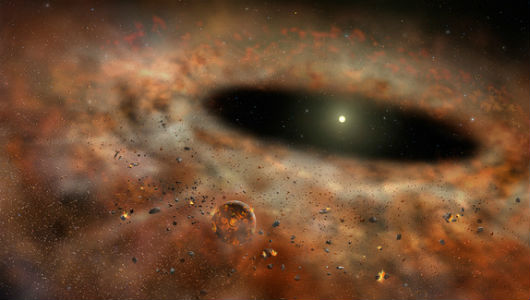
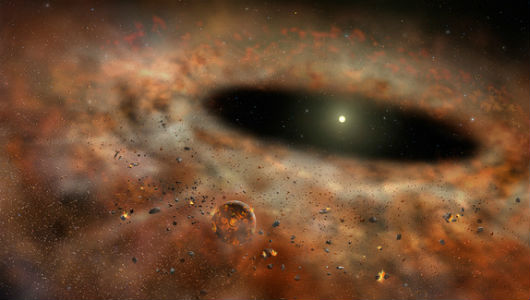
Let’s set the stage. The suspect is a star known as TYC 8241 2652 1. It’s a young star, roughly 10 million years old. In stellar terms, that is an infant. For context, our own Sun is a middle-aged 4.5 billion years old. Because TYC 8241 2652 1 is so young, it was, until recently, surrounded by a massive, chaotic, beautiful disk of gas and dust.
This is standard procedure for baby stars. This “protoplanetary disk” is the construction yard of a solar system. It’s the stuff that eventually clumps together to form rocky planets like Earth, gas giants like Jupiter, and asteroid belts. We first spotted this dusty halo back in 1983 using the Infrared Astronomical Satellite (IRAS). For decades, it sat there, glowing brightly in the infrared spectrum. It was a textbook example of a solar system in the making.
Scientists loved it. They studied it. It was stable. It was bright. It was normal.
Then came 2009.
The Great Vanishing Act
Astronomers pointed the Gemini South telescope in Chile at the star, expecting to see that familiar warm glow of dust. Instead, they saw… nothing. well, almost nothing. The infrared signature had cratered. It dropped by more than half in just a few months. By 2010, follow-up observations confirmed the impossible: the dust was gone. Not moved. Not hidden. Gone.
We aren’t talking about a few asteroids disappearing. We are talking about 1,000 trillion grains of dust.
To put that in perspective, imagine every single grain of sand on every beach on Earth. All of it. Now imagine all of that sand vanishing in less than two years. No trace left behind. No explosion. No residue. Just empty space where a massive cloud of matter used to be.
“It’s like the classic magician’s trick: Now you see it, now you don’t,” said Carl Melis of the University of California, San Diego. He’s the principal investigator on this, and even he sounds like he doesn’t quite believe it. “Only in this case, we’re talking about enough dust to fill an inner solar system, and it really is gone!”
Why This Shouldn’t Be Possible
Let’s get into the nitty-gritty of why this is freaking everyone out. In astronomy, “fast” usually means a process that takes 100,000 years. If a star changes its behavior in a century, that is considered light-speed rapid. For a protoplanetary disk to dissipate naturally, it usually takes millions of years. The drag from the star slowly pulls the dust in, or the solar wind slowly pushes it out. It is a slow, graceful dance.
TYC 8241 2652 1 didn’t dance. It sprinted.
The disappearance happened so fast that our current models of stellar evolution simply break. They do not have a math equation for “massive system-wide deletion in 24 months.” It’s like watching a mountain erode into a flat plain over the course of a long weekend. Nature doesn’t work that way. Physics, as we understand it, doesn’t like surprises.
The Failed Explanations
When this story broke, the scientific community scrambled to find a rational, boring explanation. They came up with two main theories. Both of them have massive holes.
The “Avalanche” Theory: Some suggested the dust fell into the star. Gravity won, and the star ate its own children. It sounds plausible until you run the numbers. If that much matter slammed into the surface of a young star in two years, the energy release would have been colossal. We would have seen the star flare up brighter than anything else in that sector. We saw no flare. The star’s brightness in the visible spectrum stayed exactly the same. So, the dust didn’t fall in.
The “Blown Away” Theory: Did the star sneeze? Could a massive ejection of solar wind have pushed the dust out into deep space? Again, the math refuses to cooperate. To blow away that much heavy dust that quickly, the star would need to output energy levels that TYC 8241 2652 1 simply doesn’t have. It’s a young star, sure, but it’s not a cannon. And even if it did push the dust out, we would still see the “halo” of that dust moving further away. We don’t. The infrared signal didn’t move; it vanished.
Deep Dive: The “Runaway Collisional Cascade”
There is one violent theory that holds a tiny bit of water, but it paints a chaotic picture. It’s called a Runaway Collisional Cascade. Picture a cosmic demolition derby.
The idea is that something triggered the rocks and dust in the system to start smashing into each other. Rock A hits Rock B, shattering into a million pieces. Those pieces hit other rocks. A chain reaction begins. The theory suggests that the big dust grains were pulverized into microscopic gas particles so fine that the stellar wind could blow them away instantly.
But think about the scale. To clear an entire inner solar system in two years through collisions? That is not a natural process. That is total war. It would require a cataclysmic trigger event to start such a rapid grind. What could cause every rock in a system to suddenly decide to smash itself into oblivion simultaneously? Nature is rarely that synchronized.
The Alien Elephant in the Room
Now, let’s go where the academic papers refuse to go. Let’s look at the theories that keep the conspiracy forums awake at night. If nature didn’t do this, did intelligence do it?
We are constantly searching for the “technosignatures” of advanced alien civilizations. We look for radio waves (SETI). We look for laser pulses. But maybe we should be looking for missing matter. This brings us to the concept of the Kardashev Scale.
A Type I civilization can use all the energy on their planet. We aren’t even there yet. A Type II civilization can harness the total energy of their star. To do that, you need a Dyson Sphere—a massive shell or swarm of satellites that completely surrounds a star to capture its solar output.
The Harvest Hypothesis
Building a Dyson Sphere requires an ungodly amount of raw material. You can’t just ship it in from another galaxy. You have to mine it on site. You have to strip-mine the asteroids, the comets, and the dust.
What if what we witnessed wasn’t a natural disappearance, but a harvest? Imagine a fleet of automated von Neumann probes—self-replicating machines—arriving at TYC 8241 2652 1. Their programming is simple: Collect resources. Build the swarm.
If the machines reproduce exponentially, they could technically consume the dust of a solar system in a frighteningly short window. They vacuum up the dust, process it into construction materials, and cloak it or move it. The “fading” infrared light wasn’t the dust disappearing; it was the dust being organized into cold, non-reflective structures. It is a terrifying thought. A civilization so advanced that they can clean up a solar system as easily as you vacuum a rug.
The “War in Heaven” Scenario
Let’s get darker. What if it wasn’t construction? What if it was destruction?
In science fiction, we imagine weapons that can blow up planets (The Death Star). But a weapon that can vaporize a protoplanetary disk? That is a level of power we cannot comprehend. If two Type II civilizations clashed, would they target the resources? Denying the enemy the raw materials to build a base?
The suddenness of the event mimics an explosion or a rapid reaction weapon. One day the resources are there. Two years later, the sector is barren. It looks less like geology and more like a “scorched earth” military tactic. Is TYC 8241 2652 1 a graveyard? A battlefield monument left in the cold vacuum?
The Simulation Glitch
There is a modern theory gaining traction in Silicon Valley and philosophy departments alike: The Simulation Hypothesis. The idea that our entire universe is nothing more than sophisticated code running on a computer the size of a galaxy.
If we are in a simulation, things like TYC 8241 2652 1 make a lot of sense. In video games, to save memory, the computer only “renders” what you are looking at. Things in the distance are often low-resolution or simple placeholders until you get closer.
Maybe the dust disk was a rendering error. A placeholder graphic. When we started pointing high-powered telescopes like Gemini South at it, the “engine” realized the mistake. It corrected the code. Delete dust_cloud.exe.
It sounds crazy. But when the physical explanations—gravity, accretion, stellar wind—all fail to match the data, the “glitch” theory stops sounding quite so funny. Why does the universe obey mathematical rules? Because it is code. And sometimes, code breaks.
Connecting the Dots: Tabby’s Star
This isn’t the first time a star has acted weirdly, though it might be the most extreme case. You might remember KIC 8462852, also known as “Tabby’s Star.” A few years ago, that star started dipping in brightness in a way that made no sense, leading many to speculate about “Alien Megastructures” passing in front of it.
With Tabby’s Star, the light was blocked. With TYC 8241 2652 1, the source of the light (the warm dust) was removed. They are opposite sides of the same mysterious coin. Are we seeing different stages of galactic engineering? Is one star under construction and the other being mined for parts?
The pattern is disturbing. We are seeing changes in the sky that are too fast, too big, and too unexplainable.
What Happens Next?
The scientists are keeping a close watch. They are waiting to see if the dust comes back. If this is a natural cycle—some bizarre, unknown oscillation—the dust should eventually glow again as it heats up or replenishes. But it has been over a decade since the disappearance. The silence from that sector is deafening.
If the dust never returns, we have to rewrite the textbooks on planet formation. We have to accept that solar systems can be aborted. That the raw material for life can be snatched away in a heartbeat.
Carl Melis and his team at UCSD did their job. They reported the anomaly. They published the data. But reading between the lines of their reports, you can feel the unease. They know that “magician’s trick” is just a polite way of saying “we have absolutely no idea what just happened.”
The universe is not a static painting. It is a dynamic, violent, and mysterious place. And somewhere, 450 light-years away, something massive just cleaned house. Was it a freak accident of gravity? A glitch in the matrix? Or did the neighbors just move in?
Keep looking up. The sky is full of secrets, and it seems like some of them are trying to hide.
Originally posted 2016-03-16 16:28:37. Republished by Blog Post Promoter
![SpaceDustMystery[1]](https://coolinterestingnews.com/wp-content/uploads/2012/07/spacedustmystery1.webp)