The Red Planet’s Loudest Silence: Did We Find It and Hide It?
Mars. It hangs in the night sky like a bloodshot eye. Watching us.
For centuries, we have been obsessed. Not just interested. Obsessed. We write books about it. We make movies about invading it. We dream of living there. But why? Is it just a dusty red rock floating in the void? Or is there something deep in our genetic memory that remembers this place?
Maybe we’ve been there before. Maybe we’re looking at a graveyard.
Back in late 2012 and leading into 2013, the world held its breath. The rumors weren’t just whispering anymore. They were screaming. NASA’s Curiosity rover, a car-sized laboratory rolling across the Martian dirt, had found something. Something big.
The buzz wasn’t coming from fringe conspiracy forums. It was coming from inside the house. It was coming from NASA itself.
The “History Book” Slip-Up
Let’s rewind. The year is 2012. The Curiosity rover is doing its job, drilling into rocks and sniffing the thin atmosphere. Then, John Grotzinger, the chief scientist for the mission, drops a bomb during an interview with NPR.
He says the data coming back from the rover is going to be “one for the history books.”
Stop. Think about that.
Scientists are careful. They are terrified of being wrong. They don’t use phrases like “for the history books” unless they have found the Holy Grail. They don’t hype up a new kind of basalt rock. They don’t get excited about dust. When a top-tier scientist at NASA says history is about to be rewritten, they mean one thing.
Life.
The internet exploded. Was this it? Was this the disclosure event we had been waiting for? Had the Sample Analysis at Mars (SAM) instrument found complex biological machinery? Everyone waited. Weeks went by. The silence was deafening.
Then? The walk-back.
NASA suddenly pumped the brakes. They came out and said, “Oh, wait, misunderstood. It’s just… some organic chemistry. Nothing to see here.” They claimed Grotzinger was just excited about the instrument working well. Really? You tell the world you found history-changing data because your machine turned on correctly?
Nobody bought it. And they shouldn’t.
2013: The Year the Door Cracked Open
According to insiders and independent analysts watching the data streams, 2013 wasn’t a bust. It was a soft disclosure. It was a test.
The theory is simple. NASA found evidence of fossilized micro-life. They found the chemical signatures that only life creates. But they panicked. The Brookings Report—a famous study from the 1960s commissioned by NASA—warned that confirming alien life could cause the collapse of civilization. Religious crises. Economic panic. Total chaos.
So, what do they do? They trickle the truth out.
Many sources claim NASA used that 2013 discovery not to announce “Aliens are real,” but to quietly secure massive funding for a manned Mars flight. You don’t spend billions to send humans to a dead rock just to look at more rocks. You send humans because you need a geologist with a hammer to crack open a fossil that a robot can’t handle.
The “history book” data was buried, but the mission changed. It shifted from “exploration” to “colonization.”
Has NASA Found the Proof? (The Deep Dive)
Reports that NASA’s Mars Rover ‘Curiosity’ made a phenomenal discovery are still debated today. The official story is bland. The unofficial story is mind-bending.
The report published by The Canadian at the time included video analysis suggesting the discovery was undeniable. But let’s look at the hard facts of what happened in that chemistry lab on wheels.
Here is what the initial reports stated:
“NASA’s Mars rover Curiosity has apparently made a discovery ‘for the history books,’ but we’ll have to wait a few weeks to learn what the new Red Planet find may be, media reports suggest. The discovery was made by Curiosity’s Sample Analysis at Mars instrument, NPR reports…”
Notice the delay? “Wait a few weeks.” In the information age, a few weeks is an eternity. That is enough time to sanitize data. That is enough time to have meetings at the Pentagon. That is enough time to decide what the public is allowed to know.
Grotzinger gave us a hint, even if he was later silenced. He said:
“SAM is the rover’s onboard chemistry lab, and it’s capable of identifying organic compounds — the carbon-containing building blocks of life as we know it. SAM apparently spotted something interesting in a soil sample Curiosity’s huge robotic arm delivered to the instrument recently. ‘This data is gonna be one for the history books,’ Curiosity chief scientist John Grotzinger, of Caltech in Pasadena, ‘It’s looking really good.’”
“Looking really good.” That’s the phrase that haunts sceptics.
The Building Blocks vs. The Building
NASA loves the phrase “building blocks of life.” They use it like a shield. They found carbon. They found hydrogen. They found methane. They tell us, “We found the bricks, but we didn’t find the house.”
But at a certain point, if you find bricks, mortar, glass, wood, and a welcome mat, you have to admit there’s a house nearby.
Since that 2013 incident, the rover has found:
- Seasonal Methane Spikes: This is huge. Methane usually breaks down quickly. If there is methane on Mars, something is pumping it out right now. On Earth, 90% of methane comes from living things. Cows. Termites. Microbes. Mars is breathing. Who is exhaling?
- Complex Organics: We aren’t talking about simple carbon. We are talking about thiophenes, benzenes, toluenes. These are complex chains that, on Earth, are almost always associated with biological activity.
- Boron: A key ingredient for RNA formation. It was found in the exact spots where water used to sit.
The evidence is piling up. It’s reaching the ceiling.
The Viking Betrayal: We Knew in 1976
To understand the 2013 cover-up, you have to go back to 1976. The Viking Landers. These were the first machines to touch down and really look for life.
They carried an experiment called “Labelled Release” (LR). The concept was simple: Scoop up Martian dirt. Feed it some radioactive nutrients (basically cosmic chicken soup). If there are germs in the dirt, they will eat the soup and burp out radioactive gas.
Guess what happened?
It worked. The soil burped. Immediate, positive result.
Dr. Gilbert Levin, the man who designed the experiment, popped the champagne. We had done it. We found life on the first try. But then, NASA stepped in. They said, “No, wait. Another instrument didn’t find organic matter, so the first result must be a mistake. It must be a weird chemical reaction we don’t understand.”
They marked the mission as “inconclusive.” They killed the story.
Dr. Levin spent the rest of his life fighting them. He maintained until his dying day that we found life in 1976. He believed that the 2013 “history book” discovery was just NASA finding out that Levin was right all along—and being too embarrassed to admit they ignored the truth for forty years.
The Visual Evidence: Shadows or Civilization?
It’s not just about chemistry. It’s about what we see with our own eyes.
NASA releases thousands of raw images. They rely on the fact that most people won’t look at them. But the “internet detectives” look. They scour every pixel. And what they find is… disturbing.
The “Face” and the Pyramids
Everyone knows the Face on Mars. Found in the Cydonia region in the 70s. NASA dismissed it as a trick of light and shadow. “Pareidolia,” they call it—the human brain’s tendency to see faces in toast or clouds.
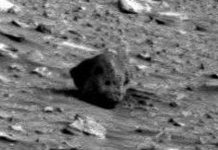
But then we have the pyramids. Massive, geometric structures that align with mathematical precision. We have the “Mars Henge.” We have photos from the rovers showing things that look suspiciously like statues, machine parts, and even bones.
In one infamous photo, there appears to be a perfectly formed doorway cut into a rock face. NASA says it’s a “shear fracture.” A natural crack. But it looks like an entrance. It looks like a place you walk into to get out of the radiation.
Are we looking at the ruins of a lost civilization? Some theories suggest Mars was Earth-like millions of years ago. Maybe they had a war. Maybe they destroyed their atmosphere. Maybe they fled… to Earth.
Are Martians us?
The “Great Filter” Theory
Why is the silence so important? Why the cover-up?
There is a terrifying concept in science called the “Great Filter.” It asks: Why is the universe so quiet? If life is common, where is everyone? The theory suggests there is a hurdle—a filter—that life rarely gets past. Maybe life destroys itself as soon as it gets nuclear weapons. Maybe asteroids wipe everyone out.
If we find simple life on Mars (germs), that’s bad news. It means life starts easily, but gets wiped out later. It means the “Great Filter” is still ahead of us. It means our doom is coming.
If we find ruins of a civilization on Mars, that is the worst news possible. It means an advanced society lived right next door and died. It means we are likely next.
Maybe NASA isn’t hiding aliens because they want to hoard the technology. Maybe they are hiding the fact that Mars is a giant warning sign. A cosmic billboard that reads: “YOU WILL NOT SURVIVE.”
It looks like Mars rover may have discovered the building blocks of life, and evidence that life did once live on Mars!
The 2013 excitement wasn’t a glitch. It was a leak.
The “history books” quote was a moment of honesty before the PR machine clamped down. Every year since, the discoveries get closer and closer to the line. They found water. Then underground lakes. Then organic molecules. Then seasonal methane cycles.
They are boiling the frog slowly. They are getting us ready.
We are the generation that will know the truth. The evidence is there. It’s in the soil samples. It’s in the photos. It’s in the desperate rush by billionaires like Elon Musk to get there and see it for themselves.
We are not alone. We never were. And the neighbor next door? They might still be home, hiding under the red dust, waiting for us to knock.
Originally posted 2016-04-19 08:27:57. Republished by Blog Post Promoter