Home Weird World Space Mars Rover discovers alien brick?

Mars Rover discovers alien brick?

2
66

The Red Planet’s Smoking Gun: Just a Rock, or the Ruins of an Empire?

Space is silent. It is vast, empty, and terrifyingly quiet. But sometimes, amidst the static and the red dust, we find something that screams at us. Something that refuses to fit the narrative. We are told Mars is a dead world. A desolate wasteland of rust and radiation where life never had a chance to start, let alone build cities. They tell us it’s just rocks and ice. But then, the rover sends back a picture. And everything changes.

Take a look at this. Really look at it.

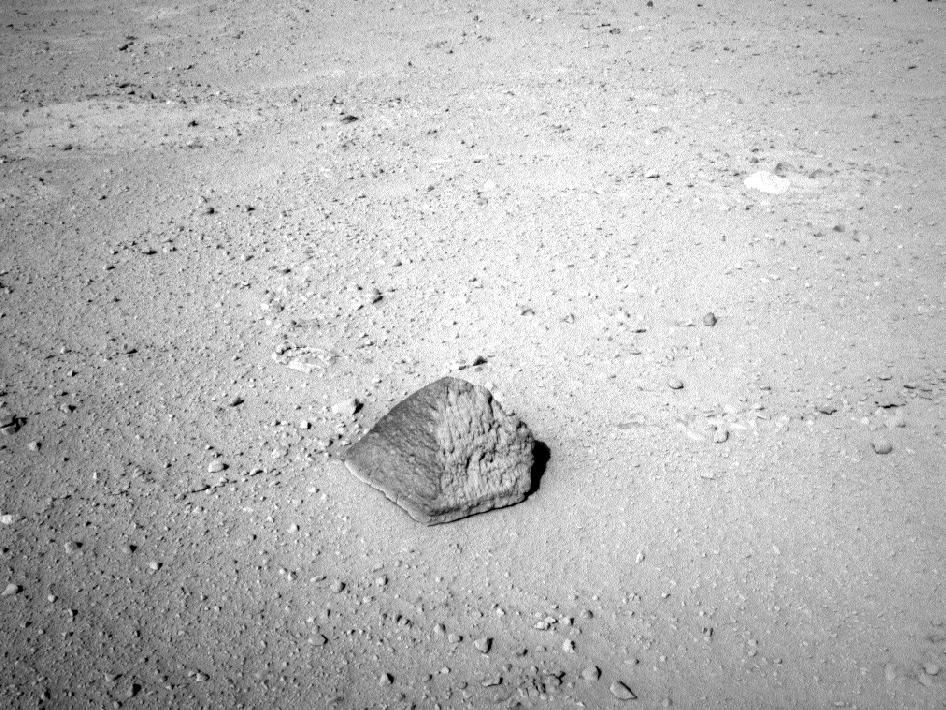
Mars rover discovered this odd rock – looks like a brick?

This isn’t just a pebble. This is geometry. This is precision.

This specific image, captured by the Mars Rover Curiosity, might just be the single most controversial photo ever beamed back from our planetary neighbor. At first glance? Sure. It’s a rock. But stare a little longer. The angles. The flat face. The pyramidal structure. Nature is messy. Nature is chaotic. Erosion tends to round things down, smoothing rough edges into soft curves over millions of years of wind and sand blasting. Nature rarely sharpens a stone into a perfect pyramid with a flat, brick-like face.

Could this really be part of an ancient alien building? A capstone? A foundation brick from a library that stood a billion years before the first human looked up at the stars? The implications are terrifying. And exciting.

Sol 43: The Day Everything Changed

Let’s set the scene. It was the mission’s 43rd Martian day, or “sol.” The date on Earth was September 19, 2012. The Curiosity rover, a technological marvel the size of a car, was trundling across the Gale Crater. It was a lonely drive. Just the hum of the electric motors and the crunch of wheels on regolith.

The drive ended, and the rover stopped. About 8 feet (2.5 meters) in front of the lens sat this object. It stood out immediately.

In a landscape littered with round pebbles and chaotic debris, this object demanded attention. It is roughly 10 inches (25 centimeters) tall and 16 inches (40 centimeters) wide. Not huge. But size doesn’t matter when you are talking about anomalies. A gold ring is small, but if you found one in the middle of the Sahara Desert, you wouldn’t say “it’s just a circular rock.” You would know someone made it.

The NASA team, usually conservative, usually slow to react, jumped on this target. They didn’t just drive past. They decided this was the perfect candidate for the first-ever use of Curiosity’s contact instruments on a rock. Why this one? Out of millions of rocks, why stop here?

Maybe they saw what we see. A brick.

The “Jake” Anomaly: Honoring a Legend, or Hiding the Truth?

Officially, NASA named the rock “Jake Matijevic.” This was a touching tribute to Jacob Matijevic (1947-2012), the surface operations systems chief engineer for the Mars Science Laboratory Project. He passed away shortly after Curiosity touched down. He was a titan of space exploration, a leading engineer for Sojourner, Spirit, and Opportunity. A man who dedicated his life to the Red Planet.

Naming the rock after him was a noble gesture. But there is a darker theory circulating in the deep web forums and alternative history boards. By giving it a human name, by wrapping it in sentimentality, do you disarm the public? It becomes “Jake.” It feels familiar. It feels safe.

If they called it “Artifact Alpha-1,” the world might panic. Words have power.

When Curiosity extended its robotic arm, it wasn’t just poking a stone. It was an interrogation. The turret at the end of the arm holds the Alpha Particle X-Ray Spectrometer (APXS) and the Mars Hand Lens Imager (MAHLI). They blasted it with X-rays. They zoomed in until the grain was visible. They wanted to know what this thing was made of.

Deep Dive: The Composition Mystery

Here is where the story gets weird. Not visually weird, but chemically weird. When the data came back, the scientists scratched their heads. The rock didn’t match the typical Martian terrain.

It was a “mugearite.”

What does that mean? On Earth, mugearite is a type of rock found on ocean islands and rifts. It is volcanic. But specifically, it is formed in the presence of water. Significant water. The composition was high in sodium and potassium. It was totally unlike the soil surrounding it. It was an outsider.

So, we have a rock that doesn’t chemically match the ground it is sitting on. It looks physically manufactured. And it suggests a wet, volcanic past.

If you were building a structure on Mars millions of years ago, wouldn’t you quarry stone from a strong volcanic source? Wouldn’t you transport it? If I find a piece of Italian marble in a forest in Ohio, I don’t assume the forest grew the marble. I assume someone brought it there. Is the “Jake” rock a piece of imported masonry from a distant Martian quarry, dropped during the construction of a city that has long since turned to dust?

The “Rubble” Hypothesis

Look at the background of the image. It is a debris field. We are conditioned to see “nature.” But swap the color palette. Imagine the sky is blue and the ground is green. What does it look like then? It looks like a demolition site. It looks like the aftermath of a bombing.

There is a theory, championed by brilliant but controversial physicists like Dr. John Brandenburg, that Mars wasn’t just destroyed by natural climate change. It was murdered. Brandenburg suggests that the high concentration of Xenon-129 in the Martian atmosphere is the fingerprint of a massive nuclear event. A weapon.

If a civilization was wiped out by a planetary-scale war, what would be left after a million years? Not the skyscrapers. Not the metal. The metal would rust away. The glass would shatter. The wood would rot.

Stone remains.

But not whole statues. Just fragments. Bricks. Cornerstones. Pyramids. The “Jake” rock looks exactly like a corner piece of a larger structure that was blown apart. The clean lines? That’s masonry. The weird location? It was thrown there by the blast.

Pareidolia or Pattern Recognition?

Skeptics love one word: Pareidolia. This is the psychological phenomenon where the human brain forces random data into recognizable patterns. It’s why you see a dragon in the clouds or a face in the burnt toast. NASA relies on this explanation for everything. The Face on Mars? Shadow and light tricks. The Mars Rat? Just a rock. The Floating Spoon? Wind erosion.

But at what point does “coincidence” become statistically impossible?

If you walk down a beach, you see millions of pebbles. They are round. Oval. Lumpy. If you suddenly look down and see a perfect tetrahedron with a 90-degree flattened base, your brain isn’t tricking you. Your brain is alerting you. “Hey, this is artificial.”

Evolution gave us pattern recognition to survive. We needed to spot the leopard in the grass. We needed to spot the spear tip in the dirt. Dismissing our instinct to recognize artificial shapes is dangerous. Maybe we are seeing exactly what is there.

The Ventifact Counter-Argument

To be fair, we have to look at the “official” explanation. Geologists call these rocks “ventifacts.” These are rocks that have been faceted by wind-blown sand. Imagine a sandblaster hitting a rock from one direction for a thousand years. It flattens that side. Then the rock shifts. The wind blasts another side. Eventually, you get a pyramid shape.

It’s a solid theory. It happens in Antarctica. It happens in the Mojave.

But look closely at the “Jake” rock again. The symmetry is uncanny. Ventifacts usually look organic and sharp, but irregular. This rock has a sense of weight and purpose to its geometry. It sits perfectly flat. It looks like you could slide it into a wall and mortar it in place.

The Bigger Picture: We Are Not Alone in Time

Why does this matter? Why write 2,000 words about a single rock?

Because it represents the crack in the dam. If we admit that one rock on Mars is artificial, the entire history of our solar system collapses and must be rewritten. It means we are the second civilization here. It means humanity is an orphan living in a haunted house.

Modern internet sleuths are doing the work that governments won’t. Every time NASA releases a “raw” image, thousands of eyes scan it. We have found statues. We have found what looks like machinery. We have found tunnels. The “Jake” rock is just the tip of the iceberg.

Think about the Great Pyramid of Giza. Now, imagine if Earth was hit by a solar flare that stripped our atmosphere. Fast forward 500 million years. The limestone casing is gone. The gold capstone is gone. The inner chambers have collapsed. What is left? Just a pile of oddly shaped rocks in the sand. A rover from Venus lands, rolls up to a limestone block, and snaps a photo.

The Venusians back home would say, “Oh, that’s just a rock formation.”

We are the Venusians in this scenario. We are looking at the ruins of our neighbors and refusing to see the truth.

What Curiosity Found Next

After analyzing “Jake Matijevic,” Curiosity kept moving. It rolled away. It left the mystery behind. This is the tragedy of robotic exploration. It cannot feel curiosity—only the engineers back on Earth can. And they have a schedule to keep.

But the data remains. The image remains.

In recent years, the conversation has shifted. With the Pentagon releasing videos of UAPs (Unidentified Aerial Phenomena) and admitting that objects are flying in our skies with physics we don’t understand, the “Mars Question” is becoming urgent. If they are here, did they come from there? Or were they the ones who lived there, and they fled to Earth when Mars died?

Maybe the “Jake” rock isn’t just a brick. Maybe it’s a message. A gravestone.

The Texture of History

Zoom in on the high-resolution version of the image if you can. The surface of the rock is relatively smooth, darker than the dusty red surroundings. It has a sheen to it. Almost like a glaze. Or a polish. Wind erosion makes things matte. It pits them. It scars them. This rock looks… finished.

The stark contrast between the “Jake” rock and the rubble around it is the key. The surrounding rocks are jagged, chaotic, rough. They look like natural geological debris. The “Jake” rock sits among them like a diamond in a pile of coal. It doesn’t fit the context unless the context is “destruction.”

Questions We Should Be Asking

  • Why is it isolated? Why aren’t there fifty other rocks shaped exactly like this right next to it? If the wind created this shape, the wind should have created similar shapes in the immediate vicinity.
  • Where is the rest of it? If it is a ventifact, where are the flakes that were chipped off? If it is a brick, where is the wall?
  • Why the silence? NASA released the chemical data, but they never addressed the visual anomaly in a meaningful way. They called it “unusual” and moved on.

A Challenge to the Reader

Don’t just accept the caption under the photo. “Mars rover discovered this odd rock.” That is passive. That is boring.

Look with your own eyes. We live in an era where the truth is often hidden in plain sight, buried under boring technical reports and grayscale images. Mars is calling to us. It is teasing us with clues. The “Jake” rock is a breadcrumb.

Are we brave enough to follow the trail? Or will we just keep scrolling, assuming the experts know best?

The universe is filled with mysteries that defy explanation. A brick on a dead planet might seem small, but it implies a builder. A builder implies a mind. And a mind implies that we are not the only ones who have ever looked up at the stars and wondered, “Is anyone out there?”

Perhaps the answer has been sitting in the red dust for a billion years, waiting for a robot named Curiosity to roll up and take a selfie.

Keep watching the skies. And keep watching the ground.

Originally posted 2016-04-13 08:28:12. Republished by Blog Post Promoter