Foundations of mission plan laid
In 2011 Bas Lansdorp and Arno Wielders lay the foundation of the Mars One mission plan. Discussion meetings are held with potential suppliers of aerospace components in USA, Canada, Italy and United Kingdom. Mission architecture, budgets and timelines are solidified from feedback of supplier engineers and business developers. A baseline design for a mission of permanent human settlement on Mars achievable with existing technology is the result.
2018
Rover and a Communication Satellite are launched
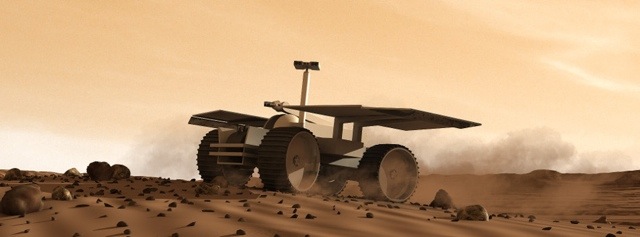
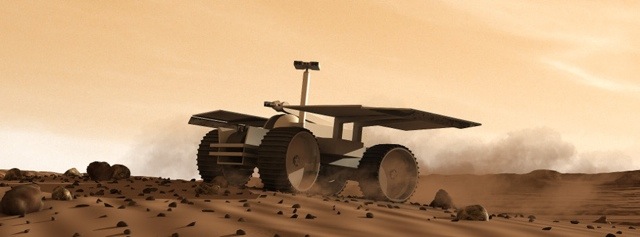
One intelligent Rover and one Trailer are launched. The Rover can use the Trailer to transport the Landers to the outpost location. On Mars, the Rover drives around the chosen region to find the best location for the settlement. An ideal location for the settlement is far enough North for the soil to contain enough water, equatorial enough for maximum solar power and flat enough to facilitate construction of the settlement.
When the settlement location is determined, the Rover prepares the surface for arrival of the Cargo missions. It also clears large areas where solar panels will lie.
A second Communications Satellite is launched to an orbit around the Sun. It takes the same orbit as the Earth but trails 60 degrees behind it in L5 Lagrangian point of the Sun-Earth system. Together with the ComSat around Mars it enables 24/7 communication with Mars, even when the sun is in between the two planets.
2020
Six Cargo missions are launched
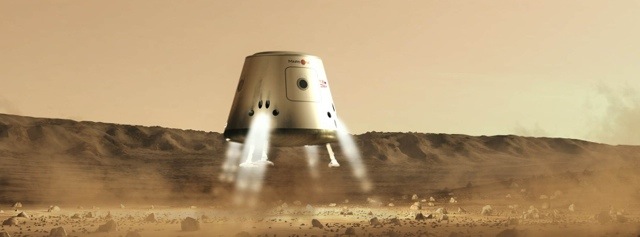
Two Living Units, two Life Support Systems, and two Supply Units are sent to Mars in July 2020. In February 2021 all units land on Mars using a Rover signal as a beacon.
Life Support Unit
The Life Support Unit is a Lander rigged with extra technologies which capitalize on the natural resources available on Mars. It uses these resources to create a habitable living environment for the astronauts, as follows:
Electrical energy is generated through the application of thin film solar photovoltaic panels. These are flexible and can be rolled up for compact transportation to Mars.
Potable water will be created through the heating of water ice in the local ground soil. About 60 kilograms of soil is loaded into a container within the Life Support Unit by the Rover and heated to evaporate the water. The water is condensed and the dry soil returned to its origin. A portion of the water is stored while a portion is used to produce oxygen. The Life Support Unit is able to collect 1500 liters water and 120 kilograms oxygen in 500 days time.
Nitrogen and argon gas are extracted from the Mars atmosphere and injected into the habitable space as inert gases. Remember, 80% of what we breathe on Earth is the element nitrogen.
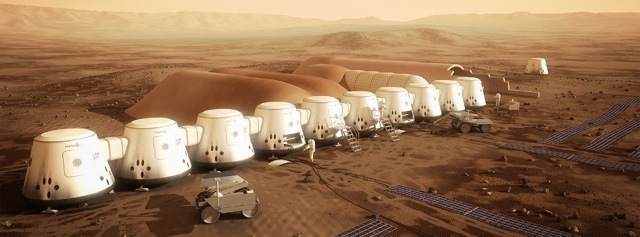
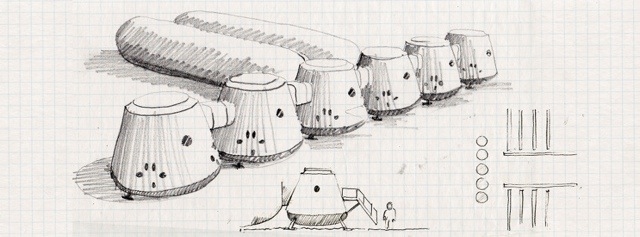
The Life Support Unit is connected to the Living Unit by a tube which feeds the oxygen, nitrogen, and argon to create a habitable atmosphere. Once the astronauts have landed, it will also be in charge of the water purification and removal of waste gas (carbon dioxide) from the Living Unit atmosphere.
The Life Support Unit is hosted inside a Lander. This system will be very similar to those units which are fully functional on-board the International Space Station.
2021
Rover sets up the outpost before the arrival of humans
The six Cargo units land on Mars, up to 10 km away from the outpost. The Rover picks up the first Life Support unit using the trailer. It places the Life Support unit in the right place and deploys the thin film Solar Panel of the Life Support unit. The Rover can now connect to the Life Support unit to recharge its batteries much faster than using only its own panels, allowing it to do much more work.
The Rover picks up all the other Cargo units and then deploys the thin film Solar Panel of the second Life Support unit and the Inflatable sections of the living units.
The Life Support unit is connected to the Living Units by a hose that can transport water, air and electricity. The Life Support System (LSS) is now activated. The rover feeds Martian soil into the LSS. Water is extracted from the Martian soil by evaporating the subsurface ice particles in an oven. The evaporated water is condensed back to its liquid state and stored. Part of the water is used for producing Oxygen. Nitrogen and Argon, filtered from the Martian atmosphere make up the other components of the breathable air inside the habitat.
Before the first crew starts their journey, the life support system has produced a breathable atmosphere of 0.7 bar pressure, 3000 liters of water and 120 kg of Oxygen that is in storage.
The Rover also deposits Martian soil on top of the inflatable sections of the habitat for Radiation Shielding.
2022
The first humans to land on Mars start their journey from Earth
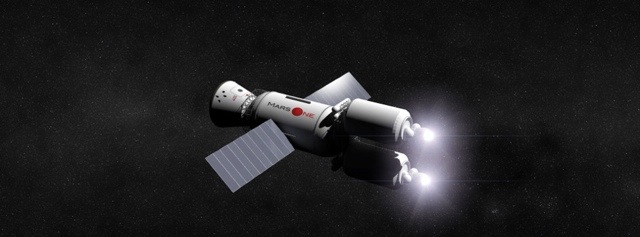
In April 2022, the components of the Mars Transit Vehicle are launched to Earth orbit on receiving the green light on the status of the systems on Mars. First, a Transit Habitat and a Mars Lander with an assembly crew on-board are launched into an orbit around the Earth. The assembly crew docks the Mars Lander to the Transit Habitat. Two propellant stages are launched a month later and are also connected.
The first Mars crew, now fully trained, is launched into the same Earth orbit. In orbit the Mars One crew switches places with the Assembly Crew, who descend back to Earth. After a final check of systems on Mars and of the Transit Vehicle, engines of the Propellant Stages are fired and the Transit Vehicle is launched on a Mars Transit Trajectory. This is the point of no return; the crew is now bound to a 210-day flight to Mars.
The Cargo for the second crew is launched to Mars in the same month.
2023
First humans land on Mars
About 24 hours before landing, the crew move from the Transit Habitat into the landing module, bringing some of the supplies from the Transit Habitat. The landing module detaches from the Transit habitat, which is too large to land on Mars. The Transit habitat is discarded and stays in orbit around the sun.
The Lander is exactly the same as those used for previous unmanned missions. This ensures the human crew land in a system that has been tested eight times. Upon landing, the crew takes up to 48 hours to recover from experiencing gravity again after spending a long time in space. In their Marssuits they leave the Lander and are picked up by the Rover.
They enter the settlement through the airlock in one of the Living units and spend the next few days recovering and settling in the new environment.
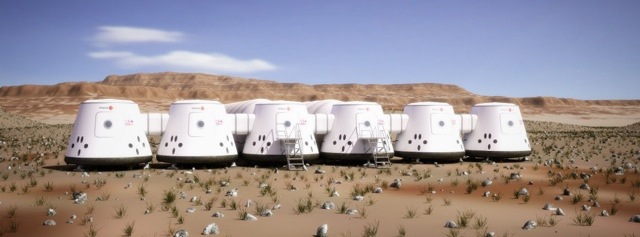
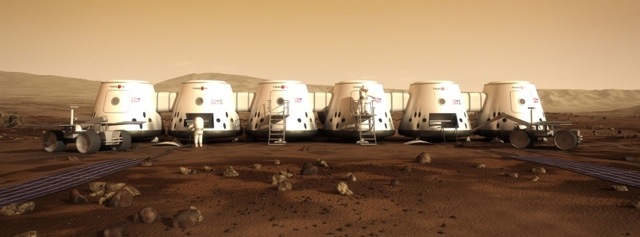
After their acclimatisation period, the settlers deploy the rest of the Solar Panels. They install the hallways between the Landers and set up Food Production units.
The Cargo for the second crew lands within a few weeks after the first crew lands; it is picked up and installed, adding to the redundancy in the settlement.
Redundancy is extremely important because, unlike the crew aboard the International Space Station, the Mars One crew can’t abandon their mission in case of an emergency. When the first crew lands they find the habitat with a good level of redundancy already: two Living units– each large enough to house the crew of four and two Life Support units–each capable of providing enough water, power and breathable air for the entire crew. When the hardware for the second crew is incorporated to the settlement, it features four Living units and four Life Support units, enough to sustain a crew of 16 astronauts.
2024
Settlement expands with departure of Crew Two
The second crew departs from Earth in October 2024. They travel to Mars on a slightly longer trajectory of 240 days. With the second crew, the Cargo for the third crew is also launched.
The second crew lands On Mars in July 2025. They are welcomed by the first crew, who has already prepared their living quarters. The hardware for crew three will land a few weeks later and added to the settlement. This process continues as additional crews land every two years.