The Sol 52 Incident: A Rodent on the Red Planet?
It has finally happened. The moment we’ve been waiting for? Or the moment we lost our collective minds? We spent billions sending high-tech rovers to Mars. We worried about contaminating the pristine Martian surface with our filthy Earth bacteria. But it appears we might have messed up big time. We didn’t just send germs. We sent a rat. Yes. A whole, living, breathing rat.
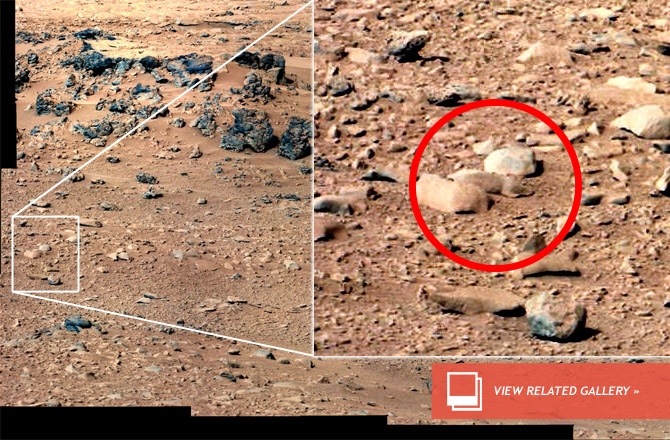
Look at the image above. Really look at it.
This isn’t some blurry, pixelated mess from the 1970s. This is high-definition evidence. Or so the internet screams. This photo comes straight from NASA’s Mars rover, Curiosity. It snapped this panorama of the “Rocknest” site with its MastCam camera on Sol 52 (that’s Martian Day 52, or September 28, 2012, for us Earthlings). At first glance? Dirt. Rocks. Dust. But zoom in. Enhance. Squint a little. Right there, nestled among the jagged stones, lies something that defies explanation. Something that looks undeniably like a rodent.
Legs. A tail. A nose sniffing the thin, carbon-dioxide-rich air. It’s all there.
But hold on. Take a breath. Let’s step back from the edge of the conspiracy cliff for just a second. As you may have guessed, after exercising an ounce of logical thought, what was once a cute furry four-legged creature suddenly becomes… wait for it… this is a good one… a rock. And there you have it, ladies and gentlemen: We’ve found a rock on Mars… that looks like a rat.
Disappointed? Don’t be. Because the truth about why you see a rat is actually way crazier than a space-faring rodent.
Your Brain is Lying to You: The Science of Pareidolia
This certainly isn’t the first time shapes on Mars have fooled the brains of many. In fact, it happens constantly. Every time a new batch of photos comes down from the Red Planet, the internet lights up. “I see a spoon!” “I see a crab!” “Is that a femur bone?”
What’s more, there’s a name for this psychological phenomenon: pareidolia.
It sounds like a disease. Maybe it is. But really, it’s possibly an evolutionary trait. A survival mechanism hardwired into your skull. Imagine you are a caveman. You are walking through the tall grass. You see a shape in the shadows. It might be a tiger. It might be a bush.
If you think it’s a tiger, and you run away, but it turns out to be a bush: You live. You feel a bit silly, but you survive to have kids.
If you think it’s a bush, but it turns out to be a tiger: You get eaten. Game over. No descendants for you.
Over millions of years, the humans who were paranoid—the ones who saw faces, threats, and animals in random noise—were the ones who survived. We are the children of the paranoid. This psychological oddity makes us see familiar objects in apparently random shapes, such as Mars yetis, faces, elephants, black ops bases, and parrots on Mars. Pareidolia is the same thing that makes us see the face of Jesus Christ in burnt toast and bunnies in clouds.
The Matrix of the Mind
Your brain hates chaos. It despises it. When visual data comes in that doesn’t make sense—like a jagged, wind-eroded rock on an alien world—your brain forces a template onto it. It scans its library of known shapes. “Jagged edges? Nope. smooth curve? Maybe. Pointy bit? Ear.”
Boom. It renders a rat.
This happens instantly. You don’t decide to see the rat. Your brain decides for you before you even consciously process the image. That is why these images are so sticky. That is why they go viral. Because for a split second, your brain screams, “ANIMAL!”
A History of Martian Hallucinations
The “Mars Rat” is just the latest celebrity in a long line of Martian anomalies. Let’s look at the Hall of Fame of space illusions.
The Face on Mars (1976)
This is the granddaddy of them all. When the Viking 1 orbiter flew over the Cydonia region, it snapped a grainy, low-res photo of a mesa. The shadows were just right. It looked exactly like a human face staring up at the stars. A warning? A monument?
For decades, people speculated. Tabloids ran wild. “NASA HIDES ALIEN CIVILIZATION.” Movies were made (remember Mission to Mars?). It wasn’t until the late 90s and early 2000s, when modern orbiters with high-resolution cameras went back, that we saw the truth. With different lighting and better zoom, the “Face” melted away. It was just an eroded hill. A mesa. The “eye” and “mouth” were just shadows cast by rocky peaks. The magic was gone. But the legend remains.
The Martian Bigfoot
Years before the rat, Spirit (Curiosity’s older cousin) took a panorama that showed a humanoid figure strolling down a hill. It looked like a woman. Or Bigfoot. Was it a statue? A frozen wanderer? Nope. It was a rock about two inches tall. Perspective is a tricky beast on Mars. Without trees or cars to give us a sense of scale, a tiny pebble can look like a boulder, and a small rock can look like a person.
The Floating Spoon
This one actually looks physically impossible. A long, thin handle with a scoop at the end, hovering just above the ground. Proof of a giant Martian soup kitchen? sadly, no. It’s a ventifact—a rock shaped by wind. Mars has a very thin atmosphere, but the wind blows constantly. Over millions of years, it carves soft rock into delicate, impossibly fragile shapes that would snap instantly on Earth under our stronger gravity. But on Mars? They float. They endure. Until a rover drives over them.
The Conspiracy: Why Do We Want to Believe?
Let’s play devil’s advocate. Why does this “Rat” photo persist? Why do people get angry when you tell them it’s a rock?
Because we are lonely.
We look up at the infinite black void of space and we are terrified that we are the only things looking back. Finding a rat on Mars—even a dirty, plague-carrying sewer rat—would be the greatest discovery in human history. It would mean we aren’t accidents. It would mean life is tenacious. It would mean we have neighbors.
There is also the distrust of authority. The “NASA is lying” crowd. The theory goes like this: Curiosity isn’t on Mars. It’s on Devon Island in the Canadian Arctic, or in a secret desert basement in Nevada. They messed up and let a rat wander onto the set. “Oops, Jerry left the door open and the lab rat got in the shot!”
Think about that for a second. If NASA were faking a multi-billion dollar mission, don’t you think they’d hire a guy to check for rats? Or maybe edit the rat out in Photoshop before releasing the image to the entire world? The sheer incompetence required for the “faked moon landing/Mars rover” theories is staggering. If the government is powerful enough to fake a space program, surely they are powerful enough to buy a cat.
The Harsh Reality: Could a Rat Survive?
Perhaps it’s time to engage some upper-level reasoning and realize that just because there’s a rock on Mars that looks like a rat (whether its a trick of the light, or if it’s genuinely shaped like a small mammal), it doesn’t mean that it is a rat. There is also the possibility that the whole “Mars rat” thing isn’t serious at all and judging by the way the initial report is worded, it could go either way.
But let’s do the science. Let’s assume, for one wild moment, that this IS a rat. How is it doing?
- The Air: The atmosphere on Mars is 95% carbon dioxide. It is less than 1% as thick as Earth’s atmosphere. If you dropped a rat there, it wouldn’t just hold its breath. The moisture on its tongue and in its eyes would instantly boil away due to the low pressure. It would suffocate immediately.
- The Cold: The average temperature is about minus 80 degrees Fahrenheit (-60 Celsius). At night, near the poles, it drops to -195 F. Our little rat friend would be a ratsicle in seconds.
- The Radiation: Mars has no magnetic field to shield it from solar flares and cosmic rays. The surface is bathed in radiation.
- The Food: There is nothing to eat. Unless this rat eats basaltic rocks and drinks perchlorates (toxic salts found in Martian soil), it’s going to have a bad time.
So, we are left with two options. Option A: A super-evolved alien rat that breathes CO2, eats rocks, and survives sub-zero radiation storms. Option B: It is a rock.
Occam’s Razor suggests it is a rock.
The Geology of Gale Crater
To really understand what we are seeing, we need to understand where Curiosity is. The rover landed in Gale Crater. This isn’t just a hole in the ground; it’s a massive geological time capsule. There is a mountain in the middle, Mount Sharp (Aeolis Mons), rising 18,000 feet high.
The “Rocknest” area, where this photo was taken, is a sandy patch where the rover stopped to scoop up soil. The rocks here are sedimentary. They were formed by water and wind. Billions of years ago, water flowed here. It tumbled stones, smoothing them out. Then, the water vanished. For eons, the wind has blasted these rocks with sand.
Sandblasting creates strange shapes. It creates pits, curves, and sharp angles. It creates “ventifacts.” The human eye, desperate for familiarity, looks at this chaotic field of wind-carved debris and picks out the shapes that match our memories. A rat here. A lizard there. A helmet. A shoe.
The irony? The rocks themselves are fascinating enough without imagining they are rodents. These stones hold the chemical history of a wet, potentially habitable Mars. They are the keys to understanding if life ever existed there—microbial life, not rodents.
The Viral Aftermath
When this image dropped in 2013, it exploded. Twitter (now X) went wild. Why? Because it’s fun. Deep down, even the conspiracy theorists probably know it’s a rock. But the “Mars Rat” became a meme. It became a mascot for the mission.
NASA, to their credit, usually ignores these things. They don’t issue press releases denying the existence of the rat. They just keep driving. They keep drilling. They keep shooting lasers at rocks (yes, Curiosity has a laser head). The rover is a nuclear-powered mobile science lab, and it has better things to do than chase imaginary vermin.
But notice something interesting. Every time one of these “findings” goes viral, traffic to NASA’s website spikes. People who never cared about space exploration suddenly want to see the raw images. They want to hunt for the next anomaly. They start looking at the geology. They start asking questions.
In a weird way, the Mars Rat did more for public engagement with the Curiosity mission than a dozen dry scientific papers. It got people looking. It got people zooming in.
What’s Next?
Curiosity is still out there. It’s climbing Mount Sharp now. It’s older. Its wheels are full of holes from driving over sharp rocks. But it’s still snapping photos. And newer rovers like Perseverance are there too, with even better cameras.
Will we find life? Maybe. But it won’t be a rat. It won’t be a lizard or a yeti. It will likely be a microscopic fossil. A chemical signature. A smudge in a rock that proves, billions of years ago, a single-celled organism lived and died in a Martian stream.
That discovery won’t be as visually exciting as a rat. You won’t be able to make a meme out of it as easily. But the implications will be earth-shattering. It will mean we are not a fluke.
Until then, keep looking at the pictures. Keep finding faces, spoons, and rats. Enjoy the pareidolia. It’s your brain’s way of keeping you safe, even if it makes you look a little crazy sometimes. Just remember: when you stare into the rocks of Mars, the rocks don’t stare back. Probably.
Deep Dive Resources
If you want to hunt for your own anomalies, don’t rely on conspiracy blogs. Go to the source. NASA releases the raw images from the rovers almost immediately. You can browse the “Raw Images” catalog for Curiosity and Perseverance. Warning: You will see thousands of rocks. Millions of rocks. And eventually, if you stare long enough, one of them will look like your Aunt Sally.
Is that proof your Aunt is on Mars? No. But it is proof that the human brain is the strangest, most wonderful machine in the solar system.