Sunday, July 12, 2026
HomeWeird WorldStrange PlacesLondons Underground Mystery - Secret Station

Londons Underground Mystery – Secret Station

London’s Deepest Secret: The Ghost Station at Bull & Bush

You think you know the London Underground. The familiar map, the rush-hour crush, the voice telling you to “mind the gap.” It’s a part of the city’s DNA. A constant, reliable hum beneath your feet.

But what if I told you there’s a ghost on the network? A station that appears on no public map, a place where no passenger has ever alighted. A concrete phantom, built and then abandoned, swallowed by the earth and a century of secrets.

It exists. Deep beneath the green fields of Hampstead Heath.

Most have never heard of it. To the engineers, it was “North End.” To the locals and the few who know, it’s “Bull & Bush.” It’s the station that never was. And its story is far stranger, darker, and more connected to the hidden history of London than you could ever imagine.

This isn’t just about a failed construction project. This is about Cold War bunkers, city-saving floodgates, and whispers of a secret underground network reserved for the elite. Forget what you know about the Tube. We’re going off the map.

A Dream Buried 200 Feet Down

Let’s rewind the clock. The dawn of the 20th century. London is buzzing, a sprawling metropolis powered by steam and ambition. The “Tube boom” is in full swing, with private companies furiously digging new electric railway lines deep into the London clay. It was an age of incredible engineering vision.

One of these companies, the Charing Cross, Euston & Hampstead Railway (CCE&HR)—the ancestor of today’s Northern Line—had a bold plan. They were pushing their tunnels north, out towards the leafy, affluent suburbs of Golders Green and Hampstead.

And right between them, under the wild expanse of Hampstead Heath, they planned a new station: North End.

This wasn’t going to be just any station. This was going to be a record-breaker. At a proposed depth of 200 feet (over 60 meters), it would have been the deepest station on the entire Underground network. A true marvel of Edwardian engineering, accessed by a battery of high-speed lifts plunging into the darkness.

The tunnellers got to work. They dug the platforms. They carved out the lift shafts. The skeleton of a station was born, a hollow space waiting for life, for passengers, for purpose.

But that purpose never came.

A Station For Nobody

The problem was simple. Devastatingly simple.

Who was it for?

The proposed surface building was set to be built on the edge of Hampstead Heath, a fiercely protected and beloved public space. Local conservation groups went ballistic. The idea of a bustling Tube station spitting out commuters onto their pristine heath was unthinkable. The planning battles were fierce.

Worse still, developers looked at the surrounding area and saw… nothing. A few scattered houses, maybe. But no bustling community, no commercial center. No passengers. The financial projections were a disaster. They were building a multi-million-pound gateway to an empty field.

So, in 1906, the dream died. The project was unceremoniously scrapped. The tunnellers packed up their tools and left. The platforms, ticket hall areas, and lift shafts were abandoned, sealed off from the main running tunnels. A concrete ghost left to sleep in the dark, bypassed by a million trains that would thunder past over the next century.

The station earned a new, informal name from the Underground staff who knew of its existence. They called it Bull & Bush, after a famous old pub located a short walk from the planned entrance. A pub made famous by a Vaudeville music hall star named Florrie Forde, whose song “Down at the Old Bull and Bush” was the smash hit of its day. The station became a phantom named after a memory.

And for decades, that’s all it was. An interesting piece of trivia. A failed project.

Then the world changed. The bombs fell. And the ghost station was given a terrifying new purpose.

The Cold War’s Secret Address

The Second World War came and went. London was scarred but survived. But a new fear crept in. A colder fear. The fear of the atom bomb.

Suddenly, governments all over the world were obsessed with one thing: continuity. How could the state function after a nuclear attack? Deep, secure bunkers became the order of the day. And in London, planners looked at their maps, searching for existing structures that could be repurposed.

What’s 200 feet deep, structurally sound, and completely hidden from public view? What’s already there, just waiting?

The abandoned platforms of Bull & Bush.

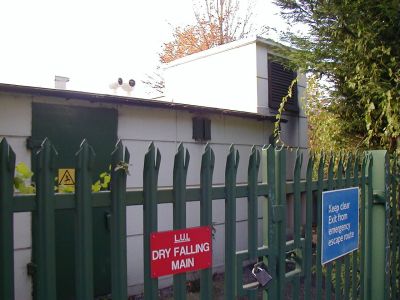
The rumors started swirling. In the 1950s, a new structure quietly appeared in a patch of woodland off North End Way. It was a small, unassuming brick building. But from it, a deep shaft containing a narrow, winding spiral staircase descended into the earth, finally providing surface access to the forgotten station for the first time.

This wasn’t for passengers. This was for something else.

The story goes that Bull & Bush was designated as London Transport’s emergency headquarters. A place where, in the event of nuclear war, the controllers of the city’s vital transport network could retreat to keep the arteries of a shattered London moving. Imagine it. The sirens wail. The sky flashes white. And deep beneath Hampstead Heath, a small group of people clatter down that metal staircase into the cold, damp concrete tomb, ready to run a ghost network in a ghost city.

It was the perfect secret hiding in plain sight.

The Floodgate Kill Switch

But its Cold War role wasn’t the only secret the station held. It was also given a job that was, in its own way, just as critical to London’s survival: flood control.

Much of the Underground network runs deep beneath the River Thames. It’s a terrifying vulnerability. A breach in a tunnel wall—from a bomb, an accident, or simple structural failure—would be catastrophic. Water would surge through the tunnels at unimaginable pressure.

Think about it. The deepest section of the Central Line is at Bank station. If a breach happened there, engineers calculated that water, flowing freely, would reach Holborn station in just four minutes. Four. Minutes. The loss of life would be biblical.

To prevent this, a system of immense, remotely-operated floodgates was installed at key points in the network. These giant steel doors could be slammed shut, isolating sections of the tunnel and containing a flood.

But where would you put the control center for such a vital system? You’d want it somewhere secure. Somewhere isolated. Somewhere… like a disused, super-deep Tube station.

That’s right. Bull & Bush is widely believed to have become one of the primary control centers for the Underground’s floodgate network. From this silent, forgotten chamber, operators could theoretically seal off huge chunks of the city’s transport system, saving countless lives. It was the network’s secret panic room. The finger on the button that could hold back the Thames itself.

The Asbestos Conspiracy: A Convenient Cover Story?

The official story takes another strange turn. At some point, an experimental sound-reducing lining was installed in the southbound running tunnel alongside the Bull & Bush platforms. This was, they claimed, an attempt to make the journey quieter for passengers on the trains speeding past.

Years later, this lining had to be removed. The reason given? It was made of asbestos.

Sounds plausible, right? A typical public health and safety job. Men in hazmat suits, sealed-off areas, careful removal of dangerous material.

But the original post that sparked this investigation noted something curious: “so they claimed, but proof never existed.”

Let’s pull on that thread. What if the asbestos was a cover story?

Think about it. If you wanted to do something secret down there—install new equipment, remove old Cold War relics, or perhaps even connect the station to something else—how would you do it without raising suspicion? How would you explain bringing in specialist crews for weeks on end and sealing off all access?

An asbestos scare is the perfect excuse. It’s a ready-made explanation that nobody questions. It provides the perfect cover for any kind of clandestine activity. Were they really removing a dangerous lining? Or were they upgrading the station’s secret systems? Were they taking something out, or putting something new in?

We’re told it was asbestos. But in the world of shadows and secrets, you learn to question everything.

The Modern Enigma: An Exit to Where?

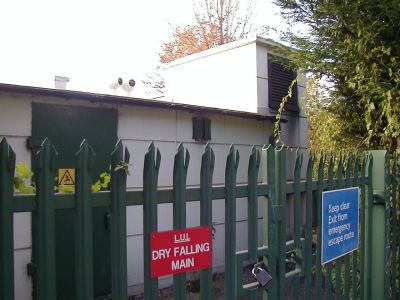
So what is Bull & Bush today? The little brick building still stands. The gates are locked tight. Signs on the door clearly state that the site is a designated “Emergency Exit” for the Underground network.

But an emergency exit from where? For who?

It makes no sense. There are no passenger areas. To get from a stranded train in the tunnel to the Bull & Bush staircase would involve climbing out onto the tracks in the dark, finding a hidden door, and navigating the old platform areas. It’s not a practical escape route for the general public.

And yet, pictures that have surfaced online show something fascinating.

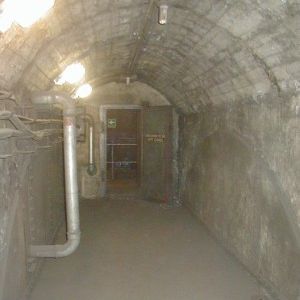
Recent images show the station is incredibly well maintained. For a place that has been officially “abandoned” for over a century, it’s remarkably clean and orderly. The lights work. The equipment looks modern. This is not a derelict ruin. This is an active site. Someone is going down there. Someone is looking after it. Why maintain a ghost?

The “Emergency Exit” sign feels less like a public safety feature and more like a piece of misdirection. A label to satisfy curiosity while hiding the building’s true, ongoing function.

Connecting the Dots: London’s Shadow Network

This is where we go really deep. The final sentence of the original post was a tantalizing breadcrumb: “Rumours suggest this is just one of a secret rail network that connects many of Londons key buildings.”

This isn’t just a wild idea. It plugs into one of London’s most enduring and compelling conspiracy theories: the existence of a secret, deep-level “shadow network.”

We know about the Post Office Railway (the “Mail Rail”), a separate, tiny-gauge underground line that once shuttled mail between sorting offices. We know about the disused Kingsway Tram Subway. We know of the legendary “Q-Whitehall” tunnels, a rumored network connecting government buildings around Downing Street to serve as a command center during a crisis.

What if they all connect?

What if Bull & Bush isn’t just a dead end? What if it’s a node? A junction box on a hidden map? A secret spur of the Northern Line that doesn’t lead to a public station, but to a military bunker, a government facility, or another part of this shadow railway?

Online forums and urban explorer communities have buzzed with these theories for years. They point to oddities in tunnel construction, to sealed-off doorways seen from passing trains, to ventilation shafts appearing in strange, strategic locations. They believe a secret track exists for the elite—a way to evacuate key personnel from the city in a national emergency, completely bypassing the public network.

Is Bull & Bush the northern terminus of this secret line? Is that why it’s kept in perfect working order? Not as a relic of the past, but as a facility waiting for a future crisis.

From a simple, failed Edwardian dream, Bull & Bush has become so much more. It’s a Cold War time capsule. A critical piece of city infrastructure. And maybe, just maybe, a doorway into a London that we aren’t supposed to know exists.

So the next time you find yourself on the Northern Line, hurtling through the pitch-black tunnel between Golders Green and Hampstead, press your face to the glass. For a few seconds, you’ll be passing right by it. Listen. You won’t hear anything. But know that you are flashing past one of London’s greatest secrets. The ghost station is down there, silent and waiting.

And you have to wonder… what is it waiting for?

Amit Ghosh
Amit Ghoshhttps://coolinterestingnews.com
Aloha, I'm Amit Ghosh, a web entrepreneur and avid blogger. Bitten by entrepreneurial bug, I got kicked out from college and ended up being millionaire and running a digital media company named Aeron7 headquartered at Lithuania.
RELATED ARTICLES
- Advertisment -

Most Popular

Recent Comments

Warren Pan Abbott on The legend of the Devil Monkey !
chris davies on The McPherson Tape Mystery
Reed Reedly on ET has Internet!
Bea Houseoffashion on Proof Of Time Travellers – Gallery
Marcus2012 on ET has Internet!
Reed Reedly on ET has Internet!
LaughsAtConspiracyNuts on The 9/11 Conspiracy – Myths and Facts
Alex Sliverman on Did the ancients fly?
Doctor Wholigan on Time Traveler in 1938 film
chris davies on The McPherson Tape Mystery
Archie1954 on 10 secret UFO hideouts
chris davies on Ghosts of flight 401
Marcus2012 on ET has Internet!
jason Macdonald on Proof of Time Travel? – China
chris davies on Long-Lost Pyramids Found?
Reed Reedly on ET has Internet!
Milkman on Connected Universe
Tenmiles on Baigong Pipes Mystery
Simon Foster on Sirius – The Documentary
From the 1st April on 2013 – Alien Contact date ?
SkyWatcher on Is ET ignoring us?
I Come From The Future on Obama to make UFO Alien disclouser soon ?
ÛñK?øWn on 2013 – Alien Contact date ?
Just another person on 2013 – Alien Contact date ?
Malcolm Windowcleaner on The strange case of Rudolph Fentz
Mason Servio on Strange Things on Mars
Marke Wisdom Seeker on What will we find as arctic melts?
Andrea A Elisabeth Levyne on Aliens Captured in Varginha, Brazil
Mitch Grouyeki on Amazing Space Shuttle pictures