It was the height of the Great Depression. A time of dust, desperation, and drifting souls. But on a freezing night in December 1933, one specific soul stepped off a Greyhound bus and walked straight into a legend that would haunt a small Ohio town for sixty years. This isn’t just a sad story. It’s a puzzle with pieces that still don’t fit, even almost a century later.
You think you know true crime? You think you’ve heard every cold case file on the internet? Think again.
We are going back to a time when people could vanish into thin air. No digital footprint. No cell phones pinging off towers. Just a girl, a blue dress, and a train barreling down the tracks at sixty-five miles per hour. Welcome to the enigma of The Girl in Blue.
The Arrival: A Stranger in a Small Town
December 23, 1933. Two days before Christmas. The air in Willoughby, Ohio, was biting cold. A Greyhound bus hissed to a halt, the doors folding open to spill a young woman onto the pavement. She didn’t look like the typical drifter of the era. She was sharp. Clean.
She wore a navy blue skirt that swayed in the winter wind, matching shoes, and a crisp white blouse. A floral-print scarf was draped casually around her neck—a splash of color against the grey winter backdrop. She was alone.
Why was she there? That’s the first loose thread.
Earlier in her journey, she had been asking questions. Strange questions. She asked about fares to Erie, Pennsylvania. Then Elmira, New York. It seemed like she was calculating a route, trying to figure out how far her money would take her. But then, abruptly, she pivoted. She asked for a ticket to Willoughby.
The Boarding House Mystery
Upon arrival, she didn’t wander aimlessly. She found a gentleman in town—a local—and asked for help finding lodging. Following his guidance, she navigated the darkened streets to the boarding house of Mrs. Mary Judd, located right in the downtown area. She checked in. She was polite. She was quiet. She went to sleep.
The next morning, Christmas Eve, she came down the stairs to the breakfast room. This is where the timeline gets tight. During breakfast, the landlady, Mrs. Judd, gave her directions. The girl wanted to know two things: where the bus station was, and where the church was.
God and travel. The two things on her mind.
She left the house, walking down the front porch stairs and heading toward downtown. But here is the kicker: One hour later, she came back. Why? What did she see? Did she meet someone? Did she get bad news? She marched directly to her room, grabbed her suitcase, and came back down clutching it tightly to her side.
She thanked Mrs. Judd. She handed over the key. She paid her bill. She walked out the door. She never came back.
Vanished From Sight
The girl headed one block south. Her path took her past the cemetery. Talk about foreshadowing. It’s the kind of detail you’d write into a movie script, but this was real life. She walked past the rows of headstones, clutching her bag, the winter wind whipping her reddish-brown hair.
She reached the end of the street. The pavement ran out. Most people would turn around. She didn’t.
She purposefully stepped into a copse of maple trees. The naked branches swallowed her up. For a few moments, she was invisible to the world. Vanished from sight. Just a shadow moving through the woods.
When she emerged on the other side, the scenery had changed. No more houses. No more streets. Just the cold, hard lines of the railroad tracks stretching off into the infinite distance. The New York Central lines.
The Steel Beast
In 1933, trains were the arteries of America. They were loud, fast, and dangerous. At that exact moment, an eastbound flyer heading to New York was barreling down the track. It was moving at sixty-five miles per hour. That is nearly 100 feet per second. A massive wall of iron and steam.
The engineer saw her. He must have frozen.
She dropped her suitcase. She didn’t trip. She didn’t stumble. She sprinted. She ran toward the tracks as if she were trying to beat the train. Or meet it.
The impact was not a direct hit. It was a glancing blow. The sheer force of the air and the metal clipped her slight body, sending her hurtling through the air. She landed hard on the gravel siding. The train screeched, the sparks flew, but it was too late. Her short-lived life was tragically over in a split second.
The Impossible Body: A Medical Anomaly?
This is where the story shifts from a tragedy to a full-blown mystery. When local authorities arrived, the scene didn’t match the violence of the event. A train hitting a human body usually results in a horrific, gruesome site. It’s messy.
But the Girl in Blue? She looked like she was sleeping.
Astonishingly, there was no blood. No visible wounds on the young woman. It defied physics. It defied logic. The police and the coroner stood over the body on the gravel, baffled. How does a 65-mph collision leave a corpse looking pristine?
They checked her pockets. Nothing. No driver’s license. No identification card. No letters addressed to her.
They opened her purse. Inside, they found:
- 90 cents in coins (enough for a meal, but not much else).
- A railroad ticket to Corry, Pennsylvania.
- A handkerchief.
- Standard makeup and trinkets.
Wait. Pause. A ticket to Corry, PA? If she had a ticket to Pennsylvania, why was she in Willoughby? Why did she get off the bus? Why did she pay for a room? She had a destination. She had a plan. And then, suddenly, she didn’t.
The Suitcase Clues
They scoured the brush nearby and found her leather suitcase. This was the holy grail of evidence. They popped the latches, expecting to find a name, a diary, anything.
Instead, they found a towel. Some envelopes with no writing on them. And a few crudely sharpened pencils.
That’s it. No clothes. No family photos. Just pencils and blank paper. Was she a writer? An artist? Or was she leaving a message that she never got the chance to write? The local authorities were stuck. They had a body, a location, and a time of death, but they had zero motive and zero identity.
The Autopsy and the Cover-Up Theories
The body was moved to the James McMahon Funeral Home. Mr. McMahon, a seasoned professional, was tasked with making sense of the physical evidence. His conclusion? She died from a fractured skull.
Internal injuries. That explained the lack of blood. The impact had shattered her internally while leaving the exterior almost untouched. It’s rare, but it happens.
He cataloged her features for the police report:
- Age: Approximately twenty-three.
- Height: Five feet, four inches.
- Weight: 135 pounds.
- Hair: Reddish-brown.
- Eyes: Hazel.
- distinctive features: Straight teeth, high cheekbones.
He noted she might have been born of foreign parents. In the 1930s, that was code for “Eastern European features.” But despite this detailed description, nobody knew who she was.
The Town That Adopted a Ghost
Mr. McMahon did something extraordinary. In an era where unclaimed bodies were often tossed into pauper’s graves without a second thought, he decided this girl deserved dignity. He announced he would give her a proper funeral.
The story hit the newspapers. “The Girl in Blue.” It went viral, 1930s style. It captured the imagination of a depressed nation.
Families from all over the country called. Mothers missing daughters. Husbands missing wives. They were desperate. They needed closure. But one by one, the leads dried up. The description didn’t match. The timing was off. She remained unclaimed.
The Funeral Phenomenon
On the day of the service, something bizarre happened. Willoughby is a small town. But on that day, more than 3,000 people descended on the funeral home. Three. Thousand.
Why? Were they grievers? Curiosity seekers? Or was it a collective sense of guilt? The entire town showed up to adopt this stranger. They filed past the casket, looking at her face, hoping for a spark of recognition. Silence filled the room. No one knew her.
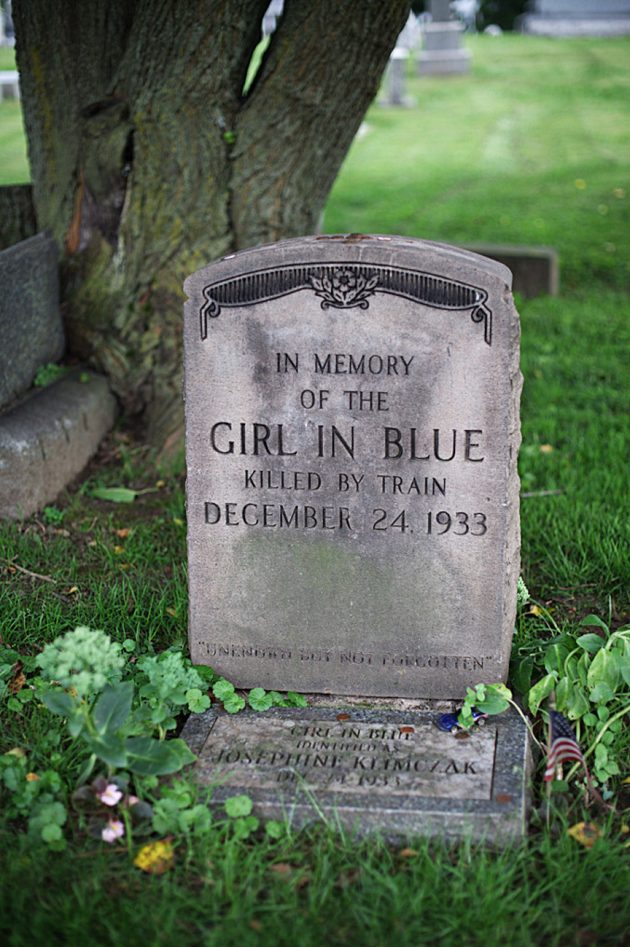
She was buried in a donated plot in the center of the Willoughby burial ground, right under the sweeping branches of a towering pine tree. It was a prime spot. Hank Heaverly, the cemetery sexton, refused to let her lie in an unmarked grave. He raised funds from the community.
The headstone they erected is still there today, hauntingly beautiful in its simplicity:
Girl in Blue
Killed by a train
December 24, 1933
Unknown but not forgotten
For decades, fresh flowers would appear on the grave. No one knew who put them there.
Deep Dive: The Great Depression Context
To understand this story, you have to understand 1933. This wasn’t just a bad year; it was the bottom of the barrel. Unemployment was at 25%. People were riding the rails, hopping trains, looking for work, looking for food, looking for anything.
But the Girl in Blue didn’t fit the profile of a “hobo.” She had money. She paid for a room. She had a ticket. She was dressed well.
Theory: Was she fleeing a domestic situation? The lack of ID suggests she didn’t want to be found. In 1933, a woman leaving her husband was a scandal. A woman leaving with 90 cents and a suitcase was a tragedy in the making.
The “crudely sharpened pencils” stick out. If she was educated, why were they sharpened crudely? Did she use a knife on the road? Was she sketching the countryside? Or were they tools of a trade we don’t understand?
The 60-Year Secret Revealed
Fast forward. The world changed. A World War happened. The Moon landing. The internet was born. And the Girl in Blue lay under that pine tree, nameless.
Then came December 1993. The 60th anniversary of her death. The News-Herald, a local paper, ran a retrospective piece. Just a “remember when” story to fill space.
But this time, the right person read it.
Ed Sekerak, a real-estate agent in Pennsylvania, was reading the paper. He froze. The details were too familiar. The date. The description. The location. Sekerak wasn’t a detective, but he was handling the sale of an old family farm—the Klimczak property in Spring Creek, PA.
He started digging through old court records and family documents. He found a missing person file that had been gathering dust for six decades. He connected the dots that the police in 1933 couldn’t.
The Girl in Blue was Josephine Klimczak.
The Legal Confirmation
Sekerak contacted William C. Gargiulo, a lawyer in Willoughby. The evidence was overwhelming. The physical description was a match. The timing of her disappearance from the Klimczak farm matched her arrival in Willoughby. The “Corry, PA” ticket made sense now—Spring Creek is right next to Corry. She had a ticket home.
Lake County Probate Court Judge Fred V. Skok reviewed the files. He made it official. The ghost had a name.
The Unanswered Questions (The “What Ifs”)
So, we have a name. Josephine. But does that solve the mystery? absolutely not. In fact, it opens up a whole new can of worms.
1. Why did she get off the bus?
She had a ticket to Corry, PA. She was going home. Why stop in Willoughby? Why spend her limited money on a boarding house? Did she get sick? Did she get scared? Or did she see someone on that bus that terrified her, forcing her to flee into a strange town?
2. The Suicide vs. Accident Debate
The coroner ruled it an accident. But witnesses said she “sprinted” toward the tracks. Was she running across to get to the other side? Or was she running into the train?
Here is a darker theory: Was she running away from someone in the woods? Remember, she walked into the trees and vanished, then emerged running. Was someone chasing her?
3. The Clean Body Conspiracy
Modern internet sleuths love this point. The “no blood” detail. Some posit that she might have been dead before the train hit her, and the scene was staged. But the autopsy reported a skull fracture consistent with impact. Still, the lack of external trauma is weird. It keeps people up at night.
The Legacy
Today, the grave of the Girl in Blue remains a pilgrimage site for mystery lovers and historians. Even though we know she was Josephine Klimczak, the headstone still reads “Girl in Blue.” It’s a monument to the unknown. A reminder that anyone, at any moment, can slip through the cracks of history.
Her purpose in visiting Willoughby remains unknown. The thoughts in her head as she stood by those tracks are lost to time.
Was it a mistake? A tragic slip on the gravel? Or was it a final, desperate decision made by a girl who felt she had nowhere left to go?
Next time you are in Willoughby, visit the cemetery. Stand under the pine tree. And ask yourself: What would you do with 90 cents and a ticket home that you never used?
Originally posted 2016-11-07 10:12:51. Republished by Blog Post Promoter

Aloha, I’m Amit Ghosh, a web entrepreneur and avid blogger. Bitten by entrepreneurial bug, I got kicked out from college and ended up being millionaire and running a digital media company named Aeron7 headquartered at Lithuania.