Home Weird World Science World’s first commercial jetpack coming soon

World’s first commercial jetpack coming soon

0
64

The Jetpack We Were Promised: What Really Happened to the $150,000 Flying Machine That Vanished?

We were all promised a future. A glorious, chrome-plated, sky-high future. The Jetsons. Rocketeer. James Bond soaring away from a Spectre safehouse. For decades, the personal flying machine, the jetpack, was the ultimate symbol of a world just around the corner. It was a dream whispered by science fiction and shouted by comic books.

Then, it happened. It got real.

Out of a garage in New Zealand, a machine emerged that looked like it was ripped straight from that future. It wasn’t a flimsy prototype or a CGI fantasy. It was metal. It had an engine. It flew. It was the Martin Jetpack, and in 2015, the world was told it could be ours. For a price.

The media went into a frenzy. News channels broadcast stunning test flights. A price tag was announced: $150,000. It was set to go on sale the very next year. The future had finally arrived.

And then… nothing.

It vanished. The headlines dried up. The company faded into obscurity. The dream of a jetpack in every garage evaporated like fuel in the morning sun. What happened? Was it all a spectacular hoax? A brilliant failure? Or was the Martin Jetpack a dream that was deliberately, and quietly, grounded by forces we never saw?

A 35-Year Obsession: The Garage Genius Who Chased the Sky

To understand the ghost of the Martin Jetpack, you have to understand the man who gave it life: Glenn Martin. This wasn’t some massive corporation with a billion-dollar R&D budget. This was one man, in his garage, with an idea that everyone else said was impossible. An obsession.

For more than three decades—thirty-five years—while the world moved on, Martin tinkered. He sketched. He failed. He welded and wired and rebuilt, fueled by a singular vision. His own children grew up with the constant roar of prototypes in the backyard, a soundtrack to a seemingly impossible quest. This wasn’t just an invention; it was his life’s work.

He saw the fundamental flaw in the classic “rocket belt” design. Those were brutal, violent things, burning through gallons of highly volatile fuel in seconds. They were less a form of transport and more a controlled explosion. You couldn’t commute on a rocket belt. You couldn’t rescue someone with it.

Martin’s idea was different. Smarter. Safer.

Deep Dive: This Wasn’t Your Grandfather’s Rocket Belt

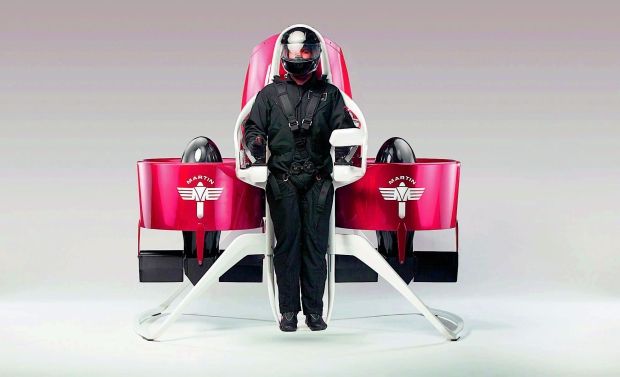
So how did it work? Forget rockets. Forget sci-fi movie magic. The Martin Jetpack was, at its heart, a magnificent piece of raw mechanical engineering. A miniature helicopter you wore on your back.

Instead of rocket nozzles, it used two enormous, powerful ducted fans. Think of them as high-tech propellers housed inside a circular wing, dramatically increasing their thrust and safety. Powering them wasn’t some exotic rocket fuel, but a grimy, familiar V4 two-stroke petrol engine. The kind you might find in a high-performance motorbike. It was loud. It was mechanical. It was real.

This design had massive advantages:

  • Flight Time: While the legendary Bell Rocket Belt of the 1960s could barely manage 30 seconds of flight, the Martin Jetpack was designed for a full 30 minutes. That’s the difference between a party trick and a genuine vehicle.
  • Control: It was designed for precision. It could take off and land vertically on almost any surface, even a small rooftop. The pilot had simple joystick-like controls to manage pitch, roll, and yaw.
  • Safety First? Martin knew that to be commercially viable, it couldn’t just be a death trap for daredevils. He built in multiple layers of redundancy. Most importantly, it included a ballistic parachute. If the engine failed mid-air, a small rocket would deploy a full-sized parachute, bringing the pilot and the machine safely back to earth.

This wasn’t just a flying platform. It was a meticulously designed aircraft. It could lift a person weighing up to 120kg (about 265 lbs) and zip through the air at 74 kilometers per hour (around 46 mph). The promise wasn’t just flight; it was *practical* flight.

The Martin Jetpack in a promotional photo

The World Gasps: A Glimpse of the Flying Future

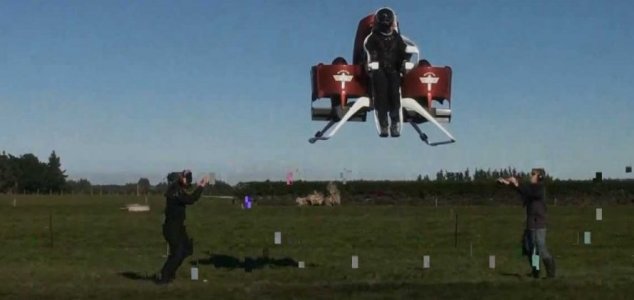
When the Martin Aircraft Company finally went public with their creation, the reaction was electric. They took it to the Paris Airshow. They released incredible videos of manned and unmanned test flights over the New Zealand countryside. It was stable. It was powerful. It looked exactly like we all hoped it would.

The price tag of $150,000 only added to the mystique. It was expensive, yes, but it put the machine in the same category as a supercar or a small boat. It was an extravagant toy, but it was an attainable one for the super-rich. The dream suddenly had a price tag.

But the company insisted it was more than a plaything.

Martin’s new chief executive, Peter Coker, a former Royal Air Force officer, saw a much bigger picture. He painted a vision of the jetpack as a revolutionary tool for emergency services. “I think the first responders will see that as a massive improvement to their capability,” Coker said at the time. “Naturally for the ambulance service getting to a point of importance of rescuing people in the shortest possible time.”

Imagine it. A paramedic soaring over a three-hour traffic jam to reach a car crash victim. A firefighter landing on the roof of a burning skyscraper to evacuate trapped residents. A search and rescue team effortlessly navigating treacherous, impassable terrain.

This was the dual promise of the Martin Jetpack: an ultimate toy for the 1% and a life-saving angel for the rest of us. The company went public. Money started pouring in, most notably a massive investment from a Chinese aerospace and tech firm, Kuang-Chi Science. The stock soared. Pre-orders were being discussed. The factory was gearing up for production.

2016 was supposed to be the year of the jetpack. So where is it?

The Great Vanishing Act

The silence that followed was deafening. 2016 came and went. No jetpacks were delivered. The company’s press releases became less frequent, their language more vague. The focus began to shift. They were no longer talking about selling to wealthy individuals. The new line was all about “unmanned” versions for commercial and military clients. A “jetpack drone.”

It was a bait-and-switch. The dream they had sold the world—personal flight—was being quietly shelved in favor of a more conventional, and perhaps less complicated, government contract machine.

Then, even that faded. The company’s stock price, once a high-flyer, crashed to earth. By 2019, the Martin Aircraft Company was in liquidation. The assets were sold off. The dream was officially dead.

The question that haunts us is… why?

Conspiracy Corner: Four Theories on Who Killed the Jetpack

The official story is one of simple economics. The company ran out of money. The R&D was too expensive, the path to certification too long. But for something so revolutionary, something that had attracted hundreds of millions in investment, that story feels… thin. Internet forums and enthusiast circles have been buzzing for years. Here are the leading theories.

Theory #1: The Tech Was a Lie

Was it all just smoke and mirrors? This theory suggests that while the prototypes could fly, they were wildly impractical, unsafe, or both. Maybe the 30-minute flight time was a theoretical maximum achieved with a tiny pilot and no wind. Maybe the engines were prone to overheating. Maybe the controls were far too difficult for an average person to master without hundreds of hours of training. In this version of events, the company took the investors’ money knowing full well they could never deliver a safe, reliable consumer product. It wasn’t a failure; it was a high-tech scam.

Theory #2: Grounded by the Government

This is the most plausible and chilling scenario. Think about the chaos. If you can buy a jetpack for $150,000, what happens next? How do you regulate it? Does a pilot need a license? What about air traffic control around airports? What stops a criminal or a terrorist from flying one into a sensitive location? The Federal Aviation Administration (FAA) and its global counterparts would have been facing an absolute nightmare. Some believe these agencies simply buried the Martin Jetpack in an impossible mountain of red tape and certification requirements, bleeding the company dry until it gave up. It’s easier to kill one company than to rewrite the entire rulebook for the sky.

Theory #3: Suppressed by the Military-Industrial Complex

What if the technology was *too* good? The military has been trying to build a viable personal flight system for over 70 years. Then a guy in a New Zealand garage cracks the code. It’s possible that a major defense contractor, or a government agency, saw the Martin Jetpack and its patents as a quantum leap in military capability. They couldn’t have that technology available on the open market. The theory goes that they, or their investors, forced the company to pivot to an “unmanned drone” version they could control, while slowly killing the personal jetpack project. The assets were then bought up in the liquidation, and the technology vanished behind the black veil of classified military projects.

Theory #4: Big Auto and Big Oil Stepped In

A classic conspiracy, but is it so crazy? Imagine a world where short-to-medium distance travel is no longer bound by roads. No more traffic jams. No more buying tires, or paying for road tax. A world where your reliance on the gasoline-powered automobile is drastically reduced. While the Martin Jetpack still ran on petrol, it was a symbol of a transportation revolution. Did the multi-trillion-dollar automotive and oil industries see this as the thin end of the wedge? Did they use their immense lobbying power and financial influence to ensure that personal aviation remained a fantasy, protecting their asphalt empire for a few more decades?

A Dream Deferred, Not Destroyed?

The Martin Jetpack is gone, a ghost of a future that never was. Its tale serves as a cautionary one, a story of how a brilliant dream can crash against the hard realities of finance, regulation, and perhaps, more shadowy forces.

But the dream itself? The dream is bulletproof.

Today, new companies are picking up where Glenn Martin left off. Richard Browning of Gravity Industries has created a true jet-powered suit. A Swedish company called Jetson is selling a personal electric aerial vehicle that looks like a flying go-kart. The technology is evolving. The materials are getting lighter, the batteries and engines more powerful.

The Martin Jetpack may not have been the final answer, but it was the first company to ask the right question on a global stage. It proved that personal flight wasn’t a matter of *if*, but *when*. And as you sit in your next traffic jam, staring at the empty sky above, ask yourself: Was the Martin Jetpack just a spectacular failure, or was it a promise that was silenced because the world simply wasn’t ready for the answer?

Originally posted 2015-11-24 10:19:25. Republished by Blog Post Promoter