Home Weird World UFO sighting Hillary and Bill Clinton tried to open UFO truths 21 years ago

Hillary and Bill Clinton tried to open UFO truths 21 years ago

0
61

The Clinton UFO Promise: The Secret History of the White House and the Fight for Alien Truth

Forget the policy debates. Forget the political scandals. The strangest, most mind-bending promise of the 2016 presidential election didn’t involve the economy or foreign policy. It involved something from far, far away.

It was a promise to open the books on the biggest secret in human history.

Hillary Clinton, standing on the precipice of the presidency, told the world she would get to the bottom of the UFO phenomenon. Not just a casual remark. A repeated, deliberate pledge. She vowed to send a team into the shadowy depths of Area 51. She promised to release the files. She was going to blow the lid off a secret held tighter than nuclear launch codes.

And then she lost.

The promise vanished into the political ether, dismissed as a quirky footnote in a brutal campaign. But it wasn’t a footnote. It was the explosive climax of a story that had been brewing for decades, a secret dance between the most powerful family in American politics, a billionaire philanthropist, and a hidden truth about what’s really flying in our skies. This wasn’t a new idea for the Clintons. This was unfinished business.

The Rockefeller Initiative: A Billionaire’s Quest for Cosmic Truth

To understand the 2016 promise, you have to rewind the clock to the 1990s. The world was different. The internet was a screeching dial-up tone. The X-Files was prime-time television. And inside the White House, an unprecedented effort was underway.

The driving force wasn’t the President himself, at least not at first. It was Laurance S. Rockefeller.

Yes, *that* Rockefeller. Heir to the Standard Oil fortune, a venture capitalist, a conservationist, and a man with everything money could buy. But he was obsessed with something beyond earthly wealth. He was convinced that the United States government was hiding evidence of extraterrestrial visitors, and he was determined to use his immense influence to bring it into the light.

This wasn’t some fringe hobby. Rockefeller was methodical. He was relentless. Starting in 1993, shortly after Bill Clinton took office, he launched what became known as the “Rockefeller Initiative.” He wasn’t chasing tabloid headlines; he was lobbying the highest levels of the United States government.

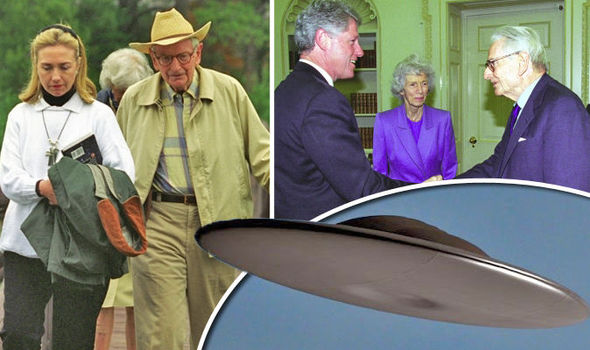
Hillary-Rockefeller-650737[1]

The picture above isn’t just a polite photo-op. It’s a piece of history. It shows First Lady Hillary Clinton meeting with Rockefeller at his Wyoming ranch in 1995. She’s holding a book. Not just any book. It was “Are We Alone?: Philosophical Implications of the Discovery of Extraterrestrial Life” by Paul Davies. Rockefeller was personally briefing her, trying to convince her of the monumental importance of this subject. He saw her, and her husband, as the key.

The Briefing Book and the V-Day Letter

Rockefeller’s approach was surgical. He financed a comprehensive report, a massive binder often called the “Briefing Book” or “The Best Available Evidence.” It was a curated collection of the most compelling UFO cases from around the world, designed to be handed to the President and his top staff. It was a UFOlogy 101 for the most powerful people on Earth.

He drafted letters. So many letters. He wrote to President Clinton’s science advisor, Dr. Jack Gibbons, pleading for a serious review. One famous letter, dated February 1, 1996, is known as the “V-Day Letter,” a nod to a potential “Victory Day” for UFO disclosure.

In it, Rockefeller urged the President to grant a full amnesty to any government witnesses who might be bound by security oaths, allowing them to come forward and speak freely about what they knew. Think about that. A Rockefeller was asking the President of the United States to pardon government insiders for breaking their silence on aliens. This was not a small request.

The goal was simple and audacious: to get the President to stand before the world and state that the UFO phenomenon was real, and that the government was taking it seriously. They weren’t asking him to announce a treaty with the Zeta Reticulans. They just wanted an end to the official policy of denial and ridicule that had been in place since the 1950s.

Enter John Podesta: The Man on the Inside

Every crusade needs a champion on the inside. For the disclosure movement, that man was, and still is, John Podesta.

In the 90s, Podesta was a key White House staffer, eventually becoming Bill Clinton’s Chief of Staff. He was the recipient of many of Rockefeller’s communications. He was the conduit. The ally. While others in Washington might have scoffed, Podesta listened. He was intrigued. He saw the logic in Rockefeller’s arguments and became a quiet advocate within the administration.

His fascination with the topic wasn’t a secret, but it became legendary after he left government. In 2015, on his last day as a senior advisor to President Obama, he sent a tweet that electrified the UFO community:

“Finally, my biggest failure of 2014: Once again not securing the #disclosure of the UFO files. #thetruthisstilloutthere”

This wasn’t a joke. This was a man who had been at the highest levels of power for two separate administrations, admitting his frustration. He had tried. He had pushed. And he had failed. The walls of secrecy were too thick, too high. Even for a man with a direct line to the Oval Office.

So when he signed on as Hillary Clinton’s campaign chairman in 2016, the hope for disclosure reignited like a phantom engine. The ultimate insider was back. And this time, he was backing a candidate who seemed willing to finish the job.

The Clintons and the Concrete Wall of Secrecy

What did Bill Clinton actually think about all this? Did he believe? According to one of his closest friends and former Associate Attorney General, Webster Hubbell, the President was more than just curious.

In his book, “Friends in High Places,” Hubbell wrote that Clinton gave him a chillingly specific directive after he arrived at the Justice Department. He said Bill told him, “Webb, if I put you over at Justice, I want you to find the answers to two questions for me. One, who killed JFK? And two, are there UFOs?”

Hubbell claimed he did look into it. He said he made inquiries. And the answer he got back was a dead end. He wrote that government officials told him they couldn’t and wouldn’t cooperate. The subject was off-limits. The message was clear: “Sir, there’s a government inside the government, and I don’t control it.”

Could the President of the United States be denied access to information? It sounds impossible. But the world of Unacknowledged Special Access Programs (U-SAPs) is a labyrinth of need-to-know compartments, where information is guarded so fiercely that even a Commander-in-Chief might not have the proper clearance.

The Rockefeller Initiative ultimately fizzled out. A few declassified files, mostly mundane, were released. But the grand acknowledgement never came. The truth, it seemed, was buried too deep.

The 2016 Promise: A Calculated Gamble or a Genuine Pledge?

Fast forward to 2016. The political landscape was a minefield. And Hillary Clinton started talking about aliens.

It began with an interview with the Conway Daily Sun in New Hampshire. When asked about UFOs, she didn’t laugh it off. She leaned in. “Yes, I’m going to get to the bottom of it,” she said, sounding serious. She even corrected the reporter’s terminology, preferring the newer term UAP (Unidentified Aerial Phenomena), showing she was up to date on the lingo.

Then came the big one: an appearance on Jimmy Kimmel Live!. Kimmel, a known UFO enthusiast, pressed her on the topic. Again, she was game.

“I would like us to go into those files and hopefully make as many of them public as possible,” she told him. “If there’s nothing there, let’s tell people there’s nothing there. If there is something there, unless it’s a threat to national security, I think we ought to share it with the public.”

This was it. A presidential frontrunner on national television, promising transparency on the most controversial topic imaginable. Podesta followed up in interviews, confirming her sincerity. He told KLAS-TV in Las Vegas, “I think I’ve convinced her that we need an effort to kind of go look at that and declassify as much as we can, so that people have their legitimate questions answered.”

Was it a genuine pledge born from decades of insider knowledge? A continuation of the work started with Laurance Rockefeller? Or was it a clever, low-risk political gambit to appeal to a demographic of voters who felt ignored by the mainstream? Maybe it was both.

What If She Had Won? A Glimpse into an Alternate Timeline

Let’s imagine it. November 8, 2016. The outcome is different. President-elect Hillary Clinton begins her transition.

What happens next? This is where the conspiracy deep-dive begins.

In this alternate reality, John Podesta isn’t just a campaign chairman. He’s likely given a high-level post—Chief of Staff again, or perhaps a special role as “Disclosure Czar.” His first task: to fulfill that campaign promise.

He would begin by requesting access. Not just to the Air Force’s old Project Blue Book files. No, he’d go for the jugular. He’d ask the Department of Energy for files on crashed materials. He’d ask the CIA for intelligence on foreign UAP programs. He would demand a full, unredacted briefing on Area 51 and its sister sites like the Tonopah Test Range.

The Pushback

And that’s where he would hit the wall. The same wall Webster Hubbell hit. The same wall that likely frustrated past presidents.

The intelligence community, the Pentagon, and powerful private aerospace contractors would almost certainly push back, citing national security. They would argue that the technologies involved—even if they are human-made secret aircraft—are too sensitive to be revealed. They would claim that disclosing what we *don’t* know is as dangerous as revealing what we *do* know, as it exposes vulnerabilities to adversaries like Russia and China.

Could President Clinton, as Commander-in-Chief, simply order them to comply? In theory, yes. In practice, it’s a battle of wills. The “permanent state,” the unelected bureaucracy of national security, has ways of slow-walking, redacting, and obfuscating. They could bury the new administration in paperwork and legal challenges until the political will to fight simply ran out.

The best-case scenario for disclosure fans? A gradual release. A trickle of information. Perhaps an official acknowledgment that UAPs are real, tracked by our military, and of unknown origin. This alone would be revolutionary. It would be the end of the official giggle factor.

The worst-case scenario? The pushback is absolute. The secret remains locked down. And the Clinton administration, facing a hundred other crises, quietly shelves the UFO project, just as it was shelved in the 90s.

The Echo of a Promise: From Clinton to Grusch

The 2016 promise may have faded, but the story didn’t end. In a strange way, the energy from that campaign seemed to bleed into the public consciousness.

Just one year later, in December 2017, the world changed. The New York Times published its bombshell story on a secret Pentagon UFO program, AATIP. They released three authenticated videos, captured by Navy fighter pilots, showing craft performing impossible maneuvers. “Tic Tac.” “Gimbal.” “Go Fast.” These terms entered the lexicon overnight.

The dam of secrecy had finally cracked. Not because of a presidential decree, but because of a handful of determined insiders, journalists, and rock stars—shout out to Tom DeLonge and To The Stars Academy.

This new wave of transparency has led directly to the stunning events of today. Congressional hearings. Whistleblowers like David Grusch testifying under oath about covert crash retrieval and reverse-engineering programs. The creation of official government UAP investigation offices.

It’s impossible not to see a direct line from the quiet lobbying of Laurance Rockefeller, to the internal struggles of John Podesta, to the public promises of Hillary Clinton, and finally to the dam-breaking revelations of the modern era.

The Clintons and their team were ahead of their time. They were grappling with a reality that the rest of the world is only now beginning to accept. The promise they made was not a quirky joke. It was a recognition of a profound mystery that sits at the heart of the national security state.

The files remain mostly classified. The full truth is still hidden behind layers of bureaucracy and fear. But the conversation has started, and it cannot be stopped. The Clinton UFO promise was never fulfilled, but perhaps its true purpose was to plant a seed—a suggestion that the truth was not only out there, but that it was finally within our reach.

Originally posted 2016-03-22 00:23:56. Republished by Blog Post Promoter