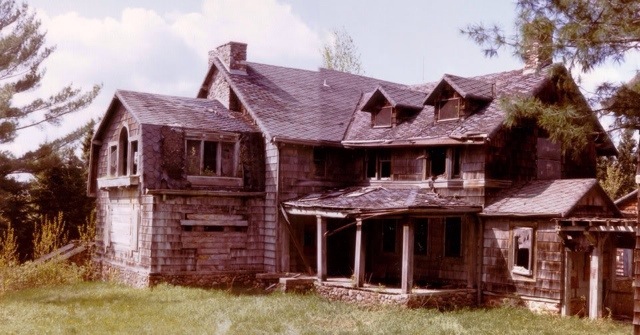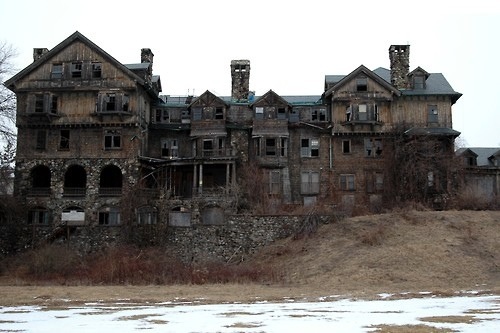
The Hollow Heart of Wisconsin: Unearthing the Vicious Secrets of Summerwind Mansion
Some places are just wrong. They’re scars on the landscape. Wounds that never heal. Out in the dense, whispering woods of North East Wisconsin, on the otherwise peaceful shores of West Bay Lake, you’ll find one such wound. It’s little more than a cellar hole now. A few skeletal chimney stacks claw at the sky, stone bones picked clean by time and fire. But this is no ordinary ruin. This is what’s left of Summerwind Mansion.
And it remembers everything.
They call it one of the most haunted locations in America, but “haunted” feels like too small a word. Too quaint. Houses have ghosts. Summerwind had teeth. It didn’t just spook its owners; it consumed them. It chewed up their sanity, spit out their dreams, and left them broken. This isn’t just a story about things that go bump in the night. It’s a story about a place that actively, violently, wanted to be alone.
An Idyllic Beginning, A Terrifying End: The Lamont Era
It didn’t start as a place of terror. Far from it. In the early 20th century, it was a simple, elegant fishing lodge. A tranquil escape for the wealthy to forget the noise of the city and listen to the call of the loons across the lake. Paradise.
In 1916, that paradise caught the eye of a very serious man. Robert P. Lamont. This wasn’t some flighty artist or recluse. Lamont was a titan of industry who would later become the United States Secretary of Commerce under President Herbert Hoover. A man of numbers, logic, and steel. He saw the property and envisioned something grander. He hired the prestigious Chicago architects Tallmadge and Watson to transform the lodge into a sprawling, magnificent mansion. For fifteen years, it was his family’s summer retreat. A place of laughter, lavish parties, and lakeside serenity.
But the whispers started early.
The domestic staff, the maids and cooks, would talk. They spoke of doors opening on their own. Of voices carried on the breeze when no one was there. Of a feeling… a heavy, watchful presence, particularly in the servants’ quarters. Lamont, a man of the modern world, dismissed their stories. Superstition. The creaks and groans of a large house settling. Nothing more.
He was wrong.
The Shot in the Dark
The story goes that one evening in the mid-1930s, Lamont and his wife were sitting down for dinner when something changed. The air grew cold. A shape began to form in the doorway between the dining room and the kitchen. Not a trick of the light. Not a shadow. It was a solid, spectral figure. An apparition.
What would you do? Freeze? Scream?
Robert Lamont, the man of action, reacted. He grabbed a pistol and fired. Not once, but twice. The bullets passed straight through the entity, punching two holes into the kitchen door. The ghost vanished. But the fear did not.
Within days, the Lamont family packed their bags. They didn’t just leave for the season. They abandoned Summerwind. They left furniture, clothes, dishes in the cupboards. They fled as if escaping a plague, never to return. The man of logic had seen something that logic could not explain, and it broke him. For years, the two bullet holes in that kitchen door served as a silent warning to anyone who dared enter.

The Long, Silent Decades
For nearly forty years, Summerwind sat empty. A silent giant decaying on the lakefront. The Great Depression and World War II came and went. The world changed, but the mansion remained, locked in its own dark timeline. Locals knew the stories. Teenagers dared each other to spend a night within its walls, most fleeing before midnight, spooked by the suffocating silence and the feeling of being watched from every dark window.
The house waited. Its paint peeled. Its windows grew clouded with grime. Nature began its slow, relentless campaign to reclaim the property. But inside, something else was waiting, too. Patiently. It was about to get a new family to play with.
A New Dream Becomes A Living Hell: The Hinshaw Nightmare
In the early 1970s, Arnold and Ginger Hinshaw, along with their four children, saw a diamond in the rough. They bought the dilapidated mansion with dreams of restoring it to its former glory. It would be their forever home. A grand project for a young, hopeful family.
The house had other plans.
It started subtly. Flickering shadows glimpsed from the corner of an eye. Muffled voices that would stop the moment you entered a room. The classic signs you try to rationalize away. It’s an old house. It’s the wind. It’s your imagination.
But then, it got worse. Much worse.
The House Fights Back
The property began to exhibit a malevolent intelligence. Heavy sash windows would suddenly fly open on their own, even in the dead of winter. Lights would flicker and die for no reason, only to blaze back to life moments later. Tools left in one room would vanish, reappearing days later in another part of the house entirely.
The Hinshaws were under siege. The family reported seeing the full-bodied apparition of a woman, floating through the dining room and kitchen—the same area where Robert Lamont had his terrifying encounter decades before. The atmosphere in the house grew thick with dread. The family was on edge, sleep-deprived, and terrified in their own home.
But the true horror was only just beginning. It was what Arnold found in the walls that pushed him over the edge.
The Crawlspace and the Portal
During renovations, Arnold Hinshaw reportedly knocked down a closet wall near the kitchen. Behind it, he found a bizarre, hidden crawlspace. And inside… something impossible. What he claimed was a human skull and a lock of hair.
This discovery sent Arnold down a rabbit hole of obsession. He became convinced he had stumbled upon a secret that went back centuries. This obsession latched onto the legend of Jonathan Carver, an 18th-century explorer who roamed the region.
Deep Dive: The Twisted Legend of Jonathan Carver
Who was Jonathan Carver? He was a real person, an explorer who charted parts of Wisconsin and Minnesota in the 1760s. The legend, however, gets murky. Carver claimed that two Sioux chiefs had granted him a massive tract of land—thousands of square miles—in what is now Wisconsin. The “Carver Grant” was never officially recognized by the U.S. government, but the tale persisted.
Arnold Hinshaw became fixated on this story. He believed the remains he found belonged to Carver. He theorized that Summerwind wasn’t just built on old land; it was built on a nexus point. A dimensional doorway. A portal. The strange activity, the ghosts, the disembodied voices—he believed they were all bleeding through from another reality. The house wasn’t haunted; it was a gateway.
This obsession consumed him. He would spend days and nights listening to strange electronic music, believing it helped him communicate with the spirits. He plastered the windows with black paper. He spoke endlessly about dimensions and frequencies. The house wasn’t just scaring him anymore. It was feeding his paranoia, twisting his mind.
Six months. That’s all it took.
In just six months, the American dream of restoring a beautiful home had curdled into an absolute nightmare. Arnold suffered a complete mental breakdown. Ginger, pushed to the brink of despair by the terrifying activity and her husband’s unraveling sanity, attempted suicide. Arnold was institutionalized. Ginger and the children fled to live with her parents. Once again, a family had been forced to run for their lives from Summerwind Mansion.

Fire from the Sky: An Act of God… Or Something Else?
After the Hinshaws left, the house was truly abandoned. It became a magnet for vandals, thrill-seekers, and paranormal investigators. Its dark legend only grew. Some who entered claimed to hear phantom organ music echoing through the decaying halls. Others felt icy hands touch them in the dark. It seemed the entity in the house was still there, angry and alone.
Then, on a stormy night in June 1988, the sky itself seemed to pass judgment.
A bolt of lightning struck the mansion. Not the tall, ancient trees surrounding it, which should have acted as natural lightning rods. The lightning hit the house. A fire erupted, consuming the dry, rotten wood with incredible speed. Firefighters could do nothing but watch as the infamous Summerwind Mansion burned to the ground.
Was it a freak accident? A random act of nature finally putting the tormented structure out of its misery? Or was it something more? Some paranormal researchers have theorized that it was the ultimate poltergeist event—a final, explosive tantrum from the entity trapped within. A final act of destruction to ensure no one would ever try to live there again.
The Ruins and the Modern Rumors
Today, all that’s left are the foundations and the towering stone chimneys, looking like ancient, forgotten monoliths. The site is on private property, but that hasn’t stopped a new generation of ghost hunters and YouTubers from exploring the digital ether and sharing their theories. Online forums buzz with speculation. Was it the ghost of a specific person? An ancient Native American curse on the land? Or was Arnold Hinshaw right? Was it a weak spot in the fabric of reality?
Those who have managed to visit the site report an unnerving quiet. A coldness that lingers even on the warmest summer days. Some claim their cameras and phones fail without explanation as they approach the cellar hole. The legend, it seems, did not die in the fire. It simply seeped into the soil.
What Truly Died at Summerwind?
So what was it? What evil force resided in that grand house on West Bay Lake? We are left with a chilling puzzle and no easy answers. We have the story of a powerful government official who fired a gun at a ghost and fled his home forever. We have the tragic tale of a family whose dream was systematically dismantled, their minds broken by an unseen tormentor in the span of half a year.
Was it a ghost, furious at the intrusion? Was it a dimensional portal, as Arnold Hinshaw crazily believed? Or is the simplest explanation also the most terrifying—that some places, for reasons we can never understand, are simply born bad? That the land itself is soured.
The fire of 1988 destroyed the house, but it didn’t destroy the story. The stone bones of Summerwind still stand in the Wisconsin woods. A silent, grim reminder that some doors are better left unopened, and some houses are better left to their ghosts.
Originally posted 2014-01-26 23:33:41. Republished by Blog Post Promoter
![20140127-003206[1]](https://coolinterestingnews.com/wp-content/uploads/2014/01/20140127-0032061.webp)