Home Weird World Science Giant camel fossil unearthed in the Arctic

Giant camel fossil unearthed in the Arctic

0
54

Everything You Know About the Desert is a Lie: The High Arctic Giant Camel Mystery

Close your eyes. Picture a camel. What do you see? Golden sand dunes rolling toward the horizon? The blistering heat of the Sahara? A caravan moving slowly past the Pyramids? Of course you do. That is the picture we have been fed since kindergarten. The camel is the “Ship of the Desert.” It is the ultimate symbol of survival in scorching, waterless wastelands.

But what if I told you that picture is wrong? What if I told you it is backward?

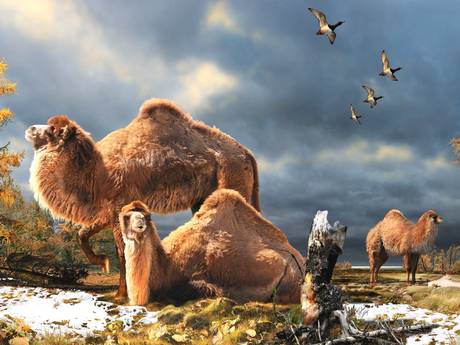
Imagine, for a second, that you are standing in the most desolate, freezing place on Earth. You are in the High Arctic. It is the middle of a winter that lasts for six months. The sun hasn’t risen in weeks. The temperature is so low it hurts to breathe. And there, stomping through the snow and the gloom, isn’t a polar bear. It is a camel.

A massive, hairy, terrifyingly large camel.

giant camel

This isn’t a fantasy. This isn’t a deleted scene from Star Wars. This is historical fact. Canadian researchers have unearthed evidence that shatters our understanding of evolutionary history. They found the remains of an extinct giant camel on Ellesmere Island.

Ellesmere Island. Look it up on a map. It is the northernmost tip of Canada, staring directly into the abyss of the Arctic Ocean. It is a frozen rock. And yet, 3.5 million years ago, it was home to a beast that was 30% larger than any camel alive today. This discovery doesn’t just rewrite the textbooks; it throws the whole book in the fire.

The Discovery That Broke the Timeline

Let’s set the scene. Dr. Natalia Rybczynski is a vertebrate paleontologist with the Canadian Museum of Nature. She wasn’t digging in a sandbox. She was at the Fyles Leaf Bed site on Ellesmere Island. This place is extreme. It’s remote. It’s hostile.

While picking through the dirt and ice, Rybczynski found something strange. Bones. Roughly 30 fragments of a tibia. But these weren’t fresh. They were old. really, really old. We are talking about the mid-Pliocene warm period, about 3.5 million years ago.

At first, it was a jigsaw puzzle from hell. The pieces were shattered. It was impossible to tell just by looking at them what kind of animal they belonged to. Was it a prehistoric bear? A giant beaver? (Yes, those existed too, but that’s a story for another day). The physical shape of the bone wasn’t enough.

This is where the story turns into a high-tech episode of CSI: Prehistoric.

CSI: The Arctic Files

Rybczynski knew she had something big, but she needed proof. She couldn’t just guess. So, she called in the heavy hitters. She enlisted Mike Buckley from the Manchester Institute of Biotechnology in the UK.

Buckley didn’t use a magnifying glass. He used chemistry. Specifically, a technique called Collagen Fingerprinting.

Here is why this is mind-blowing. usually, when we talk about identifying ancient fossils, we talk about DNA. But DNA is fragile. It breaks down. It degrades. After millions of years, DNA is often useless dust. But collagen? Collagen is tough. It’s the dominant protein in bone. It sticks around.

Buckley extracted the collagen from the 3.5 million-year-old splinters. He built a chemical profile—a fingerprint. Then, he ran it against a database.

He compared this ancient Arctic ghost against 37 modern mammal species. He also compared it to a fossil camel found in the Yukon (which is far north, but not High Arctic north). The computer crunched the numbers. The result?

It was a match.

The collagen profile was almost identical to the modern dromedary camel and the Ice-Age Yukon camel. But there was a twist. The size. The data, combined with the anatomical measurements, revealed a monster. These fragments came from a beast that dwarfed modern camels.

The High Arctic Forest: A Lost World

To understand the Giant Arctic Camel, you have to understand the world it lived in. This is where things get trippy. Today, Ellesmere Island is a polar desert. It is ice, rock, and wind.

But 3.5 million years ago? The Earth was in a “global warm spell.” The global temperature was about 2 to 3 degrees Celsius warmer than it is today. That sounds small. It isn’t. In the Arctic, that small shift meant the difference between a glacier and a forest.

The Arctic of the Pliocene era was a Boreal Forest. Imagine larch trees. Birches. Alders. It wasn’t tropical, but it wasn’t a freezer either. It was swampy, woody, and lush.

However, there was one thing that hasn’t changed: The Darkness.

Because of the tilt of the Earth, the High Arctic still experienced months of total, pitch-black darkness in the winter. The temperature would drop. Snow would fall. The plants would stop growing. It was a harsh, dark, snowy forest.

And that is exactly where the camel was born.

The Evolution Conspiracy: We Got It All Wrong

This is the part that will mess with your head. For a century, biologists told us that camels evolved for the desert. Let’s look at the “facts” we were taught:

  • The Hump: Stores fat to survive long treks across hot sand without food.
  • The Broad Feet: Act like snowshoes to keep the camel from sinking into the loose sand.
  • The Large Eyes: To see through sandstorms.

The discovery on Ellesmere Island suggests that none of this originally evolved for the desert.

Think about it. What are the challenges of the High Arctic winter? It’s dark. It’s cold. And food is scarce for six months at a time.

The Hump? It wasn’t for heat. It was a battery pack. The giant camel needed to store massive amounts of fat to survive a six-month winter where the sun never rose and the trees were bare. It was a survival mechanism for the Arctic winter, not the Sahara summer.

The Broad Feet? Have you ever tried to walk in deep snow? You sink. Unless you have snowshoes. The camel’s wide, flat feet were originally designed to trek through snow and muddy boreal swamps, not sand dunes.

The Eyes? In the permanent twilight of an Arctic winter, you need massive eyes to gather as much light as possible to see predators coming.

The camel didn’t adapt to the desert. The camel was a pre-made survival machine built for the ice, that just happened to work perfectly in the sand. When the Ice Ages really kicked in and the forests died, the camels migrated south. They walked across the Bering Land Bridge. They spread into Asia and Africa. They found deserts, and their bodies said, “Hey, we can work with this.”

The Monster in the Snow

Let’s talk about the size again. 30% larger. Modern camels stand about 7 feet tall at the shoulder. This thing would have been towering over you. We are talking about a creature that could look into a second-story window without standing on its tiptoes.

Why so big? In biology, there is a rule called Bergmann’s Rule. It states that within a group of species, the ones living in colder climates tend to be larger. Why? Surface area to volume ratio. Being big helps you hold onto body heat. A small cup of coffee gets cold fast. A giant vat of coffee stays hot all day.

This giant camel was a heat-retaining tank. It was likely shaggier, woollier, and meaner than anything you see at a zoo today.

Why This Matters Now

You might be thinking, “Okay, cool, a big dead camel. So what?”

This discovery is a warning. It is a glimpse into our future. The Pliocene era—the time this camel lived—is what scientists call a “paleo-analog” for our modern world. The CO2 levels back then were about 400 parts per million. That is exactly where we are right now.

The climate that allowed giant camels to roam a forested Arctic is the same climate we are barreling toward. As the ice melts, we aren’t just losing polar bears; we might be returning to a world that looks a lot more like the camel’s original home.

The Missing Link in North America

This finding extends the known range of camels in North America northwards by a staggering 750 miles. It connects the dots. We knew camels started in North America (the ancestors of llamas went south, the ancestors of dromedaries went west across the land bridge). But we didn’t know they could handle the extreme north.

“This is the first time that collagen has been extracted and used to identify a species from such ancient bone fragments,” Dr. Buckley said. This is a game-changer. If we can pull proteins out of 3.5 million-year-old bones in the Arctic, what else can we find?

What other “mythical” beasts are frozen in the permafrost, waiting for us to find them? Are there other giants down there? We have found giant beavers, giant sloths, and now giant camels. The Arctic was a land of monsters.

The Mystery Deepens

The Fyles Leaf Bed on Ellesmere Island is just one site. It is a pinprick on a massive map. If a population of giant camels lived there, they had to eat. They had to breed. They had to migrate. There must be thousands of bones beneath the ice.

Why did they go extinct in the North? Was it the sudden onset of the glaciations that became too intense even for them? Or was it something else? A new predator? A collapse of the food chain?

History is not a straight line. It is a messy, chaotic web. We like to put animals in boxes: Camel = Hot. Bear = Cold. But nature doesn’t care about our boxes. Nature builds a 9-foot-tall camel with snowshoes and a fat-storage hump and drops it in a frozen forest just to see what happens.

The next time you look at a picture of a camel in the desert, remember this: You are looking at a refugee from the Arctic. You are looking at a biological machine designed for the dark, cold north, masquerading as a desert wanderer.

The sands of Egypt are just their retirement home. The snow and the ice? That was their kingdom.

Source The Independent

Originally posted 2016-05-01 08:27:53. Republished by Blog Post Promoter

Originally posted 2016-05-01 08:27:53. Republished by Blog Post Promoter