Home Weird World Space Giant black hole in tiny galaxy

Giant black hole in tiny galaxy

0
46

The Cosmic Anomaly: A Monster Black Hole Trapped in an Impossible Galaxy

The universe is supposed to follow rules. Predictable rules. Comforting rules. Gravity pulls, stars burn, galaxies spin in a majestic, cosmic dance that has unfolded over billions of years. We think we have the steps memorized. We think we know the rhythm.

Then something comes along that shatters the whole performance. Something so out of place, so utterly wrong, that it forces us to question everything we thought we knew about the cosmos.

This is the story of one such impossibility. A cosmic freak show.

It’s the story of a tiny, forgotten galaxy hiding a secret of truly monstrous proportions. A secret that breaks the most fundamental rule of galactic evolution. This is the story of NGC 1277, and the behemoth lurking in its heart.

A Discovery That Rewrote the Star Charts

Imagine being an astronomer. You spend your nights staring into the abyss, sifting through faint smudges of light from millions of light-years away. You’re on a hunt, part of a team using the powerful Hobby-Eberly Telescope in Texas, trying to bag the biggest black holes in the known universe. You’re looking for them in the usual places. The cores of giant, sprawling elliptical galaxies. The galactic titans.

It makes sense, right? Big galaxy, big black hole. Small galaxy, small black hole. They grow together. A neat, tidy, symbiotic relationship. That’s the rule. It’s been the rule for decades.

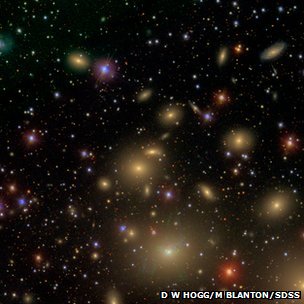
But then your data points you towards NGC 1277. It’s a speck. A pipsqueak of a galaxy, just a quarter the size of our own Milky Way, nestled 220 million light-years away in the constellation Perseus. Nothing to see here, probably. You run the numbers. You check them again. And again.

The computer screen must be lying. It has to be.

Because the numbers staring back at you don’t just bend the rules. They take the rulebook, tear it into a million pieces, set it on fire, and scatter the ashes across the cosmos. Inside this tiny, unassuming galaxy lurks a black hole so massive, so disproportionately huge, it simply should not exist. A cosmic error. An absolute monster.

Meet NGC 1277: The Little Galaxy with a Giant Secret

So what is this place? What is NGC 1277? It’s not a glamorous, star-forming spiral like our home. It’s what astronomers call a lenticular galaxy. Think of it as a compact, disc-shaped collection of ancient stars. It’s old. Very old.

Astronomers call galaxies like this “red and dead.” Its star-forming days are long over. It’s packed with old, reddish stars that have been circling the galactic core for billions of years, a quiet cosmic retirement home. There’s very little gas or dust to kick up a fuss or form new, bright blue stars. It’s a relic.

A Fossil From the Dawn of Time?

Some theories, whispered in the halls of astronomy departments, suggest NGC 1277 isn’t just old—it’s a fossil. A “relic galaxy.” This means it might be a snapshot of what galaxies looked like in the very early universe, a primordial structure that somehow survived unscathed for over 10 billion years without crashing into other galaxies or changing much at all. It’s a time capsule. And that makes the monster inside it even more perplexing.

Giant black hole in tiny galaxy

How could a beast of this magnitude grow so huge, so fast, in the ancient universe, inside a galaxy that then just… stopped evolving?

The questions were just beginning.

The Monster in the Machine: Just How Big Are We Talking?

When the initial discovery was announced, the numbers were mind-numbing. The black hole at the center of NGC 1277 wasn’t just big. It was an ultramassive black hole, a member of the most exclusive club in the cosmos.

Let’s Talk Numbers (That Will Break Your Brain)

The initial estimate, championed by a team led by astronomer Remco van den Bosch, pegged its mass at a staggering 17 billion times the mass of our Sun. Let that sink in. Not million. Billion.

For comparison, Sagittarius A*, the supermassive black hole at the center of our own sprawling Milky Way, is a mere 4 million solar masses. This thing in NGC 1277 was potentially over 4,000 times bigger. It was one of the largest black holes ever detected at the time.

But its raw size isn’t the most shocking part. The truly bizarre, rule-breaking detail is its size relative to its home. In most galaxies, like our own, the central black hole accounts for about 0.1% of the galaxy’s total mass (specifically, the mass of the central bulge). It’s a tiny cherry on a massive galactic cake.

In NGC 1277, the black hole isn’t the cherry. It IS the cake.

That 17-billion-solar-mass beast makes up an unbelievable 14% of its galaxy’s entire mass. That’s not a co-evolutionary partner; that’s a parasite that has almost consumed its host. It’s like finding a 20-pound heart inside a house cat. It’s fundamentally, physically wrong according to our models.

Deep Dive: How Do You Weigh the Invisible?

This all begs a very important question. If a black hole is, by definition, black—swallowing all light that gets too close—how in the world do you put it on a scale? You can’t see it. You can’t poke it.

The answer is gravity. Pure, beautiful, relentless gravity.

A black hole’s presence is given away by its “sphere of influence,” the region of space where its gravitational pull dominates the movement of everything around it. Astronomers become cosmic detectives, looking for gravitational fingerprints.

For a nearby black hole like ours, we can actually track individual stars. We can watch them whip around an unseen central point at incredible speeds, like planets orbiting a star, but so, so much faster. By measuring the speed and path of those orbits, using Kepler’s laws of planetary motion, we can calculate the mass of the object they’re orbiting. That’s how we know Sagittarius A* is 4 million solar masses.

But for a galaxy 220 million light-years away, you can’t see individual stars. It’s just a fuzzy blob. So, astronomers use a cleverer, broader technique. They measure something called “stellar velocity dispersion.” Instead of tracking one star, they look at the light from the entire central region of the galaxy. The starlight is smeared out into a spectrum, and within that spectrum are dark lines—absorption lines—that tell us about the chemical makeup of the stars. But these lines are also broadened or “smeared.” Why?

Because some stars in that cluster are moving towards us, some are moving away, and some are moving side to side, all orbiting the central black hole at insane speeds. This collective chaos of movement blurs the spectral lines. The more massive the black hole, the faster the stars are scrambling, and the more “dispersed” or smeared out those lines become. By creating complex computer models of all possible stellar orbits, astronomers can match the observed smear to a specific black hole mass.

This is what the team did for NGC 1277. And the model spat out a number that broke physics.

The Co-Evolution Conspiracy: A Cosmic Lie?

The discovery of NGC 1277’s monster threw a wrench into the elegant theory of galaxy and black hole co-evolution. This theory was the bedrock of galactic astronomy. It stated that as a galaxy grows by accumulating gas and merging with other galaxies, its central black hole “feeds” on the inflowing material and grows with it. The galaxy’s growth and the black hole’s growth are locked in a beautiful, proportional dance that lasts for eons.

NGC 1277 spits in the face of that theory.

Its black hole is far too developed for its young-looking (but ancient) galactic body. It’s a sign that something is terribly wrong with our understanding. This opens the door to wild, alternative theories that sound like science fiction but are being debated by real scientists right now.

  • What If… It’s a Stripped Giant? One of the leading ideas is that NGC 1277 wasn’t always so small. What if it was once a colossal galaxy, and its oversized black hole was perfectly normal for its original size? Then, through some violent cosmic hit-and-run, a much larger galaxy flew by and its immense gravity “tidally stripped” away NGC 1277’s outer layers. All that was left was the dense central core and its now-laughably-oversized black hole. It would be the galactic equivalent of a turtle losing its shell.
  • What If… The Black Hole Came First? This is a mind-bender. Our models say galaxies form first, and then the black holes in their centers grow. But what if, in the chaotic dawn of the universe, things worked differently? What if colossal “primordial” black holes formed directly from the collapse of massive clouds of gas, *before* most galaxies even existed? Then, these giant gravitational seeds would have captured the surrounding matter, and the galaxy would have formed *around* the pre-existing black hole. In this scenario, the black hole didn’t grow with the galaxy; the galaxy grew around the black hole.
  • What If… It’s a Galactic Cannibal? Perhaps the black hole’s growth had nothing to do with its own galaxy’s gas. NGC 1277 lives in a crowded neighborhood—the Perseus Cluster, a dense metropolis of galaxies. In the early universe, this region would have been even more crowded. What if NGC 1277’s black hole grew not by sipping gas, but by violently merging with other supermassive black holes from galaxies that it consumed? It would be a case of runaway growth, where the black hole’s mass gain completely outpaced that of its host galaxy.

The Plot Thickens: Has the Mystery Been Solved?

The original discovery was so reality-shattering that it immediately attracted intense scrutiny. Science, after all, is a battlefield of ideas. When someone makes an extraordinary claim, others will line up to try and tear it down. And that’s exactly what happened.

The Great Recalculation: A War of Data

In the years following the initial 2012 announcement, other teams of astronomers took a crack at measuring the beast in NGC 1277, using different techniques and improved models. And the results have created a full-blown scientific controversy.

One team, looking at the problem from a new angle, argued that the original team’s models were flawed. They claimed the mass was much lower, perhaps “only” 5 billion solar masses. Another study came out that suggested an even lower number, around 2 billion.

But just when it seemed the monster was being downsized, other studies, including a follow-up by the original team with better data, re-affirmed the colossal mass. They stood by their initial findings, arguing that the other teams weren’t accounting for the unique, compact structure of the galaxy’s core. The debate rages on. The data is fuzzy, the distance immense, and the techniques are at the very limit of our technological ability.

Even “Smaller,” It’s Still an Absolute Freak

Here’s the incredible part. Even if you take the most conservative, lowest estimate on the table—let’s say 2 billion solar masses—the black hole in NGC 1277 is *still* a monster that breaks the rules. A 2-billion-solar-mass black hole would still account for a few percent of the galaxy’s total mass. That’s dozens of times larger than the 0.1% rule we see everywhere else.

The core mystery doesn’t go away. No matter who is right about the exact number of zeroes, the fundamental problem remains: this galaxy hosts a black hole that is far, far too big for its britches. The anomaly is real.

Echoes in the Void: We’re Finding More of Them

For a while, NGC 1277 was a lone freak. A cosmic unicorn. But as our telescopes have gotten better and our surveys more comprehensive, we’ve started to find others. We’re discovering more “over-massive” black holes in other compact galaxies. Objects that defy the neat co-evolutionary relationship. It seems NGC 1277 wasn’t a one-off error. It was the first clue.

It was the harbinger of a new, mysterious class of cosmic objects that are forcing us back to the drawing board. It’s a sign that our neat and tidy models of the universe are just that: models. Approximations. And that the true reality of the cosmos, especially in its violent youth, might have been far stranger and more chaotic than we ever dared to imagine.

So what is the truth behind NGC 1277? Is it a stripped-down giant, a victim of galactic bullying? Is it a pristine fossil from the dawn of time, built around a primordial monster? Or is the answer something far stranger, something our current physics can’t yet comprehend?

We don’t know. All we know is that it’s out there, in the dark. A quiet little galaxy, holding onto a secret that rips a hole in our understanding of everything. And it reminds us that for all our knowledge, for all our powerful telescopes, the universe still holds the capacity to shock us to our very core.

Originally posted 2016-04-16 00:29:39. Republished by Blog Post Promoter