Stop what you are doing. Look up at the night sky. Somewhere out there, hidden in the velvet blackness of the constellation Ophiuchus, sits a secret neighbor that might just change everything we know about our place in the universe.
We aren’t talking about Mars. We aren’t talking about some distant, gaseous blob thousands of light-years away that we’ll never reach.
We are talking about Wolf 1061c.
Fourteen light-years. That’s it. In the grand, impossible scale of the cosmos, that is not a journey; it’s a stone’s throw. It’s right next door. A team of Australian scientists from the University of NSW cracked this code, identifying what is likely the closest potentially habitable planet outside our solar system. And the details? They are absolutely mind-bending.
The Discovery That Shook the Astronomers
Let’s rewind. Space is big. Really big. Usually, when NASA or the European Space Agency announces a “Goldilocks” planet—a world that isn’t too hot and isn’t too cold—it’s Kepler-452b or something similar, sitting 1,400 light-years away. We can look, but we can’t touch. We can’t even dream of sending a signal that would get there before human civilization rises and falls ten times over.
But Wolf 1061c is different.
At 130 trillion kilometers, the distance sounds insurmountable to a human brain. But to an astronomer? It’s practically in the front yard. This star system is the 35th closest to Earth. Think about that. Out of billions of stars, this one is in our immediate local cluster.
The team, led by Dr. Duncan Wright, didn’t just find a rock. They found a system. Three planets orbiting a Red Dwarf star. But it’s the middle one—Wolf 1061c—that has everyone sweating.
Why This Isn’t Just Another Gas Giant
Most exoplanets we find are like Jupiter. Big. Bloated. Made of gas. You couldn’t stand on them; you’d just sink until the pressure crushed you into a diamond. Wolf 1061c is special. The data suggests it is rocky.
Solid ground.
Mountains. Valleys. Maybe even canyons carved by ancient rivers. Dr. Wright’s team analyzed the mass and radius with extreme precision. The verdict? “It is a particularly exciting find because all three planets are of low enough mass to be potentially rocky and have a solid surface,” Wright noted.
Imagine standing there. Gravity might feel heavier, perhaps pulling at your bones a bit more than on Earth, but you could walk. You could build. And if the conditions are right, something else might be walking there too.
The Goldilocks Dilemma: Not Too Hot, Not Too Cold
Location is everything. In real estate and in astrophysics.
The Wolf 1061 system has three main players. The inner planet is a furnace; it hugs the star too tightly, likely boiling away any atmosphere it ever had. It’s a scorched wasteland. The outer planet? A freezer. Too far out to sustain liquid water, likely a barren rock of ice and silence.
But then there is the middle child. Wolf 1061c.
It sits in the Habitable Zone. This is the magic strip of space where temperatures allow water to remain liquid. Liquid water is the holy grail. Where there is water, there is chemistry. Where there is chemistry, there is biology.
“The middle planet, Wolf 1061c, sits within the ‘Goldilocks’ zone where it might be possible for liquid water – and maybe even life – to exist,” Dr. Wright said.
But here is where things get weird. Really weird.
The Red Dwarf Menace
The sun in our sky is a Yellow Dwarf. It’s stable. It’s bright. It’s predictable. Wolf 1061 is a Red Dwarf (M-type). These stars are the rascals of the galaxy. They are smaller, cooler, and redder. They live for trillions of years, far longer than our own sun will exist.
Because the star is cooler—burning at about 3,300 Kelvin compared to our sun’s blistering 5,800 Kelvin—the habitable zone is much, much closer to the star.
To stay warm, Wolf 1061c has to cuddle up to its sun.
It orbits the star every 18 days. Let that sink in. An entire year on this planet passes in less than three weeks of Earth time. You’d have a birthday every 18 days. The seasons would flash by in hours.
But the proximity comes with a terrifying cost.
The Nightmare of Tidal Locking
This is the part that sounds like it was ripped straight out of a sci-fi horror movie.
“Given how close the planet is to the star it is likely to be ‘tidally locked’,” Dr. Wright explained to the press.
What does that mean? It means the planet does not rotate like Earth. Or rather, its rotation is perfectly synced with its orbit. It faces the star the same way the Moon faces the Earth. One side is locked in an eternal, unblinking stare with the sun.
The Day Side: A permanent, scorching noon. The sun never sets. The radiation beats down relentlessly. Oceans might boil. The ground might bake.
The Night Side: Eternal darkness. A frozen, black wasteland where the sun hasn’t risen in a billion years. Temperatures plunge to levels that would shatter steel.
So, how could life exist in such a bipolar hellscape?
The Terminator Line: Where Life Hides
Hope lies in the gray areas. Specifically, the “Terminator Line.”
This is the twilight strip running around the planet, separating the burning day from the frozen night. In this ring of eternal dusk, the temperatures might be… perfect.
Imagine a world of perpetual sunset. The sun sits low on the horizon, huge and red, never moving. Great winds would howl constantly, driven by the temperature difference between the hot side and the cold side. The atmosphere would function like a global engine, pumping heat from the day side to the dark side.
If life exists here, it wouldn’t look like us. It would live in the shadows. It would evolve to withstand high winds and perpetual dim light. The plants might be black or deep purple to absorb the weak infrared light from the Red Dwarf star.
Why Haven’t We Heard From Them?
This brings us to the most unsettling question of all. The Fermi Paradox.
Wolf 1061 is an old system. Red Dwarfs burn slowly. This planet has likely been sitting there, in the habitable zone, for billions of years—possibly longer than Earth has existed. If evolution takes time, Wolf 1061c has had plenty of it.
If civilizations inevitably rise, and if 14 light-years is a short hop for radio waves, why is the signal silence so deafening?
Are we listening on the wrong frequencies? Or is the environment of a Red Dwarf simply too hostile?
The Flare Problem
Red Dwarfs are temperamental. They are known for “superflares”—violent outbursts of X-rays and ultraviolet radiation that can strip the atmosphere right off a nearby planet.
For life to survive on Wolf 1061c, it would need a magnetic field of immense power to deflect these flares. Or, life might have gone underground.
Think about it. A subterranean civilization, hiding from the angry red eye of their sun, thriving in the warmth of the planet’s core, completely unaware of the universe above. Or perhaps they are aware. Perhaps they are watching us, waiting for us to stop shouting into the void.
The Future of the Search
The discovery of Wolf 1061c was just the beginning. Now, we have tools that Dr. Wright’s team could only dream of a few years ago.
The James Webb Space Telescope (JWST) is currently scanning the heavens. Its infrared capabilities are perfectly tuned to look at Red Dwarf systems. Scientists are scrambling to point these high-tech eyes at Wolf 1061c to sniff the atmosphere.
What are they looking for? Biosignatures.
- Oxygen: The breath of life.
- Methane: The waste product of biology.
- Nitrous Oxide: Another tell-tale sign.
If they find a mix of these gases in the twilight ring of Wolf 1061c, it changes human history instantly. We go from “Are we alone?” to “Hello, neighbor.”
A Reality Check: The Heavy Gravity
Let’s assume you built a spaceship. You engaged the warp drive (or a generation ship) and traveled the 14 light-years. You arrive at the Twilight Zone of Wolf 1061c. What happens when you step out?
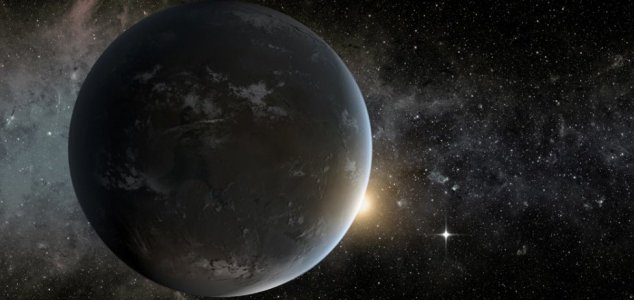
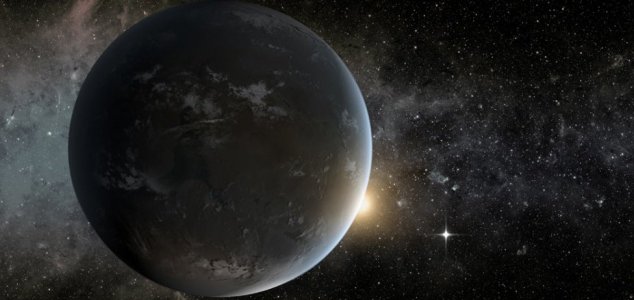
You’d feel heavy. The planet is a “Super-Earth,” with a mass over four times that of our world.
Your blood would struggle to pump up to your brain. Falling down would hurt a lot more. The native wildlife? They would likely be short, stocky, and incredibly strong to combat the gravitational pull. No giraffes here. Think six-legged, low-slung armored crabs or squat, muscular vegetation clinging to the rocks to avoid being swept away by the eternal winds.
The “Eyeball Earth” Theory
Recent internet theories have dubbed planets like this “Eyeball Earths.” Because the star melts the ice on the day side, you get a round ocean looking directly at the star, surrounded by white ice on the rest of the planet. From space, it would look like a giant, watery eye staring back at its creator.
It’s a haunting image. A giant, wet eye floating in the dark.
Is there something swimming in that pupil? Is there something building cities on the iris?
Why This Matters Now
We are living in the golden age of exoplanet discovery. For decades, we thought our solar system was the standard. We were wrong. The universe is weirder, wilder, and more crowded than we dared to imagine.
Wolf 1061c represents a shift. It’s not just data points on a graph. It is a world. A real place with weather, geography, and potential. It challenges our definition of “habitable.” It forces us to ask if life requires a yellow sun and a 24-hour day, or if life finds a way in the twilight storms of a locked world.
The silence from Wolf 1061c is heavy. But we are just starting to listen.
Keep your eyes on the news. The next time you hear about a “biosignature” found in a nearby star system, remember the name Wolf 1061c. It’s out there. It’s waiting. And at just 14 light-years away, it’s practically knocking on our front door.
The question isn’t just if something is living there.
The question is: Are they looking back at us?