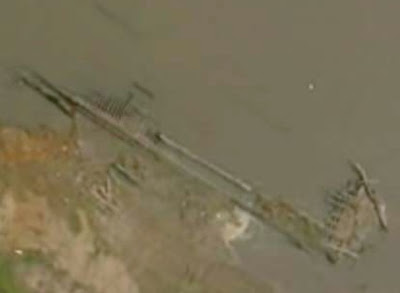
The River’s Secret: A Ghost Ship Rises from the Mud
The water level drops. Slowly, then all at once.
The relentless sun beats down, baking the earth and drinking the rivers dry. We call it a drought. A disaster. But sometimes, a disaster is just a revelation in disguise. Sometimes, when the water pulls back, it reveals secrets it was never meant to give up. Ghosts.
And on the mighty Missouri River, one hell of a ghost just broke the surface.
They call her the Montana. A name that echoes with the ambition and the danger of the Old West. For more than a century, she was a legend whispered among river rats and historians. A monster of a ship, the biggest of her kind, swallowed whole by the treacherous currents. Gone. Lost to time and the river’s greedy silt.
Until now.
Thanks to a brutal, historic drought, the Missouri is gasping for air. Its water levels have plummeted to near-record lows. And as the river shrinks, the bones of the past are emerging. The skeletal timbers of the long-lost Steamboat Montana are now visible, a haunting silhouette against the mudflats. A warning from a forgotten era.

But this isn’t just a story about an old, rotten boat. Oh no. This is about what the boat represents. It’s about a time when this river was the main artery to the heart of a wild, untamed continent. It’s about the secrets that went down with these ships. And it’s about why, even today, the authorities are so desperate to keep people away from these watery graves.
What really happened to the Montana? And what other phantoms are waiting to surface from the Missouri’s murky depths?
A Titan of the West: The Story of the Steamboat Montana
To understand the Montana, you have to understand the world that built her. We’re talking about 1882. The Civil War was a fresh scar. The West was still wide open, a place of myth and opportunity. And the Missouri River? It was the superhighway. The I-95 of its day. But it was a highway that actively tried to kill you.
They didn’t call it the “Big Muddy” for nothing. This wasn’t a gentle, flowing stream. It was a churning, unpredictable beast of a river, thick with sediment, constantly shifting its own course. Its currents could spin a boat like a top, and its depths hid a forest of deadly obstacles.
Into this chaos sailed the great steamboats. They were the lifeblood of the frontier, hauling everything from whiskey and flour to gold prospectors and nervous brides. And among these workhorses, the Montana was engineered to be the king.
Longer Than a Football Field, Built for an Untamed River
Get this picture in your head. The Montana was over 250 feet long. From end to end, it would stretch from one goal line to the other on a modern football field and then some. It was a true giant, a side-wheel paddle steamer designed for one purpose: to conquer the Missouri. Her massive paddle wheels churned the water with the force of a locomotive, pushing against the relentless current to deliver goods deep into the frontier territories.
She wasn’t a luxury liner like the Mississippi riverboats you see in movies. She was a brute. A freight hauler. Her decks would have been piled high with crates, barrels, and livestock. The air would have been thick with the smell of coal smoke, sweat, and manure. The sound of her steam whistle would have echoed for miles, a bellowing announcement that civilization, or at least its supplies, was on its way.
For two years, the Montana was the undisputed champion of the river. She made the perilous journey again and again, a symbol of industrial power taming a wild land. Her captains were legends. Her crew, a collection of the toughest men you could find. They thought she was unsinkable.
They were wrong.
One Fatal Night: What Really Sank the Montana?
The end came swiftly. Violently. It was 1884. The Montana was on another routine run, steaming through the dark, muddy water. The official record is frustratingly simple. Almost *too* simple.
But when you dig deeper, the questions start to pile up.
The Official Story: A Simple, Tragic Accident
According to the books, the Montana struck a submerged object. An underwater tree, or “snag,” as the rivermen called them. These were entire trees, swept away by erosion, that became embedded in the river bottom, their sharpened tops pointing downstream like giant, wooden spears waiting to impale a ship’s hull.
The impact would have been catastrophic. A sound like a thunderclap, the sickening crunch of wood splintering and iron bending. Water would have rushed into the hull instantly. The captain, a man of skill and experience, managed to pilot the dying vessel towards the riverbank, running her aground before she could be swallowed by the main channel. The crew scrambled to save what they could. But the Montana was done. Her back was broken. The river had claimed its prize.
For 128 years, she sat right there, a permanent fixture on the river bottom. Over the decades, the Big Muddy buried her in silt and sand, erasing her from sight. A footnote in a history book.
A simple, tragic accident. Case closed. Right?
A Deeper Conspiracy? Sabotage on the Missouri
Let’s look at this with a more critical eye. The Missouri River was not just a highway; it was a battlefield for corporate interests. Rival shipping companies fought tooth and nail for lucrative government contracts and control of the most profitable routes. The Montana, being the biggest and most efficient boat on the river, was a massive threat to its competitors. Taking her out of commission would have been a huge financial win for someone else.
Was it just a random tree? Or was it something more deliberate? It wouldn’t be the first time a “snag” was placed intentionally in a shipping lane. It would be almost impossible to prove. The perfect crime.
Think about the cargo. What was the Montana carrying on that final, fateful trip? Official manifests are often incomplete or lost to time. Was there something on board that someone didn’t want to reach its destination? Payroll for a remote army fort? Gold from the mines? Evidence of some kind of corruption?
The internet is buzzing with these theories. Forum posts point out inconsistencies in the few surviving accounts. Some suggest the damage was too severe for a simple snag. Others whisper that the crew was sworn to secrecy. We may never know the truth. The river keeps its secrets, and the powerful men who profited from the Montana’s demise are long dead. All that’s left is the wreck itself, a silent witness in the mud.
The Missouri’s Sunken Graveyard: What Else Lies Beneath?
Here’s something that will blow your mind. The Montana isn’t alone down there. Not even close.
The Missouri River is one of the largest ship graveyards in the world. Historians estimate that over 400 steamboats were lost to its currents during the 19th century. Four. Hundred. That’s an astonishing number. The river was a meat grinder for these vessels.
Imagine it. Scattered along the riverbed, buried under layers of mud and time, lies a lost fleet. Each wreck has its own story. The Bertrand, which sank in 1865, was discovered in 1968 with its cargo perfectly preserved. It was a time capsule of the Civil War era, filled with everything from canned peaches to bottles of whiskey. The Arabia, sunk in 1856 and unearthed in a Kansas cornfield after the river changed course, yielded an even more stunning collection of frontier artifacts.
These discoveries prove that the Missouri doesn’t just swallow ships; it preserves them. It mummifies them in a low-oxygen environment. So when the Montana reappears, it begs the question: what other historical treasures are still waiting down there? What other stories are just waiting for the next big drought to bring them to the surface?
Hands Off! Why the Government Is Guarding These Wrecks
So, you’re thinking of grabbing your shovel and metal detector and heading to the river, right? Finding a piece of history. Maybe a little treasure.
Don’t even think about it.
The moment these wrecks become visible, they become protected sites. According to federal law, any shipwreck on the Missouri River belongs to the state. The area around the Montana is patrolled. Warning signs are posted. Treasure hunting is strictly, unequivocally forbidden. Anyone caught removing an artifact faces hefty fines and even jail time.
The Law Says “No,” But What Are They Hiding?
The official reason is historical preservation. And that makes sense. These sites are fragile. They need to be studied by professional archaeologists, not picked apart by souvenir hunters. Every stray button, every broken plate tells a piece of the story.
But the blogger in me, the part that always looks for the story behind the story, has to ask: Is that all there is to it?
The speed and severity with which they lock these sites down feels… intense. It’s a total clampdown. Why such a heavy-handed approach? Are they just protecting old wood and rusty nails? Or are they worried about what else might be found? Could some of these wrecks contain things that would rewrite the official history books?
Think about it. Military payrolls that went “missing.” Shipments of weapons that never arrived at their destination. Perhaps even sensitive documents or the remains of important people whose deaths were convenient for someone. By declaring everything state property under the guise of “preservation,” they gain total control over the narrative. They get to decide what parts of the story the public gets to hear.
It makes you wonder what they found on the Bertrand and the Arabia that was never released to the public. It makes you wonder what they’re so afraid we’ll find on the Montana.
Modern Droughts, Ancient Secrets: What the Internet Is Saying
This isn’t just a local story anymore. The reappearance of the Montana is part of a global phenomenon. All over the world, climate change and severe droughts are lowering water levels in rivers and lakes, exposing things that have been hidden for generations. In Europe, “hunger stones” with warnings carved centuries ago are emerging from riverbeds. In Lake Mead, bodies of mob victims are literally being found in barrels.
History is no longer buried. It’s resurfacing, and the internet is the perfect place to watch it unfold in real time.
Drone footage of the Montana wreck has gone viral. Amateur historians on Reddit and web forums are cross-referencing old maps with modern satellite imagery, trying to pinpoint the locations of other lost Missouri steamboats. They’re creating a digital treasure map, sharing information faster than the authorities can possibly control it.
This is a new era of discovery. It’s not just for academics in dusty libraries anymore. It’s for anyone with an internet connection and a sense of curiosity. The secrets the river has kept for over a century are now being exposed not just by a lack of water, but by a flood of information. And as more of these ghost ships emerge from their watery graves, the official stories will be challenged, and the true, wild, and often dark history of the American West will be dragged, kicking and screaming, into the 21st century.
The Montana is just the beginning. The Big Muddy has hundreds more stories to tell. The only question is, are we ready to listen?
Originally posted 2016-03-30 16:28:15. Republished by Blog Post Promoter