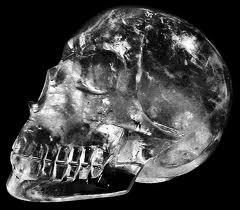
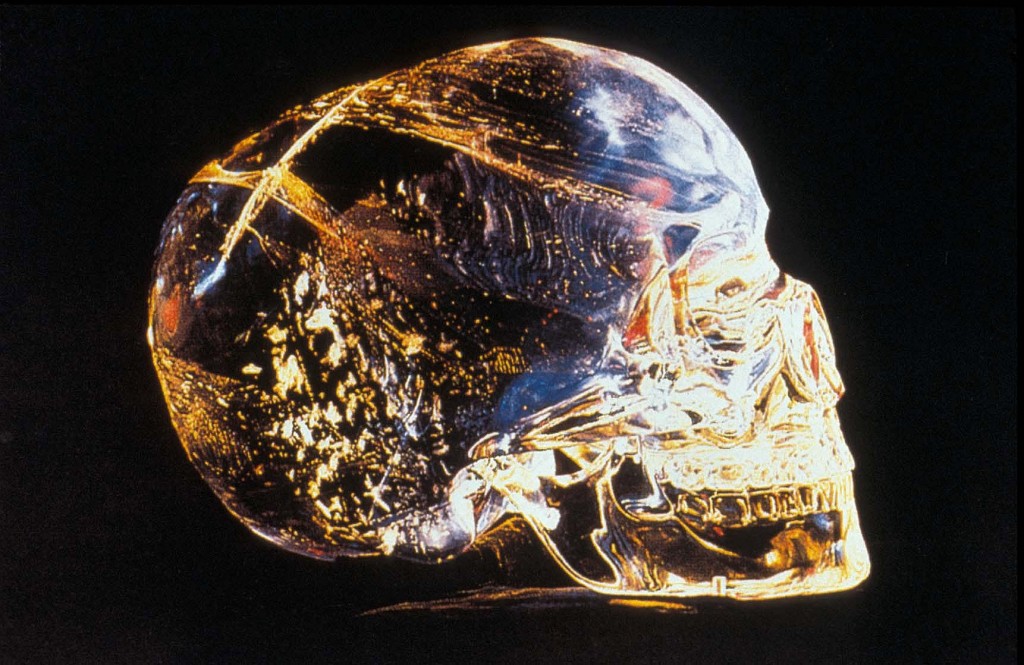
Imagine holding a human skull in your hands. Now, imagine it isn’t bone. It isn’t dry, brittle, or decaying. Instead, it is carved from a single, solid block of crystal. It is heavy. Cold to the touch. And when the light hits it, the eyes seem to ignite with a fire that shouldn’t be there. You are looking at one of the most controversial objects on the planet.
This isn’t just a story about art. It isn’t just about history. This is a rabbit hole that goes straight down into the basement of human belief, ancient technology, and perhaps, the origins of civilization itself.
Welcome to the enigma of the Crystal Skulls.

For decades, these objects have sat at the intersection of serious archaeology and wild conspiracy. Are they leftovers from a high-tech pre-flood society? Are they tools left behind by extraterrestrial visitors? or are they simply the greatest hoax ever pulled on the Victorian world?
Let’s crack this mystery open.
The Legend of the 13: A Prophecy of Doom or Salvation?
There is a whisper that has circulated through spiritual communities for nearly a century. It speaks of a number. Thirteen.
According to legend, there are 13 master crystal skulls hidden across the globe. They are not just statues. They are pieces of a puzzle. The story goes that these skulls were left behind by the Maya, the Aztecs, or perhaps a civilization far older—like the lost citizens of Atlantis or Lemuria.
The prophecy is chilling. It says that one day, when humanity is on the brink of absolute destruction (some say we are there right now), all 13 skulls will be rediscovered. They must be brought together. Reunited.
Why?
Because together, they form a massive library. A computer. A repository of cosmic knowledge. When aligned in the correct formation, they will supposedly activate, releasing ancient wisdom that will either save our species from extinction or transition us into a new golden age of consciousness. It’s a compelling idea. It feels like the plot of a blockbuster movie because it hits on a primal hope: that someone, somewhere, left us a life raft.
But before we get too lost in the stars, we have to look at the hard, cold reality of the stones themselves.
The Impossible Objects: “They Shouldn’t Exist”
Here is where things get weird. Forget the magic for a second. Let’s talk about physics.
The crystal skulls are hardstone carvings. Most are made from clear or milky white quartz. In art history circles, they call this “rock crystal.” It is beautiful. It is also incredibly unforgiving.
Quartz has a hardness of 7 on the Mohs scale. For comparison, a steel pocketknife is usually around a 5 or 6. Diamond is a 10. To cut quartz, you need something harder than quartz. Today, we use diamond-tipped power tools. We use lasers. We use high-speed rotary drills.
But the people who allegedly made these—the pre-Columbian Mesoamericans—didn’t have power tools. They didn’t have steel. They didn’t have lasers.
So, how did they do it?
This is the question that keeps alternative historians awake at night. If you try to chisel quartz, it shatters. It has a molecular structure that grows in a spiral. If you cut “against the grain” (the axis), the whole thing explodes into useless shards.
Yet, the most famous skulls, like the Mitchell-Hedges skull, are carved against the axis. They defy the laws of lapidary work. Hewlett-Packard, the computer giant, reportedly analyzed the Mitchell-Hedges skull in the 1970s. Their conclusion? One researcher allegedly stated, “This thing shouldn’t exist.”
Without modern tools, the only way to create one of these skulls would be to rub it with sand and water. Endlessly. Day after day. For generations. Some estimates suggest it would take 300 years of continuous human labor to polish a single skull using primitive methods. Would an entire lineage of artisans dedicate three centuries to a single head?
Or did they have help? Help from a technology we have forgotten?
The Mainstream Rebuttal: A 19th-Century Con?
While the believers look to the stars, the museums look to the microscope. And what they see is damning.
None of the “celebrity” skulls have ever been authenticated as pre-Columbian in origin. Not one. When scientists take these artifacts into the lab, the magic starts to fade, and a different kind of mystery emerges—a mystery of fraud.
Studies conducted by the British Museum and the Smithsonian have been brutal. They looked at the tool marks. Under high-powered electron microscopes, they found perfectly straight, parallel lines. These are the tell-tale scratches left by rotary wheels. They found traces of carborundum (silicon carbide), a modern abrasive that wasn’t synthesized until the late 1800s.
The results suggest that nearly all the famous skulls were manufactured in Europe, likely Germany, between 1867 and 1886. This was a time when wealthy Victorians were obsessed with the “exotic” ancient world. They wanted artifacts. They wanted mystery. And the market provided it.
Despite claims in popular books, legends of crystal skulls with mystical powers do not actually appear in genuine Mesoamerican or Native American mythologies. The Aztecs loved skulls, yes. They carved them on stone walls. They wore them as jewelry. But clear quartz skulls that function as computers? That appears to be a modern invention.
Paranormal Activity: When the Stone Speaks
Science says they are fakes. But try telling that to the people who have stood in front of them.
The skulls are often claimed to exhibit paranormal phenomena that science cannot explain. We aren’t talking about vague feelings. We are talking about physical manifestations.
Witnesses report the skulls changing color. Some say a soft, blue mist forms inside the cranial cavity. Others claim to hear voices—a high-pitched choir or a deep, resonant hum—emanating from the stone itself.
This isn’t just one or two crazy people. It’s thousands. Even hardened skeptics have reported feeling a strange “charge” in the air when near the skulls, like the static electricity before a lightning strike.
Crystal skulls are not uncommon. Thousands are produced every year in Brazil, China, and Germany for the “New Age” market. You can buy one on eBay right now for twenty bucks. But those are just carved rocks. They are inert.
The mystery lies with the handful of “ancient” ones. The macabre objects that have fueled intense interest and controversy among archaeologists, scientists, spiritualists, and museum officials for more than a century.
There are perhaps a dozen of these rare crystal skulls in private and public collections. Some are crystal clear, others of smoky or colored quartz. Some are actual human size and of very fine detail, while others are smaller and less refined. All are believed to originate from Mexico and Central America, regardless of what the microscope says.
The Atlantis Connection
Many believe these skulls were carved thousands or even tens of thousands of years ago. The timeline doesn’t fit the Aztecs? Fine. Then go back further.
One popular theory suggests they are relics from the legendary island of Atlantis. When the continent sank, the high priests scattered the wisdom of their people across the globe, locking the data inside these quartz vessels. Others think they are proof that extraterrestrials visited the Aztec sometime before the Spanish conquest, gifting them these “communicators.”
Supernatural Fascination
Stories about the skulls focus heavily on their perceived supernatural powers. It’s not just about what they are, but what they do.
Joshua Shapiro, coauthor of Mysteries of the Crystal Skulls Revealed, has spent his life chasing this phenomenon. On his website, he cites claims of miraculous healings. People with chronic illnesses touch the skull and are cured. Others report expanded psychic abilities—suddenly being able to see auras or predict the future after being in the presence of the artifacts.
“We believe the Crystal Skulls are a form of computer which are able to record energy and vibration that occur around them,” he writes. ” The skull will pictorially replay all events or images of the people who have come into contact with them (i.e. they contain the history of our world).”
The Silicon Hypothesis
Is Shapiro crazy? Maybe not. Think about the device you are reading this on right now. Your phone. Your laptop. What is the brain of that computer made of?
Silicon.
And what is quartz? Silicon dioxide. We use quartz crystals in watches to keep perfect time. We use silicon chips to store the entire sum of human knowledge. Is it really such a stretch to imagine that an advanced ancient culture figured out how to use quartz for data storage long before we did?
Perhaps the skulls aren’t statues. Perhaps they are hard drives. And we just haven’t figured out how to plug them in yet.
Most archaeologists and scientists are skeptical, to say the least. They prefer the dirt and the pottery shards.
Skulls were prominent in ancient Mesoamerican artwork, particularly among the Aztec, so the connection between these artifacts and these civilizations is apt. It makes sense visually.
“[I]t was a symbol of regeneration,” says Michael Smith, a professor of anthropology at Arizona State University. “There were several Aztec gods that were represented by skulls, so they were probably invoking these gods. I don’t think they were supposed to have specific powers or anything like that.”
The Man Who Sold the World: Eugene Boban
If the skulls are fake, who made them? All roads lead to one man.
Eugene Boban. A French antiquities dealer in the late 19th century. He was a colorful character—part historian, part con artist. He spent years in Mexico and later opened a shop in Paris. He is the man responsible for the appearance of several of the most famous skulls in museum collections today.
All Fakes?
Boban had a problem. He had wealthy clients who wanted “unique” Aztec artifacts. But there weren’t enough to go around. Historians suspect Boban commissioned the skulls in Germany, where the lapidary industry was booming, and then shipped them to Mexico just so he could “find” them there and bring them back to Europe.
In addition, recent electron microscope analyses of skulls by the British Museum and the Smithsonian Institution revealed markings that could only have been made with modern carving implements. Both museums estimate that their skulls date to sometime in the mid- to late 1800s, a time when public interest in ancient cultures was high and museums were eager for pieces to display.
Its examinations and the fact that no such skull has ever been uncovered at an official archaeological excavation led the British Museum to extrapolate that all of the famed crystal skulls are likely fakes.
But here is the catch.
Even if Boban faked some, did he fake them all? The “Mitchell-Hedges” skull, arguably the most perfect one, has a backstory that doesn’t involve Boban at all. It was supposedly found by a young girl, Anna Mitchell-Hedges, under a collapsed altar in Lubaantun, Belize, in the 1920s. She spent her entire life guarding it. She refused to sell it. She claimed it had a consciousness.
Skeptics say her father bought it at an auction in London (Sotheby’s, 1943) and made up the story. But why would he? And why does that skull possess optical properties that even modern scientists struggle to replicate?
The Mystery Endures
There is passion on both sides of the issue. The skeptics have their microscopes and their records of French fraudsters. The believers have their personal experiences, the unexplainable visions, and the undeniable weirdness of the stones themselves.
The fact remains that no one knows for sure who made these skulls and when. Carbon dating works on organic matter—bone, wood, cloth. You cannot carbon date a rock. A piece of quartz is as old as the Earth itself. You can only date the cut, and even that is an imperfect science.
And since there is currently no way to accurately determine the age of such inorganic objects, the mystery will likely continue. In fact, it’s sure to get a boost every time Hollywood decides to revisit the idea, like in 2008 with the release of the action-adventure sequel Indiana Jones and the Kingdom of the Crystal Skull.

So, the next time you see a picture of those hollow eyes, ask yourself: Are you looking at a 19th-century paperweight? Or are you staring into the face of a god that is just waiting for us to figure out the password?
Originally posted 2016-02-01 20:06:11. Republished by Blog Post Promoter