Home Films & Documentaries Da Vinci The Lost Treasure – Documentary

Da Vinci The Lost Treasure – Documentary

0
63

The Da Vinci Deception: Was The World’s Greatest Genius Hiding History’s Biggest Secret?

Let’s get one thing straight. The story they tell you about Leonardo da Vinci is a fairy tale. A nice, neat, comfortable little story for the history books.

They tell you he was a painter. A genius, sure. The quintessential Renaissance Man. They point to a handful of paintings—masterpieces, no doubt—and they build a legend around them. They talk about his brilliant mind, his anatomical sketches, his curious inventions.

But it’s a story with holes. Big ones. Holes so large you could fly one of his ornithopters right through them.

Because Leonardo wasn’t just a painter. He was a puzzle maker. A cryptographer. And his true work wasn’t on canvas or in a sketchbook. It was a secret. A secret he embedded in everything he touched, a breadcrumb trail for the ages. A secret that, if revealed, could completely rewrite human history. They want you to see the artist. They don’t want you to see the Grand Master of a secret order, the guardian of a forbidden truth.

So, forget the sanitized museum tours. Forget the dry art history lectures. We’re going behind the canvas, into the shadows where the real story lives.

The Man They Show You

Who was he, really? Born in 1452. The illegitimate son of a notary. He showed immense talent from a young age, apprenticed to the great artist Verrocchio in Florence. So far, so good. The official record paints him as a polymath, a man whose curiosity knew no bounds. He studied anatomy by dissecting corpses, filled thousands of pages with mirrored script, and designed war machines for powerful patrons.

9505462

And of course, he painted. The Mona Lisa. The Last Supper. Works that have mesmerized the world for five centuries. The establishment holds these up as the pinnacle of his achievement. They are wrong. These paintings aren’t just art. They are lockboxes. And we’re about to start picking the locks.

Cracking the Code in the Canvas

If you want to understand Leonardo’s real mission, you have to look closer. You have to ignore the guidebooks and use your own eyes. His most famous works are not celebrations of faith or portraits of Florentine merchants’ wives. They are messages in a bottle, thrown into the ocean of time.

What is Mona Lisa Really Smiling About?

The Louvre. Millions of people every year push and shove to get a glimpse of her. The world’s most famous painting. But what are they actually looking at?

A simple portrait? Please.

That enigmatic smile has been debated for centuries. Is she happy? Sad? Mocking? The answer is none of the above. The smile is a distraction. A piece of brilliant misdirection to keep you from looking at the real clues.

For years, researchers have pointed out the strange, almost androgynous features of the subject. The lack of eyebrows. The strong jawline. When you overlay the Mona Lisa with Leonardo’s famous self-portrait, the facial structures align with a terrifying precision. Was Leonardo painting a woman at all? Or was he painting himself, embodying a Gnostic principle of the sacred union between male and female? A concept the Church would have considered pure heresy.

But the modern hunt has gone digital. High-resolution scans of the painting, analyzed by internet sleuths and art historians, have supposedly found something unbelievable. Tiny letters, almost invisible to the naked eye, painted into her pupils. An ‘L’ and a ‘V’ in the right eye. In the left, letters that are harder to make out, perhaps ‘C’ and ‘E’. His own initials, LV, for Leonardo da Vinci? Or something else entirely?

And then there’s the background. That bizarre, alien-looking landscape that doesn’t match on the left and right sides. Art historians say it’s an idealized landscape. But why doesn’t it line up? The horizon lines are mismatched. It’s a geological impossibility. Unless… it’s not a landscape. Unless it’s a map. A coded message pointing to a specific location, disguised as a backdrop to the world’s most famous portrait. A place of immense importance.

The Last Supper’s Unholy Secret

If the Mona Lisa is a coded map, then The Last Supper is a direct statement. A defiant, dangerous declaration hidden in plain sight on a monastery wall in Milan.

Look at the painting. Jesus has just announced that one of his disciples will betray him. Chaos erupts. But look closer. Look at the figure to Jesus’s right.

For centuries, we’ve been told this is the apostle John, the “beloved disciple.” But the figure is incredibly feminine. Flowing red hair, delicate features, hands clasped demurely. There is no beard. This isn’t John. This, the theory proposes, is Mary Magdalene.

Why would Leonardo place Mary Magdalene in the seat of honor next to Jesus? And notice the space between them. It forms a perfect ‘V’ shape. A symbol for the divine feminine, the chalice, the Holy Grail itself. Not a cup, but a person. A bloodline. Now, look at their clothes. They are mirror images of each other. Where Jesus wears red with a blue cloak, “John” wears blue with a red cloak. A symbol of a union. A marriage.

The message is staggering. Leonardo was painting the forbidden truth: that Jesus was married to Mary Magdalene, and that they had a child. A bloodline that continued in secret, protected for generations. A truth the Catholic Church would have done anything to extinguish.

Think it’s a stretch? What about the hand? Look just to the right of the center. A disembodied hand, belonging to no one in particular, juts into the scene holding a dagger. Whose hand is it? It seems to emerge from behind Peter, who is leaning aggressively toward Mary. Is it a threat? A warning? A symbol of the betrayal that was not just of Jesus, but of Mary and the sacred feminine itself?

It gets stranger. Italian musician Giovanni Maria Pala discovered that if you map the positions of the bread rolls on the table and the apostles’ hands, they correspond to notes on a musical staff. When played, they form a somber, haunting 40-second melody. A requiem. A coded funeral dirge hidden within the painting. A soundtrack to a secret.

The Grand Conspiracy: A Secret Society and a Hidden Tomb

So, if Leonardo was embedding these heretical codes into his art, who was he doing it for? Was he a lone wolf, a genius playing a dangerous game with the Church? Or was he part of something bigger? Something ancient and organized.

This is where things spiral out of the art gallery and into the shadowy world of secret societies. Many researchers believe Leonardo da Vinci was a high-ranking member, perhaps even a Grand Master, of an organization called the Priory of Sion. A secret order whose sole purpose was to protect the bloodline of Jesus and Mary Magdalene, and to safeguard the documents that proved their union – the so-called “Sangreal,” or Holy Grail documents.

This theory, which exploded into the mainstream, connects Leonardo to a long line of supposed Grand Masters, including Isaac Newton and Victor Hugo. And it connects his art to other mysterious works.

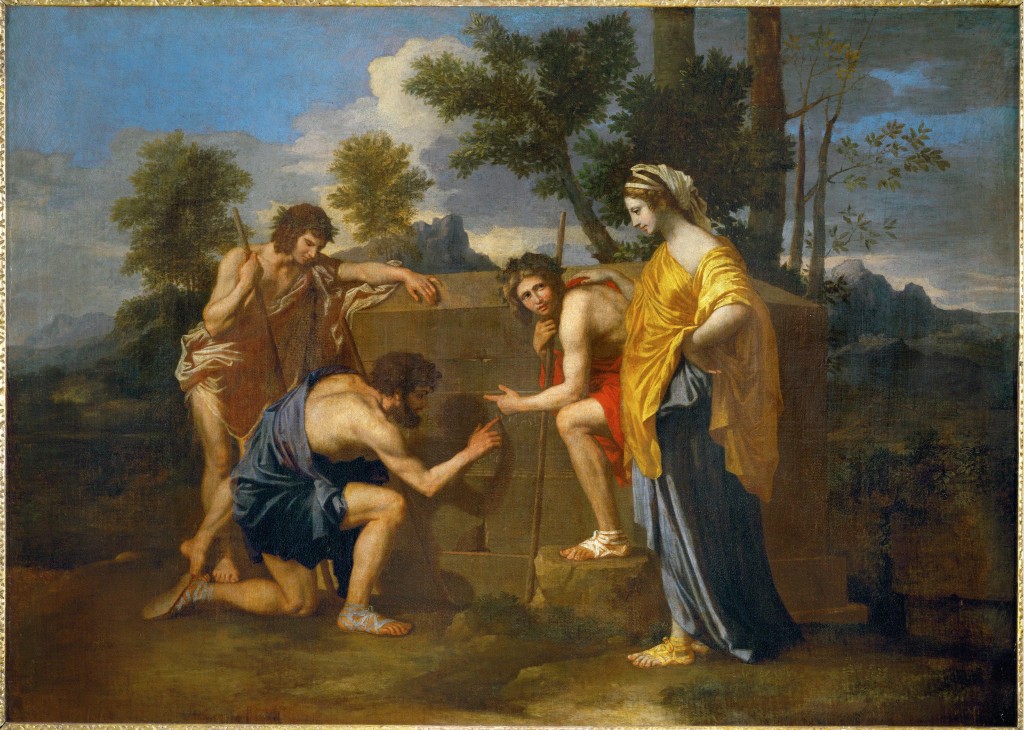
Nicolas_Poussin_-_Et_in_Arcadia_ego_(deuxième_version)

“Et in Arcadia Ego”: The Shepherd’s Secret

Look at this painting by Nicolas Poussin, another alleged member of the secret brotherhood. It’s called “Les Bergers d’Arcadie,” or The Shepherds of Arcadia. It depicts shepherds gathered around a tomb, spelling out an inscription: “Et in Arcadia Ego.”

On the surface, it’s a memento mori, a reminder of death. The phrase is usually translated as “Even in Arcadia (paradise), I (death) exist.” But what if that’s not the true meaning? What if it’s an anagram? A code.

Conspiracy researchers have rearranged the letters to form the phrase “I! TEGO ARCANA DEI.”

“Begone! I conceal the secrets of God.”

A message on a tomb. A tomb that Poussin was allegedly painting from a real location in the south of France, near the mysterious village of Rennes-le-Château—a hotbed of Holy Grail and Templar conspiracy theories. Was Poussin, like Leonardo, using his art to point to a physical place? A place where a secret was buried? Perhaps the very tomb of Mary Magdalene?

This is the web Leonardo was a part of. A network of artists, scientists, and thinkers, passing down a forbidden knowledge through the centuries, using art as their uncrackable codebook.

The Inventor from Another Time

If the codes in his art weren’t enough to make you question the official story, then open his notebooks. The thousands of pages of mirrored script are filled with inventions so far beyond his time they defy logical explanation.

We’re talking about a detailed design for an armored fighting vehicle—a primitive tank—400 years before it was ever built. We’re talking about a helicopter, or “aerial screw,” centuries before the principles of flight were understood. He designed scuba gear, a parachute, a giant crossbow, a calculator, and even a robot. A robotic knight that was allegedly built and could sit, stand, and move its arms.

How? How did one man, in the 15th and 16th centuries, conceive of technologies that would not become reality for hundreds of years? Was his brain just that advanced? A once-in-a-millennium fluke of evolution?

Or was he getting information from somewhere else?

This is where the theories go from historical conspiracy to something far more mind-bending. Was Leonardo a time traveler, bringing back future knowledge to his own time? Or, even more startling, was he in contact with a non-human intelligence? An ancient, hidden source of knowledge that the Priory of Sion was guarding? It sounds like science fiction. But look at the evidence. How do you explain a 15th-century tank?

You can’t. Not with the conventional story.

The Echo in Pop Culture: Distraction or Disclosure?

Fast forward to our time. This story, these secrets, they refuse to stay buried. They bubble up in books, documentaries, and even movies. The most famous, of course, was Dan Brown’s *The Da Vinci Code*, which took these very theories and turned them into a global phenomenon.

And when a phenomenon that big hits, the parasites aren’t far behind.

In 2006, a direct-to-video film called The Da Vinci Treasure was released by The Asylum, a studio famous for its “mockbusters.” It was a cheap knock-off designed to ride the coattails of the Hollywood blockbuster. A silly, forgettable movie.

Or was it?

Think about it. In the world of secrets and disinformation, what’s the best way to discredit a powerful truth? You mock it. You flood the zone with cheap imitations and silly versions until the original idea seems just as ridiculous. Is it a coincidence that as soon as these theories gained real traction, a wave of low-budget knock-offs appeared to make the whole subject feel like a joke?

It’s a classic disinformation tactic. Muddy the waters. Make the truth-seekers look like fools who can’t tell the difference between a serious investigation and a B-movie. They want you to lump the genuine codes in Leonardo’s art with the fictional plots of films like The Da Vinci Treasure. It’s a clever way to keep people from digging.

The Search Continues

The story of Leonardo da Vinci is not over. It’s a living mystery. Just a few years ago, a “new” Leonardo, a painting called *Salvator Mundi*, appeared on the art market. It sold for a staggering $450 million, becoming the most expensive painting in history, before disappearing into the private collection of a Saudi prince amid raging debates over its authenticity. Was it real? A fake? Or another piece of the puzzle, placed into the world to create a stir?

So, who was he? A simple artist? A heretic? A time traveler? The guardian of God’s greatest secret?

The answer isn’t in a museum. It’s in the shadows, between the brushstrokes, in the anagrams and the impossible inventions. Leonardo left the door cracked open, just a little. He left a trail for those brave enough to follow it. The official story is the frame. But the real masterpiece is the deception itself.

Originally posted 2016-02-18 20:29:09. Republished by Blog Post Promoter