Beyond the Great Wall: China’s Secret Conquest of the Stars
Forget everything you think you know about the space race. We all know the story, right? America versus Russia. Capitalism versus Communism. A high-stakes cosmic duel played out for the world on grainy television sets. But while the eagle and the bear were clawing at each other for orbital supremacy, a third power was moving in the shadows. Silently. Patiently.
A dragon was stirring.
Today, China’s space program is a titan. They’ve landed on the far side of the moon, built their own space station, and are planning missions to Mars and beyond. They moved with shocking speed. Too fast, some might say. It’s almost as if they had a head start. Or a helping hand.
The official history is a neat, tidy timeline of glorious achievements. But peel back the layers of state-sponsored propaganda, and you find a story riddled with strange events, suspicious timing, and unanswered questions. Is the China National Space Administration just another scientific body? Or is it the public face of a secret, decades-long mission to not just explore space, but to control it?
The answers are out there. And they are far more shocking than you can imagine.
The Ghost in the Machine: Did America Accidentally Build China’s Space Program?
Our story doesn’t begin in China. It begins in Pasadena, California, in the heart of America’s rocket development program.
The year is 1955. The man is Qian Xuesen. You’ve probably never heard of him, but he was a certified genius. A co-founder of the Jet Propulsion Laboratory (JPL), a man so brilliant that the US Undersecretary of the Navy called him “one of the most outstanding minds in the country.” He held the highest-level security clearance and knew virtually all of America’s missile secrets. He was the key to America’s future in space.
Then, the Red Scare happened.
Suddenly, this titan of rocketry was accused of being a Communist. His security clearance was stripped. He was placed under house arrest for five years. Finally, in a decision that military officials would later call one of the dumbest in American history, Qian Xuesen was deported. He was traded for a handful of American pilots shot down in the Korean War.
Think about that. The United States government, in a fit of paranoia, took the man who held the blueprints to the stars in his head and gift-wrapped him for Mao Zedong’s China. He arrived home a hero and was immediately put in charge of building China’s ballistic missile and space program from scratch.
Was it just a colossal blunder? Or was something else going on? Internet forums have buzzed for years about the possibility that Qian was a deep-cover agent all along, playing a long game that would end with China’s rise. A ghost in America’s own machine. Whatever the truth, the result is undeniable. America’s paranoia became China’s launchpad.
Deep Dive: The Sound of Red Propaganda
Fifteen years after Qian’s return, the world heard the result. On April 24, 1970, China launched its first satellite, Dongfanghong 1. It was heavier than the first satellites of America, Russia, Britain, and France combined. It was a statement.
But it wasn’t just a silent chunk of metal. For 26 days, it circled the globe, broadcasting a single, tinny song for anyone with a shortwave radio to hear: “The East is Red.” It was the ultimate act of propaganda. A revolutionary anthem beamed down from the heavens, declaring to the entire planet that a new player had entered the game. The dragon had roared for the first time, not with fire, but with sound.
The Silent Decades and Whispers of Failure
After the loud debut of Dongfanghong 1, an eerie quiet fell over the Chinese program. The official timelines you see online often jump from the early 70s straight to the late 90s, as if two decades of nothing happened. But nothing could be further from the truth.
This was China’s “silent decade,” a period of intense, secret development. And brutal failures.
Have you ever heard of Project 714? Probably not. It was China’s first attempt at a manned space program in the 1970s. The goal was to put two “taikonauts” into space by 1973 in a craft called the Shuguang-1, or “Dawn.” Astronauts were selected. Training began. Then… nothing. The project was canceled, and all records were buried deep in state archives.
Why? The official line is “economic and political turmoil.” But is that the whole story? Rumors persist of catastrophic launch failures. Of rockets exploding on the pad. Of taikonauts who were erased from history. We see the successes, but the failures are scrubbed from the record, leaving a sanitized version of history. How many secret disasters paved the way for their later triumphs?
Then there’s the 1975 mission. China launched its first recoverable satellite. The stated purpose? To collect data on “extra-terrestrial objects.” A vague description, isn’t it? What was it really looking at? In the midst of the Cold War, a satellite that can be brought back to Earth is the perfect spy tool. It was almost certainly a military reconnaissance bird, its camera pointed not up at the stars, but down at Soviet military bases and American naval fleets. The Long March into space had begun, but its first steps were those of a spy.

The Dragon Awakens: The “Divine Vessel” and the Knocking in Space
By the turn of the millennium, the silence was over. The dragon had fully awoken. The Shenzhou program, which translates to “Divine Vessel,” began. Think about that name. Not scientific. Not technical. Divine. It speaks to a sense of destiny, an almost religious belief in their right to conquer the heavens.
After a series of unmanned test flights, the moment arrived. On October 15, 2003, Yang Liwei, a former fighter pilot, was strapped into the Shenzhou 5 capsule and blasted into orbit. He became the first Chinese citizen in space, a national icon overnight. His mission was a flawless success. At least, that’s the official story.
But years later, Yang Liwei revealed something strange. Something unsettling. In an interview, he described a sound he heard while in orbit. A persistent, rhythmic knocking.
He described it as “someone knocking the body of the spaceship just as knocking an iron bucket with a wooden hammer.” He grew nervous. He checked his instruments. Nothing. He peered out the porthole, but could see nothing. The sound appeared without cause and disappeared without a trace.
The official explanation? The mundane sound of the capsule’s inner pressure changing and causing the spacecraft’s shell to slightly deform. Plausible, sure. But other taikonauts on later Shenzhou missions reported hearing the exact same sound. The theory that has lit up corners of the internet is far more chilling: was something out there? Was something, or someone, trying to get in? Or perhaps just… saying hello?
This wasn’t just a joyride. The Shenzhou missions were methodically building China’s capabilities. A few years later, in 2008, Zhai Zhigang performed China’s first spacewalk from Shenzhou 7. As he floated in the void, waving a Chinese flag, the world saw a beautiful moment of human achievement. The Pentagon saw something else. They saw a nation that could now maneuver its people in space. A nation that could repair its own satellites. A nation that could, if it chose, attack another nation’s satellites.
The spacewalk wasn’t a scientific experiment. It was a demonstration of military power.
The Lunar Enigma: Why is China Obsessed with the Moon’s Far Side?
For decades, the Moon was America’s trophy. We planted the flag, collected the rocks, and basically declared victory. But China never saw it that way. To them, the Moon isn’t a museum piece. It’s the future.
Their lunar exploration program is named “Chang’e,” after the ancient Chinese goddess of the Moon. Again, notice the mythology, the sense of destiny. The first probes mapped the surface with a precision never seen before. They were looking for something. But what?
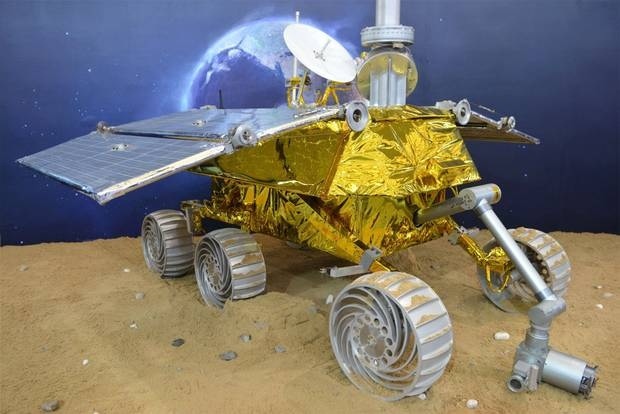
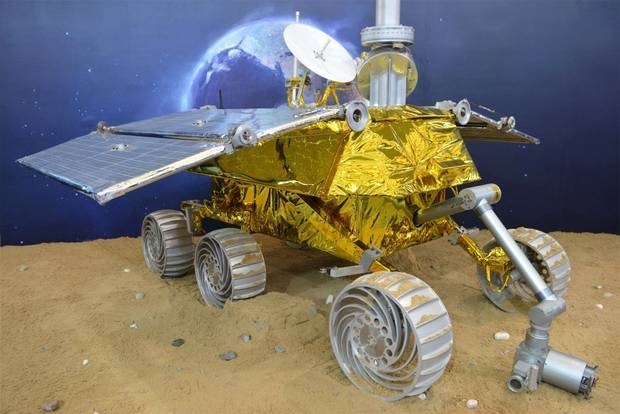
Then they did the impossible. On January 3, 2019, the Chang’e 4 lander and its Yutu-2 (“Jade Rabbit”) rover touched down on the far side of the moon. The side that permanently faces away from Earth. No nation had ever done this before. Ever.
Why there? Why go to all the extra trouble of communicating via a relay satellite, of landing in uncharted, treacherous territory? The official reason is science. The far side is free from Earth’s radio interference, making it perfect for astronomy. A neat and tidy answer.
But the real reason might be far more strategic. The far side of the moon is the ultimate hiding place. A base built there would be completely shielded from Earth’s prying eyes and spy satellites. You could build anything there, and no one would know until it was too late.
Deep Dive: The “Gel-Like Substance” and the Whispers of Discovery
Things got even weirder. During its exploration, the Yutu-2 rover stumbled upon something that baffled scientists. A strange, “gel-like substance” with an “unusual color” discovered in a small crater. The discovery made headlines worldwide. What was it?
The official Chinese explanation, released much later, was “impact melt breccia.” Basically, rocks melted together by a meteor impact. Case closed. Move along.
But the story doesn’t sit right with many. The initial excitement from the Chinese science team seemed far too high for it to be just a weird-looking rock. Online researchers and conspiracy forums exploded with theories. Was it evidence of water? Some kind of non-terrestrial biological material? The wreckage of something not of this world? By landing on the far side, a place untouched by American or Soviet probes, had China found the one thing everyone else had missed?
They are searching for resources, yes. Helium-3, a potential fuel for clean nuclear fusion, is abundant on the moon. But they are also searching for answers. Maybe even for contact. By going to the silent, dark side, they are ensuring that if they find something, they are the only ones who know.
The Heavenly Palace: A New Gatekeeper in the Sky
While America’s attention was elsewhere, China was building a palace in the sky. Their space station program, named Tiangong, or “Heavenly Palace,” began with prototype modules launched in 2011 and 2016.
These were just practice runs. The real deal, the massive, multi-module Tiangong space station, is now fully operational in orbit. It is brand new, state-of-the-art, and entirely Chinese.
Now, consider this. The International Space Station, that symbol of global cooperation, is aging. It’s creaking. It’s set to be deorbited and crashed into the ocean around 2030. When that happens, there will be only one station orbiting the Earth. China’s.
Think of the power that gives them. Every nation that wants to conduct experiments in space, every astronaut from Europe, Russia, or even the United States who wants to fly, may have to ask Beijing for permission. China will become the gatekeeper to low-Earth orbit.
But is its purpose purely scientific? A “palace” can also be a fortress. A command post. Its high-resolution cameras can watch troop movements, its sensors can detect missile launches, and its robotic arms, designed for “maintenance,” could just as easily be used to grab or disable other satellites. It’s a perfect military high ground, a panopticon in the sky, watching the entire world.
The Final Frontier… or the Next Battlefield?
From a single, propaganda-blaring satellite to a permanent palace in the heavens. From a reverse-engineered rocket to a rover on the hidden face of the moon. China’s Long March into space has been a masterclass in patience, secrecy, and relentless ambition.
They learned from the West’s successes and its failures. They waited. They planned. And now, they are poised to lead.
The questions we must ask are no longer about if they can do it, but why. Are they truly just explorers, driven by the same curiosity that drove humanity for centuries? Or are we witnessing the first steps of a cosmic conquest?
The official narrative is one of peaceful exploration for all mankind. But the names—Divine Vessel, Heavenly Palace—and the obsession with strategic locations like the lunar far side, hint at a different, more ancient ambition. The ambition of emperors. The desire to build a new Great Wall, not of stone and earth, but of orbits and technology, enclosing the final frontier for themselves.
The silent dragon has left Earth’s atmosphere. It now soars among the planets. The real mystery is no longer how it got there. The mystery is what it plans to do next.