Home Weird World Space China lands rover on the moon

China lands rover on the moon

0
62

The 37-Year Silence: Why China’s Jade Rabbit Really Went to the Moon

For thirty-seven years, the Moon was a ghost town. Think about that. An entire generation was born, lived, and grew up without humanity setting a single new foot—or wheel—on the lunar surface. The chaotic, world-uniting frenzy of the Apollo missions faded into grainy documentary footage. The Soviets sent their last robotic probe, Luna 24, to snatch a bit of dust in 1976 and then… nothing. Silence.

A profound, deafening silence from the one place that had captured our collective imagination like nothing else in history. The official story? We got bored. It was too expensive. The political will just wasn’t there. We’d “won” the space race, planted the flag, and moved on.

But what if that’s a lie?

What if the silence wasn’t about budgets or boredom? What if it was about fear? What if the first wave of explorers, both American and Soviet, found something up there? Something that made the world’s superpowers quietly agree to declare our nearest celestial neighbor off-limits. A secret quarantine.

And then, on December 14th, 2013, someone kicked the door open. China landed its Chang’e 3 probe and its now-legendary Yutu rover on the Moon. After nearly four decades of cosmic silence, a new player had arrived on the scene, and they weren’t asking for permission. They weren’t just planting a flag for pride. They were looking for something.

The history books will tell you it was a glorious technological achievement. A nation staking its claim as a space-faring power. But dig a little deeper, connect the dots, and a far more chilling picture emerges. This wasn’t just a mission. It was an investigation.

A Dragon Awakens: The Official Story

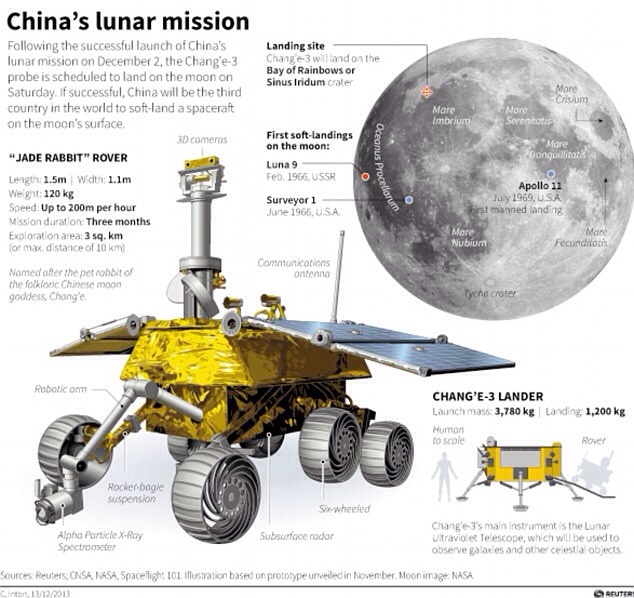
On the surface, the narrative was flawless, a masterclass in state-run PR. The China National Space Administration (CNSA) executed a picture-perfect landing. At around 8:11 a.m. EST, the Chang’e 3 lander, a marvel of engineering, fired its thrusters for a nail-biting 12-minute descent. It wasn’t a clumsy crash. It was a “soft landing.” Controlled. Precise. Gentle.

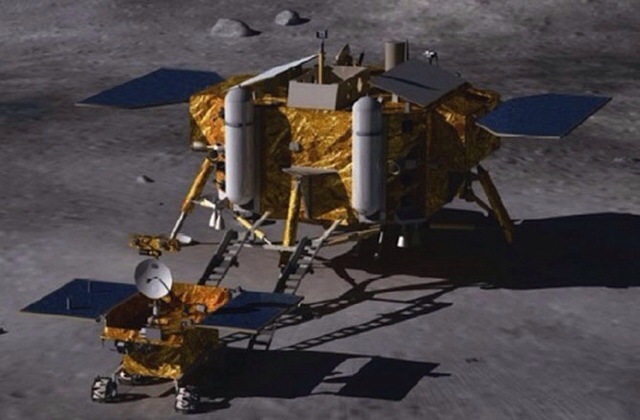
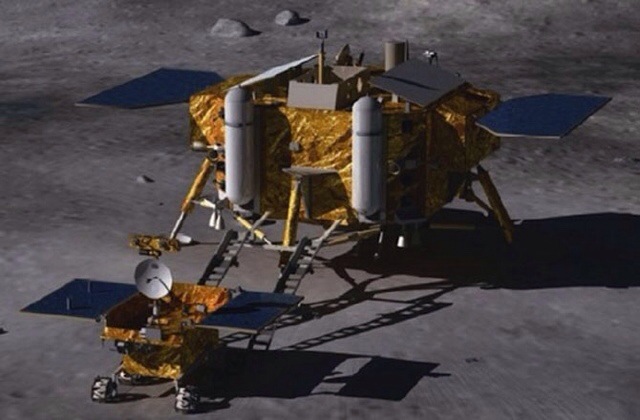
It settled on the dusty plains of Sinus Iridum. The Bay of Rainbows. Sounds poetic, doesn’t it? It’s a vast, flat, lava-flooded crater, chosen, they said, for its smooth terrain and lack of previous exploration. The perfect spot for a test drive. Shortly after touching down, the lander’s solar arrays unfolded like metallic wings, soaking up the unfiltered sunlight. The mission was on.

20131214-220501.webp

Then came the star of the show. A six-wheeled, 310-pound robotic explorer rolled down a ramp and onto the grey soil. Its name was Yutu, or “Jade Rabbit,” a name pulled directly from ancient Chinese folklore. The legend tells of a loyal rabbit who lives on the Moon as a companion to the Moon goddess, Chang’e. A charming, culturally significant name. Or was it a signal? A message that they knew the old stories were more than just myths?

Yutu was a beast. It was designed to trundle across the lunar surface for months, packed with high-tech gear. It had cameras to see, an alpha particle X-ray spectrometer to analyze the chemical composition of rocks, and most intriguingly, a Ground-Penetrating Radar (GPR) capable of seeing up to 100 meters beneath the surface. They told the world it was for geological surveys. To map the layers of ancient volcanic rock.

But a tool that can map rock layers can also map something else. It can map structures. Voids. Things that aren’t natural. Things that might be buried.

Deep Dive: Why the Bay of Rainbows?

Let’s talk about real estate. When you’re sending a billion-dollar robot 238,900 miles from home, you don’t pick a landing spot by throwing a dart at a map. Every square inch is scrutinized. So why Sinus Iridum?

The official line is that it was a large, flat, and geologically interesting area that hadn’t been visited by the Apollo or Luna missions. Safe. Unexplored. Scientific. It sounds reasonable, right?

But whispers on internet forums and among amateur satellite analysts for years had pointed to strange anomalies in that very region. Fleeting shadows that didn’t match known craters. Puzzlingly regular, almost geometric patterns of rock formations that looked just a little too unnatural. Most of it was dismissed as pixelation or tricks of light and shadow. Classic pareidolia. But China has access to high-resolution orbital maps we can only dream of. Did they see something in those classified maps? Was the “safe and flat” landing zone just a convenient cover for getting close to something far more interesting?

Think about it. You don’t send a rover with ground-penetrating radar to a “boring” spot. You send it where you suspect something is hidden beneath the dust of ages.

The Jade Rabbit’s Secret Hunt

The Yutu rover began its slow, careful journey across the lunar landscape. It sent back stunning, high-definition images. Crystal clear panoramas of a dead, silent world. The CNSA was surprisingly open with the data at first, releasing images that sent a fresh wave of moon-fever across the globe. But what was the rover’s *real* priority?

The GPR Anomaly

The rover’s ground-penetrating radar was its most potent secret weapon. Officially, it revealed nine distinct layers of ancient lava flows beneath the surface, a fascinating glimpse into the Moon’s volcanic past. This was hailed as a major scientific discovery. But what about the data they *didn’t* release? GPR data is complex. It can show voids, metallic signatures, and sharp, geometric angles that scream “artificial.”

Online researchers have claimed that faint, redacted sections of the initial data releases hint at something strange deep below the ninth layer of basalt. A pocket. A void. Something that didn’t fit the geological models. Was this the real target? A buried structure? The entrance to a sub-surface lunar base, protected from the harsh radiation and micrometeorites on the surface?

“Unusual” Rocks and a Strange Discovery

One of the rover’s last major tasks before it ran into trouble was to analyze a specific rock formation. The official announcement was that Yutu had discovered a new type of basalt, compositionally different from anything the Apollo astronauts brought back. Again, a scientific win. But for those reading between the lines, the term “new type of rock” is a tantalizing breadcrumb.

What does that actually mean? Was it a rock with an isotope ratio that shouldn’t exist? A mineral composition that hinted at being artificially manufactured or processed? We’ve only ever been shown the sanitized, peer-reviewed version of the findings. The raw, unfiltered data from the spectrometer remains a closely guarded secret of the Chinese space program. Some insiders have hinted that the rock wasn’t just “new,” it was “anomalous.”

A Sudden, Suspicious End

And then, just as the mission was getting interesting, it all went wrong. Horribly, suspiciously wrong. Before entering its second lunar night—a brutal, two-week period of absolute darkness and cryogenic temperatures—the Yutu rover experienced a “mechanical control abnormality.” The official explanation was that the mast, which held the solar panels and needed to be folded down to protect the rover’s electronics, failed to retract properly. This left the delicate internal workings exposed to the savage cold.

When the sun rose again two weeks later, Yutu was silent. It was crippled. It never moved again.

20131214-221217.webp

The world mourned the little rover. Its official social media account, written in a charming first-person, posted a final, poignant “goodnight.” It was a touching story of a heroic robot succumbing to the harsh lunar environment.

Or was it?

The timing is just too convenient. The rover functions perfectly through its first lunar day and night. It performs its GPR scans, analyzes its “unusual” rock, and then, right before it’s set to explore further, it suffers a catastrophic, mission-ending failure? It’s a pattern we’ve seen before with probes that get too close to the truth on other worlds.

Was it just a mechanical failure? Or did the Jade Rabbit see something it shouldn’t have? Did it get too close to an energy source that fried its circuits? Was the “mechanical abnormality” not a random accident, but a deliberate shutdown? A kill switch flipped by its masters back in Beijing to prevent it from broadcasting something paradigm-shattering to the world? Or worse… was it disabled by someone—or something—already on the Moon?

The Path to the Far Side: What This Was *Really* About

Here’s where the puzzle pieces snap into place. The Chang’e 3 mission was never the endgame. It was a dress rehearsal. A test. A scouting mission for the real prize: the Far Side of the Moon.

The “dark side” of the moon, which is a misnomer—it gets just as much sunlight, we just never see it from Earth. It is permanently shielded from our planet’s radio chatter, making it the most radio-quiet place in the inner solar system. The perfect place for a secret to hide. For decades, conspiracy theorists have claimed that alien bases, crashed ships, and ancient cities are hidden on the lunar far side, safe from our prying eyes.

China used the lessons from Chang’e 3 and the crippled Yutu rover to build its successor, Chang’e 4. And in 2019, they did what no nation in history had ever accomplished: they landed a probe on the Far Side of the Moon. They went to the one place the old myths and modern conspiracies all pointed to.

Coincidence? Not a chance.

The 2013 mission to the Bay of Rainbows wasn’t just about testing landing technology. It was about testing the waters. To see if anyone, or anything, would react. They confirmed their tech worked, they likely confirmed their suspicions about *something* being buried under the surface, and then they made a beeline for the real objective.

The Jade Rabbit didn’t fail. Its mission was a success. It found the trail of breadcrumbs that led China to the Moon’s greatest secrets. The information blackout from the far side missions has been even more severe than it was for Yutu. They are broadcasting data, but what that data contains is perhaps the biggest secret on—or off—the planet today.

The 37-year silence wasn’t an accident. It was a standoff. And China just called the world’s bluff. The new space race is on, but this time, it’s not about flags and footprints. It’s about uncovering a truth that has been kept from us for over half a century. The Jade Rabbit stopped rolling, but the tracks it left behind point toward a mystery far deeper and darker than any lunar crater. And the question that should keep you up at night is this: What did China find… and what are they going back for?

Originally posted 2013-12-14 21:07:20. Republished by Blog Post Promoter