The Martian Monolith: A Glitch in the Matrix or a Cosmic Tombstone?
There is something on Mars that should not be there.
In the vast, unending sea of red dust and cratered chaos, a place defined by its raw, untamed geology, one object stands out. It stands in defiant opposition to the curves and slopes of the Martian landscape. It is sharp. It is geometric. It looks… manufactured.
For decades, we’ve stared at the Red Planet, searching for anything. A fossil. A microbe. A hint that we are not alone. We’ve sent rovers to scratch at its surface and orbiters to map its every feature. We’ve been told it’s a dead world.
But what if it isn’t? What if the evidence has been staring back at us all along?
This isn’t about fuzzy photos from the 70s. This is about a high-resolution image, taken by one of NASA’s most advanced pieces of equipment, that captured something so strange, so out of place, that it ignites a firestorm of questions that science is reluctant to answer. A perfectly rectangular object, standing tall against the Martian terrain. A monolith.
A Signal in the Noise
The year is 2009. NASA’s Mars Reconnaissance Orbiter (MRO) is silently screaming through the thin Martian atmosphere, 165 miles above the surface. Its mission: to map the planet in unprecedented detail. Onboard is the High Resolution Imaging Science Experiment, or HiRISE. Think of it as the Hubble telescope, but pointed at our next-door neighbor. It can spot an object the size of a dinner table from orbit. Nothing escapes its gaze.
And it saw this.

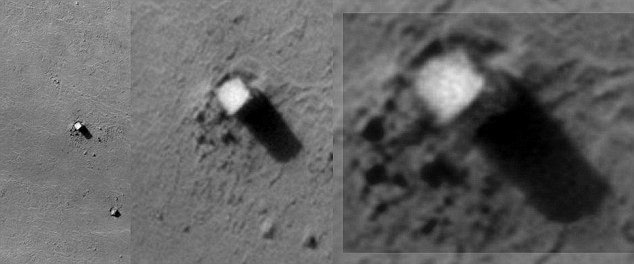
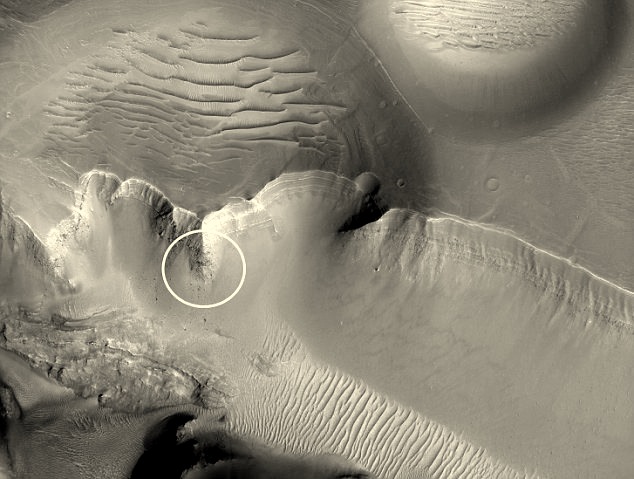
Buried within a routine data download, amongst thousands of other images of dunes and craters, was an anomaly. A single, dark, rectangular slab jutting out from the ground. It casts a long, sharp shadow, confirming it has significant height. It sits at the bottom of a cliff, surrounded by debris, yet it seems strangely pristine, almost unnaturally symmetrical.
The internet, of course, erupted. Anomaly hunters and space enthusiasts, pouring over the publicly available HiRISE images, flagged the object. The “Mars Monolith” was born. The image went viral, a digital ghost whispering of a forgotten past. Was this the smoking gun? The final, undeniable proof of a lost Martian civilization?
Deep Dive: The Official Story vs. The Unsettling Truth
NASA and its associated scientists were quick to offer a more… grounded explanation. Yisrael Spinoza, then a spokesman for the HiRISE department at the University of Arizona’s Lunar and Planetary Laboratory, tried to pump the brakes on the speculation. “It would be unwise to refer to it as a ‘monolith’ or ‘structure’ because that implies something artificial, like it was put there by someone for example,” he stated.
The official line is simple. It’s a rock. A big, rectangular chunk of rock.
Scientists explain that Martian geology isn’t all that different from Earth’s. Rock can fracture along clean, straight lines called joints. It’s possible that this particular chunk simply broke away from the nearby cliff face, tumbled down, and, by a one-in-a-billion chance, landed upright. Its sharp features suggest it’s a relatively recent fall, having not yet been eroded by Martian winds.
A simple coincidence. A trick of light and shadow. A geological oddity. Case closed?
Not even close. Because the “coincidences” were just getting started.
Look at the object again. Is it really just a random boulder? Skeptics point out that while rocks can break into rectangular shapes, the object in the photo appears almost too perfect. Its isolation is strange. Why is it the only object of its kind in the immediate vicinity?
The internet hummed with theories. Was it a marker? A tombstone? The tip of a much larger, buried structure? Could this be the first stage of a slow, calculated disclosure by the powers that be? A single, undeniable image to prepare humanity for a truth it might not be ready for?
The questions were dizzying. And then, a hero from the golden age of space exploration stepped forward and threw a gallon of rocket fuel on the fire.
Buzz Aldrin and the Sentinel of Phobos
If you thought one monolith was strange, buckle up. Because Mars has two moons. And one of them has a monolith of its own.
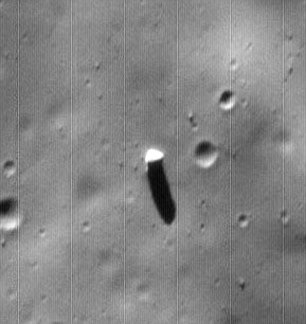
Phobos. A bizarre, lumpy, potato-shaped rock that whips around Mars in less than eight hours. It’s one of the strangest objects in the solar system. Scientists aren’t even sure if it’s a captured asteroid or a chunk of Mars blasted into orbit by an ancient impact. Its surface is covered in strange grooves and craters, but one feature stands apart from all the others: a massive, solitary pillar of rock that casts an impossibly long shadow across the moon’s barren surface.
This isn’t a new discovery. The Phobos monolith has been known about for years, but it was largely confined to scientific circles. Until Buzz Aldrin, the second human being to ever walk on another world, talked about it on national television.
In a now-famous interview, Aldrin, a man who has seen things you and I can only dream of, said this:
“We should visit the moons of Mars. There’s a monolith there – a very unusual structure on this little potato shaped object that goes around Mars once every seven hours. When people find out about that they are going to say, ‘Who put that there? Who put that there?'”
Stop and think about that. A legend of space exploration, a man with unparalleled credibility, is publicly calling attention to a “very unusual structure” and asking the question we’re all thinking. Who put that there?
Aldrin finished his thought with a classic deflection, saying, “Well the universe put it there, or if you choose God put it there.” But the damage was done. The question had been asked on a global stage. The cat was out of the bag.
A Mission to the Other Monolith
Buzz Aldrin’s comments weren’t just idle chatter. The Phobos monolith is so scientifically interesting that it was the primary target for a proposed mission.
In 2007, the Canadian Space Agency funded a study for an unmanned mission called PRIME, which stands for Phobos Reconnaissance and International Mars Exploration. The main proposed landing site? Right next to the building-sized monolith.
Now, the official reason isn’t because they suspect alien activity. Scientists believe the object is a massive boulder, an “ejecta block” thrown up from a nearby crater impact. They think that because it’s a solid, exposed piece of Phobos, it could hold the secrets to the moon’s origin and composition. It’s a one-stop-shop for geological data.
Dr. Alan Hildebrand, a PRIME investigator, essentially confirmed its importance, telling his science team, “If we can get to that object, we likely don’t need to go anywhere else.”
Think about that statement. One rock could answer every question they have. But what if it answers questions they haven’t even thought to ask?

The Phobos monolith is estimated to be about 90 meters (295 feet) tall. For comparison, the Statue of Liberty is 93 meters tall. This isn’t a small rock. It’s a skyscraper-sized object on a tiny moon. Its existence strains the imagination. How could such a massive object be lifted by an impact and land perfectly upright? Why is it the only thing like it for miles around?
Connecting the Cosmic Dots
So now we have two. Two monoliths. One on the surface of Mars, and one on its moon, Phobos. A coincidence? Maybe.
Or maybe it’s a pattern.
Let’s zoom out. This isn’t happening in a vacuum. For decades, researchers have pointed to other strange formations on Mars that defy easy explanation. The infamous “Face on Mars” in the Cydonia region, which, despite being debunked by NASA as a trick of light, still bears an uncanny resemblance to a humanoid face in early photos. Nearby are the “pyramids,” a collection of five-sided mounds that look unnervingly geometric and intelligently arranged.
Are these all just tricks of the mind? A phenomenon called pareidolia, where our brains are wired to see patterns, like faces in the clouds? That’s the easy answer. The safe answer.
But what if it’s the wrong one?
What If: A Portrait of a Lost World
Let’s entertain the grand “What If.” What if Mars wasn’t always a frozen, irradiated desert? We know for a fact that it once had liquid water. Rivers, lakes, maybe even a shallow ocean. It had a thicker atmosphere. It had all the ingredients for life.
Imagine a Martian civilization that rose and fell millions of years ago. A civilization that built cities, created art, and looked up at the stars, just as we do. What would be left of them now, after eons of wind erosion and asteroid impacts? Not much. Buildings would crumble. Metals would rust into oblivion. Almost everything would be ground back into dust.
Almost everything.
What if the only things that could survive would be massive, simple, solid-stone structures? Like monoliths. Markers left behind by a dying world. Perhaps they are tombstones for an entire planet. Or maybe they are beacons, designed to last for millions of years, waiting for the next intelligent species in the solar system to arise and find them.
Could the monolith on Phobos be an observation post? A sentinel? From its position, it would have a perfect view of Mars. A silent watcher, placed in orbit by a long-dead civilization, keeping vigil over their ruined home world.
It sounds like science fiction. But the images are real. The objects are there. The questions are legitimate.
The Final, Unsettling Question
We are left with two competing realities.
In one reality, these are just rocks. A couple of spectacular, but ultimately natural, geological coincidences. Our desire to find meaning and intelligence in the universe is simply making us see patterns that aren’t there.
In the other reality, these objects are exactly what they look like. Artificial structures. Silent monuments from a past so ancient it defies comprehension. Proof that we are not the first, and that even the greatest civilizations can fall and be forgotten, leaving behind only whispers in the dust.
The evidence is there, captured by our own technology, waiting for an explanation. The official story is tidy and safe. The alternative is mind-bending and world-changing.
The images are on your screen. The shadows are long. And out in the cold silence of space, two strange sentinels wait.
The only question left is… when are we going to go get a closer look?