
The Day the Sky Cracked Open: Inside the 1994 Ariel School Alien Encounter
September 16, 1994. A Friday.
For the students of Ariel School in Ruwa, Zimbabwe, it began like any other day. The morning sun was already baking the red African earth. The air was thick with the scent of dust and blooming jacaranda trees. Recess was a chaotic symphony of laughter and shouting as more than sixty children, aged between five and twelve, flooded the playground.
They were just kids. Playing tag. Kicking a ball around. Lost in their own worlds.
Until the world they knew was shattered forever.
It didn’t start with a bang. It started with a hum. A high-pitched, penetrating sound that vibrated in their bones. Then, a shadow fell over the playground, swift and unnatural. The laughter died in their throats. Every head snapped upwards.
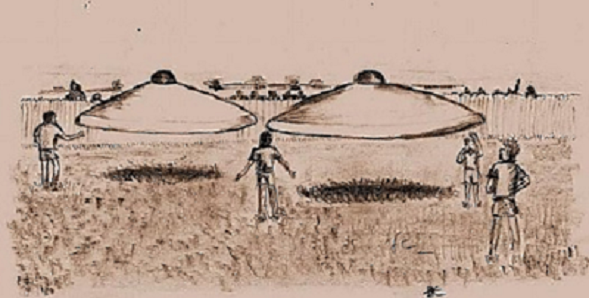
Hanging in the sky, silent and impossible, was a silvery, disc-shaped craft. It was no plane. It was no helicopter. It moved with a purpose that defied physics, gliding over the scrubland that bordered their school. Then, as if answering an unspoken command, several smaller craft detached from the main object, zipping through the air like metallic dragonflies.
And then it landed.
One of the ships, sleek and otherworldly, settled down in a field of brush and small trees just beyond the edge of their playground. Maybe 100 meters away. Close enough to see. Far too close for comfort.
For what felt like an eternity, but was probably only fifteen minutes, the children of Ariel School stood frozen. Paralyzed by a mix of terror and fascination. The adults? They were all inside, oblivious, wrapped up in a staff meeting. The children were completely, utterly alone with whatever had just dropped out of the sky.
Contact: The Man with the Haunting Eyes
A ramp or door opened. A figure emerged.
This wasn’t the monster from a cheap horror movie. This was something far stranger. All the children, in dozens of separate interviews later, would describe it in eerily similar detail. It was small, barely the height of the youngest kids. It was dressed in a tight, one-piece black suit. It had long, straight black hair, well below its shoulders. And its eyes… oh, its eyes.
They were huge. Immense, dark, almond-shaped voids that seemed to swallow the light. They weren’t just eyes to see with; they were windows into something ancient and sad.
The being moved with a strange, almost clumsy grace, as if unaccustomed to our gravity. It glided over the uneven ground, not quite walking. It didn’t seem to notice the children at first. But then, it stopped. It turned. And it looked directly at them.
The collective breath of sixty children hitched. Some screamed. Others began to cry. A few of the older boys, driven by a primal instinct, started running towards it, a strange mix of aggression and curiosity.
But then something else happened. Something that couldn’t be explained by sight or sound. A new communication. A new sense.
Deep Dive: A Message Without Words
The children didn’t hear a voice. They received thoughts. Images. Feelings. A direct, unfiltered torrent of information flooded their young minds.
It was a message of profound sadness. A warning.
One girl, known then only as “Elsa,” described the feeling with a wisdom far beyond her years. “I got the feeling he was interested in all of us,” she said. “He looked sad and without love… In space, there is no love, and down here, there is.”
But the sadness was mixed with a terrifying premonition. A vision of the future. Our future.
“Like all the trees will go down and there will be no air. People will be dying,” she recalled, her voice trembling. “Those thoughts came from the man—the man’s eyes.”
Another student, ten-year-old Isabelle, confirmed the chilling environmental warning. “We were trying not to look at him ’cause he was scary,” she said. “My eyes and feelings went with him… We are doing harm to the Earth.”
Think about that. Sixty children, from different backgrounds, all receiving the same silent, terrifying message about ecological collapse from a being that had just landed in a spaceship. They weren’t told about technology or wars. They were shown the consequences of our own actions. The planet dying. The air turning to poison. All transmitted in an instant, through a glance from a pair of impossibly large, dark eyes.
The sheer intensity of the experience was too much. The being, perhaps startled by the children’s panic or having delivered its message, turned. It glided back to its craft. The ship lifted off the ground without a sound, and in a blink, it was gone. The sky was empty again. The only evidence left behind was the pounding hearts and terrified minds of sixty-two young witnesses.
The Aftermath: Chaos and Credibility
The bell rang, signaling the end of recess. The children, dazed and crying, stumbled back into the schoolhouse. They burst in on the teachers’ meeting, babbling about a spaceship and a strange little man.
The initial reaction? Disbelief, of course. The teachers thought it was a prank, a game that had gotten out of hand. They told the children to calm down and get back to their lessons.
But the story wouldn’t die. The children couldn’t stop talking about it. When school let out, they ran home and told their parents. The school’s phone lines began to light up. Every parent was hearing the same fantastic, detailed story from their child. The consistency was unnerving.
This wasn’t a case of one child with a wild imagination. This was a shared experience, described with the same details, the same emotional weight, by dozens of kids who had no reason to cook up such a bizarre and frightening tale.
Enter the Harvard Professor
Word spread quickly. Tim Leach, the BBC’s bureau chief in Zimbabwe, heard the news and went to investigate. He was a seasoned journalist, not prone to flights of fancy. What he found stunned him. The children were sincere, frightened, and their stories were incredibly consistent.
But the case truly went global when it caught the attention of Dr. John E. Mack.
This is where the story gets serious. Mack wasn’t some fringe UFO chaser. He was a Pulitzer Prize-winning author, a professor, and the head of the psychiatry department at Harvard Medical School. He was, by any measure, a pillar of the academic establishment.
Mack had become fascinated by the “alien abduction” phenomenon, approaching it not with belief or disbelief, but with clinical curiosity. He believed that people were having very real, life-altering experiences, and he wanted to understand what that meant. When he heard about the Ariel School incident, he knew he had to go.
He flew to Zimbabwe with a film crew. Over two days, he interviewed the children, their parents, and the teachers. He didn’t ask leading questions. He simply asked them to draw what they saw and tell him what happened. The results were astounding.
- The Drawings: Dozens of drawings all showed the same thing: a classic “flying saucer” shape, a small figure with a large head, long hair, and massive eyes. The consistency, even in small details, was uncanny.
- The Testimonies: Child after child recounted the same sequence of events, the same description of the craft and the being, and the same telepathic message about the environment. They spoke with the raw, unpolished emotion of people describing a genuine trauma.
Mack concluded that the children were not lying or hallucinating. He stated, “They describe a real event. It was a very powerful, intense experience for them, and it has had a lasting effect on their lives.” For a man of his stature to make such a statement was earth-shattering. It gave the Ariel School incident a level of credibility that few UFO cases ever achieve.
Skeptical Scrutiny: What Else Could It Have Been?
Of course, not everyone was convinced. The incident has been picked apart for decades by skeptics trying to find a more “rational” explanation. Let’s look at the common arguments.
Was It Mass Hysteria?
The theory goes that one or two kids saw something unusual—maybe a conventional aircraft or a weather balloon—and their excited story snowballed into a shared delusion among the other children. But this doesn’t hold up. Mass hysteria typically lacks the specific, shared details seen here. How could sixty children independently invent the *exact same* description of a long-haired being and a telepathic environmental warning? The level of detail and consistency among witnesses argues powerfully against this.
Misidentification?
Could they have seen a unique aircraft, maybe a secret military prototype? Perhaps. But no known human technology can move with the silence and speed described by the children. Furthermore, no aircraft accounts for the landing and the emergence of a non-human figure. The area was searched. No landing marks were found, but the ground was hard and dry, making impressions unlikely.
Cultural Contamination?
Did the kids just see something on TV and re-enact it? This is a popular theory. But in 1994, in rural Zimbabwe, access to Western media was far from universal. Many of these children had never seen movies like *Close Encounters of the Third Kind* or *E.T.* Even if they had, the being they described—with its long black hair—doesn’t neatly fit the pop-culture “Grey alien” stereotype of the time.
The Bigger Picture: The 1994 Southern Africa UFO Flap
The Ariel School encounter didn’t happen in a vacuum. It was the climax of an unprecedented wave of UFO sightings across southern Africa.
In the two nights *before* the school sighting, thousands of people in Zimbabwe, Zambia, and Botswana reported seeing strange lights, fireballs, and objects moving erratically through the night sky. The national weather service in Zimbabwe was flooded with calls. Their radar tracked an anomalous object. Even a prominent meteorologist, on record, stated that the phenomena could not be explained by known celestial events.
Sonic booms rattled windows in towns hundreds of miles apart. This wasn’t a quiet event. It was a massive, regional phenomenon. The Ariel School landing, seen in broad daylight by dozens of credible witnesses, was simply the most dramatic and personal chapter of a much larger story. It was the moment the phenomenon stopped being lights in the sky and became something tangible, real, and interactive.
Decades Later: The Lasting Echoes
Filmmakers have tracked down many of the Ariel School witnesses, who are now adults scattered across the globe. Their story has not changed. Not one of them has recanted.
If anything, their conviction has deepened with time. The event was not a fleeting childhood memory; for many, it was a defining moment that shaped their worldview, their careers, and their spiritual beliefs. They speak of it with a solemnity and seriousness that is impossible to fake. They carry the weight of that 15-minute encounter to this day. They feel they were chosen to receive a message, a burden they still struggle to understand and convey.
The documentary evidence, including John Mack’s original interview tapes, remains a compelling testament.
A Warning We’re Still Ignoring?
The Ariel School incident stands as one of the most compelling and well-documented close encounter cases in history. You have over 60 witnesses. You have consistency in their testimony, taken immediately after the event and decades later. You have the backing of a respected Harvard psychiatrist. You have the context of a massive regional UFO flap.
What are we left with?
Was this just a fantastical story told by a group of imaginative children on a hot African afternoon? A bizarre psychological quirk?
Or was it something more? Was it a genuine, physical event? A brief, shocking moment when the veil between our world and another was torn away, right in front of the most innocent among us. And if it was real, what about the message? A desperate, silent plea transmitted from a sad-eyed being, warning of a future where the trees are gone and the air is unbreathable. A future that, year by year, looks less like science fiction and more like our current reality.
Perhaps the most haunting question isn’t whether the aliens landed at Ariel School in 1994. The most haunting question is: were we given a warning, and did we fail to listen?









