The Apollo 11 Tapes: What Did We Really See on the Moon?
July 20, 1969. A date burned into the collective memory of humanity. A grainy, black-and-white image flickers across a billion television sets. A man in a bulky white suit descends a ladder. He speaks words that will echo through history: “That’s one small step for man, one giant leap for mankind.”
We all know the story. We’ve all seen the footage.
Or have we?
The official record states that Apollo 11 was the spaceflight that landed Americans Neil Armstrong and Buzz Aldrin on the Moon. A triumph of human ingenuity. A decisive victory in the Cold War’s bitter Space Race. Armstrong and Aldrin spent a little over two hours on the lunar surface, collecting rocks, planting a flag, and bouncing around in low gravity while Michael Collins orbited above, the loneliest man in the universe.
It’s a clean story. A perfect story. Maybe… a little too perfect.
For decades, whispers have grown into shouts. Questions that were once dismissed as crackpot theories are now debated in mainstream forums, fueled by internet sleuths and newly unearthed documents. The official story, they say, has holes. Big ones. Holes you could fly a Saturn V rocket through. What if the most-watched television event in history wasn’t a live feed from the Moon, but the most ambitious, expensive, and successful movie production ever made?
The Story We Were All Told
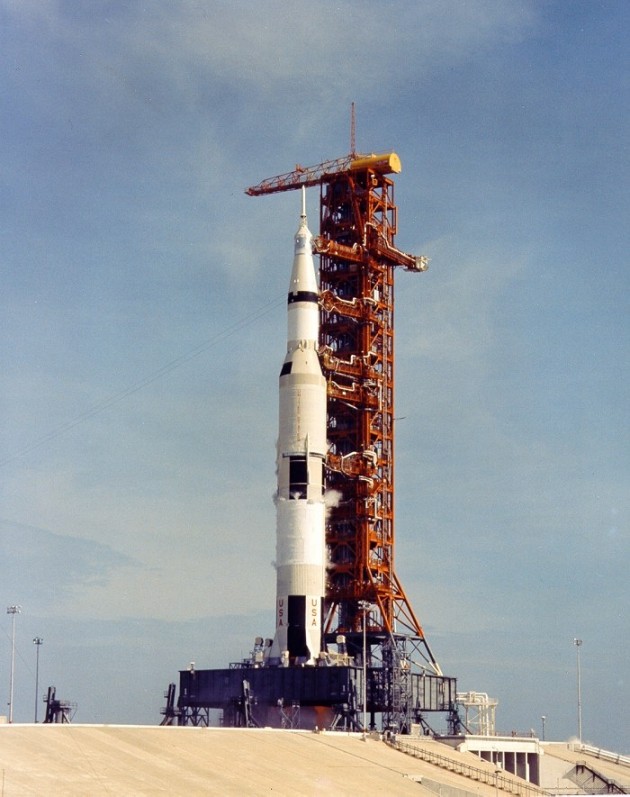
Let’s rewind the tape. The mission began on July 16, 1969. The world held its breath as the colossal Saturn V rocket, a 363-foot tall beast of controlled fury, prepared to defy gravity. Inside the command module, a tiny capsule perched atop this metal giant, sat three men: Commander Neil Armstrong, Lunar Module Pilot Buzz Aldrin, and Command Module Pilot Michael Collins. They were the tip of the spear, the culmination of a decade of work by over 400,000 people and a budget that would make a modern billionaire blush.
The countdown reached zero.
Fire. Smoke. An earthquake of sound. The rocket clawed its way into the Florida sky, a blazing monument to a nation’s will.

The journey was flawless, according to the mission logs. Three days to cross the 240,000-mile void. They entered lunar orbit, the pockmarked gray surface spinning silently below. It was a hostile, alien world. Utterly magnificent. Utterly terrifying.
A View From a Tin Can
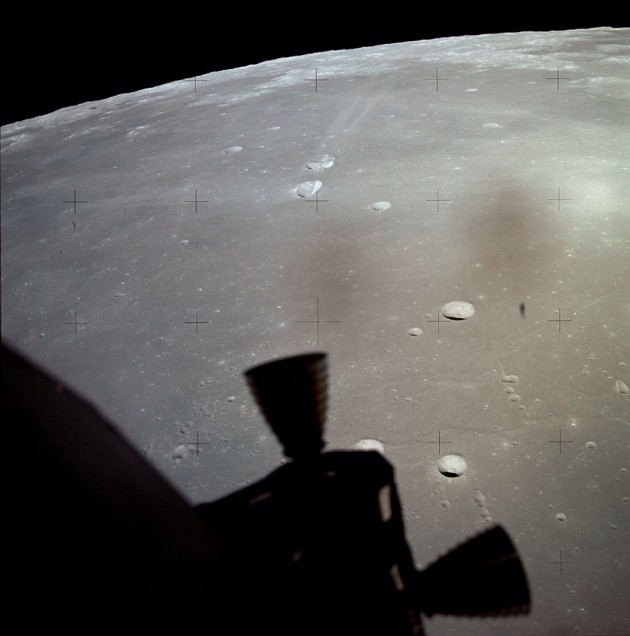
From their tiny windows, the astronauts stared out at a landscape no human had ever seen up close. The official NASA archives contain thousands of these images, each one cataloged with clinical precision. Look at this one, a view of the Sea of Fertility, or Mare Fecunditatis, as seen from Armstrong’s window. NASA tells us the two prominent craters are Messier and Messier A, with strange, light-colored rays shooting out from one of them. The sun’s angle was low, they say, about 29 degrees, just enough to cast deep shadows inside the crater rims.

It’s a beautiful, desolate photograph. But look closer. Is it really the Moon? Or is it a meticulously crafted model, shot on a soundstage with carefully positioned studio lights? The details are perfect. Almost too perfect. The captions read like a geologist’s textbook, but they don’t capture the sheer strangeness of it all. They were there. Alone. Staring into the abyss.
Then came the moment of truth. Armstrong and Aldrin entered the Lunar Module, the “Eagle.” They undocked from Collins in the “Columbia” and began their perilous descent. Alarms blared. The onboard computer was overloaded. Armstrong, with ice in his veins, took manual control, searching for a safe landing spot among the craters and boulders. With only seconds of fuel remaining, he set the Eagle down in the Sea of Tranquility.
“Houston, Tranquility Base here. The Eagle has landed.”
The world erupted. But the real show was just beginning.
But the Official Story Has Cracks… Big Ones.
For every action, there is an equal and opposite reaction. For every official report, there is a counter-narrative. The moon landing is no exception. The moment the celebrations died down, the questions began. And they haven’t stopped since.
Let’s start with the most damning piece of evidence: the missing tapes. You read that right. NASA, the organization that successfully managed the most complex technological feat in history, somehow *lost* the original, high-quality television broadcast tapes of the moon landing. They admit it. In 2006, they confessed that they had likely erased and reused over 200,000 tapes to save money, including the crystal-clear originals from Apollo 11.
Really?
The single most important historical recording of the 20th century, and they taped over it? All we’re left with are the grainy, degraded copies recorded from TV screens back on Earth. Was this a colossal blunder? Or was it a deliberate destruction of evidence that was too high-quality, evidence that might reveal the whole thing was a sham if analyzed with modern technology?
Deep Dive: The “Evidence” of a Hoax
Skeptics point to the photographic and video records themselves as proof of a massive deception. When you start looking for anomalies, you find them everywhere.
Exhibit A: The Flag That Waved
It’s perhaps the most iconic image after the footprint. Buzz Aldrin saluting the American flag on the lunar surface. But something is wrong. The flag is rippling, as if caught in a gentle breeze. But there’s no air on the Moon. No atmosphere. No wind. So how can a flag wave?
NASA’s explanation is that the flag was mounted on an L-shaped pole to make it “fly” for the camera. The ripples, they claim, were just wrinkles from being packed so tightly, and the “waving” motion was the flag settling after Aldrin twisted the pole into the ground. It makes sense. Sort of. But watch the video footage. It continues to move. Was it a hidden fan on a secret film set, accidentally left on by a clumsy stagehand?
Exhibit B: The Starless Void
Look at any of the photos taken on the moon’s surface. The sky is a deep, profound, absolute black. But where are the stars? With no atmosphere to obscure the view, the stars should be breathtakingly brilliant, a celestial light show unlike anything seen from Earth. Yet, there’s nothing. Not a single pinprick of light.
The official line is all about camera settings. The lunar surface was brightly lit by the sun, and the astronauts’ suits were brilliant white. To get a proper exposure of the foreground, the camera’s aperture had to be set small and the shutter speed fast. This meant that the faint light from distant stars simply wouldn’t have been bright enough to register on the film. It’s a plausible, scientific explanation. But it’s also incredibly convenient. A star-filled sky is difficult to fake accurately. A black void? That’s easy. Just use a black backdrop.
Exhibit C: The Impossible Shadows
This is where things get really strange for the internet investigators. On the Moon, there should be only one strong light source: the Sun. Therefore, all shadows should be pitch-black and run parallel to each other. Simple physics, right?
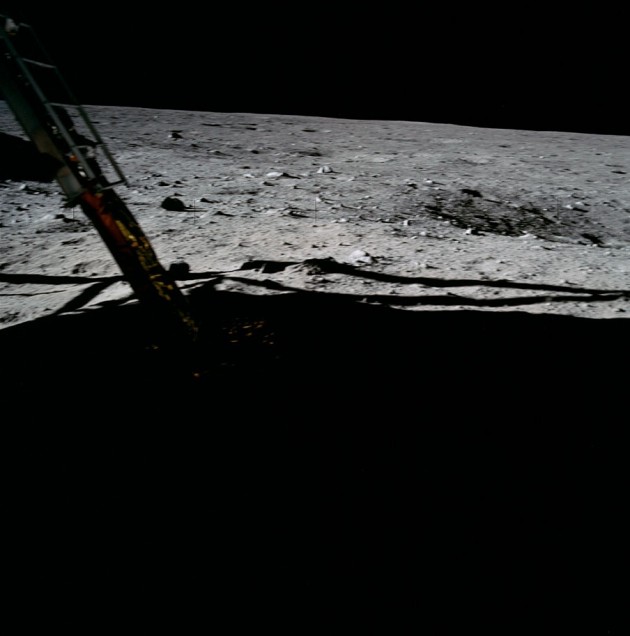
But in the Apollo photos, that’s not what we see. Shadows converge at odd angles. They cross over each other. Objects that are in shadow are somehow still visible, suggesting a fill light is illuminating them—just like a photographer would use in a studio. This image of Armstrong near the ladder is often cited. The official caption notes the image is blurred, as if taken in a hurry. Why the rush? Look at the shadows. The west footpad is in deep shadow, yet you can still see details on the ladder. Where is that light coming from?

Proponents of the hoax theory argue this is undeniable proof of multiple light sources—studio lighting on a set. NASA counters, saying that the undulating, uneven lunar surface can cause shadows to appear non-parallel, and that light reflecting off the surface, the Lunar Module, and even the astronauts’ own suits could act as a secondary fill light. Who do you believe?
The Ultimate Question: Why Fake It?
If it was a hoax, it begs the biggest question of all: why? Why would the U.S. government orchestrate such a monumental lie?
The answer is simple: The Cold War.
In the 1960s, America was losing. The Soviet Union was first into space with Sputnik. First to put a man in orbit with Yuri Gagarin. They were winning the technology war, and by extension, the ideological war. Communism looked like the future. Capitalism looked slow and clumsy.
In 1961, President John F. Kennedy made a bold, desperate promise: America would put a man on the Moon and return him safely to the Earth before the end of the decade. It wasn’t just a scientific goal. It was a declaration of war. A challenge. The pressure was immense. Failure was not an option. But what if, as the deadline loomed, NASA realized they couldn’t actually do it? What if the technological hurdles, like protecting the astronauts from the deadly radiation of the Van Allen belts, were simply too great? Would they admit defeat to the Soviets? Or would they choose a different path? The path of deception.
Faking the landing would achieve the same result. It would bankrupt the Soviets who tried to keep up, demoralize their scientists, and broadcast American supremacy to the entire world. It was the perfect checkmate in the Cold War. A lie so big, no one would dare question it.
A Modern Twist: What if They Went… But Hid What They Found?
Here’s a theory that has gained traction in the darker corners of the internet, a theory that splits the difference. What if NASA *did* go to the Moon… but the footage we saw was a fake?
Stay with me. Imagine Apollo 11 lands, and Armstrong and Aldrin look out the window. And they see something. Something that isn’t supposed to be there. Structures. Ruins. Evidence of a prior visitation. Something so world-shattering that revealing it to the public would cause global panic and upend every belief system on the planet.
What would NASA do? What would the government do? They can’t just turn around and come home. They have to complete the mission. So, they go out, they collect their samples, but they can’t show the public the real video feed. It’s too dangerous. Instead, they broadcast a pre-recorded, sanitized version that was filmed in a secret studio. A performance for the world, while the real mission, the *classified* mission, took place in secret.
This theory suggests the waving flag, the missing stars, the weird shadows—they weren’t mistakes. They were intentional clues, left by insiders who wanted the truth to one day get out. It explains everything. The erased tapes weren’t destroyed to hide a fake landing, but to hide the *real* one.
Splashdown: The End of One Story, the Beginning of Another
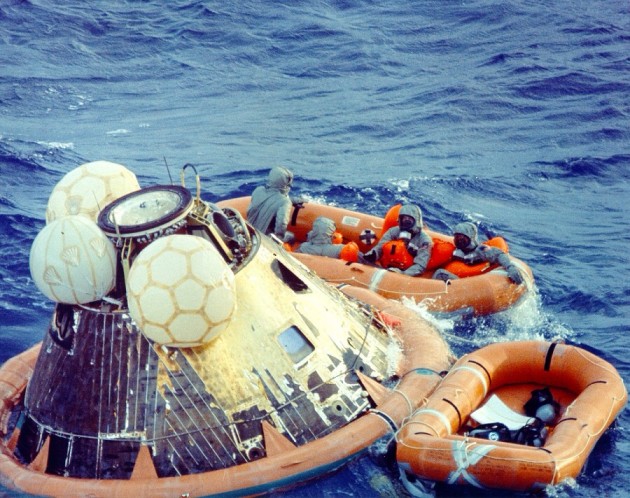
On July 24, 1969, the Apollo 11 command module streaked back through Earth’s atmosphere and splashed down in the Pacific Ocean. The astronauts were heroes. They were recovered, put in quarantine (in case of “moon germs”), and celebrated with ticker-tape parades.

Look at this photo of the crew awaiting pickup. They look exhausted, relieved. But look into their eyes. Do you see the unbridled joy of men who have just returned from the greatest adventure in human history? Or do you see the quiet, heavy burden of men who are carrying the world’s biggest secret?
They became intensely private men afterward. Armstrong, in particular, famously shied away from the public eye. Was it humility? Or was he terrified that one day, in an unguarded moment, he might let the truth slip?
You Decide: History or Hoax?
The debate rages on. For every piece of “evidence,” there is a scientific explanation. For every explanation, there is a counter-claim of conspiracy. Was Apollo 11 the crowning achievement of the 20th century? Or was it the most audacious lie ever told?
The men who knew the full truth are now gone. The original evidence is lost, erased by a government that asks us to simply trust them. We are left with grainy images, aging film, and a story that, for many, just doesn’t quite add up. The truth is out there. But you might not find it in the history books.