Sunday, September 13, 2026
HomeSpace & ScienceSpaceAnomaly hunters spot 'spoon' in Mars picture

Anomaly hunters spot ‘spoon’ in Mars picture

The Floating Spoon of Mars: NASA’s Strangest Anomaly or Proof of a Lost Civilization?

Mars. The Red Planet. A world of silent, rusty dust and whisper-thin atmosphere. For decades, it has been the ultimate prize in our cosmic backyard—a place we dream of walking, a world we scrutinize from millions of miles away through the unblinking eyes of our robotic explorers. We send rovers, tireless geological workhorses, to crawl across its craters and plains, zapping rocks with lasers and sending back postcards from the edge of human ambition.

Most of what they send back is exactly what you’d expect. Rocks. Dust. More rocks. Grand, desolate vistas that are both beautiful and terrifyingly empty.

But sometimes… sometimes they send back something that makes you lean in closer to the screen. Something that just doesn’t fit.

Something impossible.

Something like a spoon. Floating in mid-air.

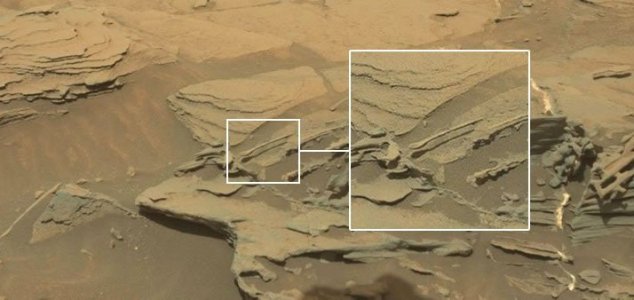
Look at that image. Really look at it. Captured by the multi-billion-dollar Curiosity rover, this wasn’t some blurry, ambiguous blob. The shape is unmistakable. A long, slender handle. A perfectly formed bowl at the end. And the shadow… oh, that shadow. It’s cast directly beneath it, a dark patch on the Martian soil that screams one unbelievable thing: this object is levitating.

When this photograph first hit the internet, it exploded. UFO forums, anomaly-hunting websites, and late-night social media feeds lit up. Was this it? The smoking gun? Not a fossilized microbe or a chemical signature in the soil, but a manufactured object. An artifact. A piece of cutlery left behind after a Martian picnic billions of years ago?

The questions came thick and fast. Who made it? What is it made of? And the biggest one of all… why is it floating?

The Official Story: A Trick of Wind and Shadow

Almost as quickly as the “discovery” went viral, the scientific community and NASA offered a much more… grounded explanation. They have a word for what they claim is happening here: Pareidolia.

It’s a mouthful, but the concept is simple. It’s the human brain’s incredible, and sometimes overly eager, ability to see meaningful patterns in random data. It’s why you see a face in the clouds, a man in the moon, or a religious figure on a piece of toast. Our brains are pattern-recognition machines, fine-tuned by evolution to spot the glint of a predator’s eye in the bushes. On Mars, where there are no bushes, that same software starts seeing faces, animals, and, apparently, kitchen utensils in the rocks.

A Deep Dive into Martian Geology

So if it’s not a spoon, what is it? The likely answer is a type of rock formation known as a “ventifact.”

Mars may not have liquid water flowing on its surface today, but it has wind. Lots of it. For eons, winds carrying abrasive sand and dust have scoured the Martian landscape, acting like a planetary sandblaster. This process, called aeolian erosion, carves rocks into bizarre and fantastic shapes that would look alien even if they weren’t on another planet.

The “spoon” is almost certainly one of these ventifacts. Imagine a rock with harder and softer parts. Over millions of years, the Martian wind blasted away the softer material, leaving behind a more resistant, slender piece of stone. It’s geology, not archaeology.

But what about the floating? That, my friends, is a classic optical illusion. A trick of light, shadow, and perspective. The “spoon” is not hovering. It is a long, thin rock formation connected to the ground at a point that is obscured from the rover’s camera angle. The stark Martian sunlight, coming from a specific direction, casts a dark shadow directly underneath the main body of the rock, creating the powerful illusion of levitation. It’s a cosmic magic trick, performed by a planet-sized stage magician.

Convincing? Maybe. But for many, that answer feels a little too neat. A little too easy.

The Martian Anomaly Hall of Fame

The floating spoon doesn’t exist in a vacuum. It’s just the latest entry in a long and bizarre catalog of strange objects spotted on the Red Planet. For as long as we’ve been taking pictures of Mars, people have been finding things that shouldn’t be there. It’s a tradition.

The Original Sin: The Face on Mars

You can’t talk about Martian anomalies without talking about the big one. The legend. In 1976, NASA’s Viking 1 orbiter snapped a picture of a region called Cydonia. In one of those frames was a landform that looked, for all the world, like a colossal humanoid face staring up into space. It had eyes, a nose, a mouth. It was two miles long.

For over 20 years, the “Face on Mars” was the poster child for ancient alien theorists. Books were written. Documentaries were made. People were convinced it was an artificial monument, a message left by a dying civilization, a Martian Mount Rushmore. NASA insisted it was a mesa, a simple rock formation, and that the “face” was a trick of light and low-resolution photography.

Finally, in 1998 and 2001, the Mars Global Surveyor flew over Cydonia with much more advanced cameras. The new, high-resolution images showed… a hill. A very normal, heavily eroded, and distinctly non-face-like hill. The mystery was solved. Or, as some theorists claim, the evidence was covered up.

The Martian Menagerie

Since the rovers landed, the “discoveries” have gotten smaller and weirder. The cameras are on the ground now, getting up close and personal with the rocks. And people are finding a whole zoo of strange creatures.

  • The Mars Rat: In 2012, Curiosity photographed a collection of rocks, and among them was one that looked uncannily like a rodent, complete with a nose, eyes, and what looked like little legs. Scientists say it’s a rock. Of course.
  • The Thigh Bone: Another Curiosity classic. A rock that is shaped so perfectly like a femur bone that it’s genuinely unsettling. NASA had to issue a statement explaining that if there were life on Mars, it was likely small, simple microbes, not large vertebrates that would leave behind skeletal remains.
  • The Woman on Mars: In 2007, the Spirit rover captured a panorama that included a strange figure on a ledge. It looked like a cloaked person, arm outstretched, walking down a slope. It remains one of the most compelling and eerie examples of pareidolia to date.
  • The Traffic Light: A stack of three round, uniform rocks that looked for all the world like a set of traffic signals. Was it a sign to stop, or a sign that we should keep looking?

The list goes on and on. Squares, spheres, things that look like crashed drones, bits of metal. For every one of these, the official explanation is the same: it’s a rock, shaped by natural processes, and your brain is filling in the blanks.

What If… They’re Not Just Rocks?

Okay. Let’s get down to it. Let’s play devil’s advocate. The scientific explanation is plausible. It’s logical. It’s also incredibly boring.

What if, just for a moment, we entertain the other possibility? That our eyes aren’t deceiving us. That these aren’t just random formations.

What if they are the scattered, wind-eroded ruins of a civilization that vanished a billion years ago? Think about it. We look for pyramids and city grids. Maybe that’s all gone, ground down to dust by eons of storms. Maybe all that’s left are the small things. The durable things. A fossilized bone here. A small statue there. A utensil made from a material so advanced it can resist erosion for geologic time scales.

In this scenario, the “Face on Mars” wasn’t a mountain. It *was* a monument, and the high-resolution photos we saw were of its ruins, not the original structure. The “woman” on the hill wasn’t a rock, but a statue, weathered and worn down like an ancient Greek sculpture.

And the spoon? Maybe it’s an artifact, tossed aside by a being we can’t possibly imagine. Why is it floating? Perhaps it’s not. Perhaps it’s impaled in the ground, standing upright against the wind. Or maybe—just maybe—it’s made of a material that possesses some strange property we don’t understand, a technology so ancient it looks like magic to us.

The Deeper Conspiracy: Is NASA Hiding Something?

This line of thinking inevitably leads to an even darker question. If these things are real, does NASA know?

There is a persistent conspiracy theory that the space agency is engaged in a program of slow disclosure. The idea is that they can’t just come out and say, “We found ruins on Mars,” because it would cause global panic and upend every religion and social structure on Earth. So instead, they release these little breadcrumbs. These odd photos.

They release a picture of a “spoon” and let the internet run wild with it. Then they calmly debunk it as a rock. But the image is out there. The seed has been planted in the collective consciousness. They are slowly, carefully preparing us for a truth so monumental it would break the world if revealed all at once.

Some theorists go even further. They claim that the images we see are heavily altered. The Martian sky, they say, is actually blue like Earth’s, but it’s tinted red in all the photos to make the planet look more alien and inhospitable. They argue that obvious signs of life or technology are routinely airbrushed out of the images before they are released to the public. In this view, the “anomalies” are simply the mistakes—the little things the digital artists at the Jet Propulsion Laboratory missed.

Is it paranoid? Absolutely. Is it possible? In a world of secrets and hidden information, who can say for sure?

A Spoonful of Truth in an Ocean of Dust

So where does that leave us? Standing in front of a photograph from another world, looking at an object that defies easy explanation.

One path leads to a comfortable, scientific answer: a uniquely shaped rock, sculpted by wind, seen at just the right angle to trick our primate brains. It’s a story of geology, optics, and psychology. It’s a neat and tidy explanation.

The other path leads into a rabbit hole of staggering possibilities. A path that suggests we are not alone, and that we have been staring at the proof for decades. A story of lost civilizations, forgotten technologies, and a universe infinitely more mysterious and crowded than we are led to believe.

Ultimately, the floating spoon of Mars is whatever you want it to be. A geological curiosity. A psychological projection. Or a relic from a lost world, waiting patiently in the red dust for someone to finally recognize it for what it truly is.

The rocks of Mars hold their secrets close. The rover keeps rolling, its cameras keep clicking, and we keep watching. The real question isn’t what the rover saw. It’s what else is out there, waiting in the silence, just outside the frame?

Arindam Mukherjee
Arindam Mukherjee
Arindam loves aliens, mysteries and pursing his interest in the area of hacking as a technical writer at 'Planet wank'. You can catch him at his social profiles anytime.
RELATED ARTICLES
- Advertisment -

Most Popular

Recent Comments

Warren Pan Abbott on The legend of the Devil Monkey !
chris davies on The McPherson Tape Mystery
Reed Reedly on ET has Internet!
Bea Houseoffashion on Proof Of Time Travellers – Gallery
Marcus2012 on ET has Internet!
Reed Reedly on ET has Internet!
LaughsAtConspiracyNuts on The 9/11 Conspiracy – Myths and Facts
Alex Sliverman on Did the ancients fly?
Doctor Wholigan on Time Traveler in 1938 film
chris davies on The McPherson Tape Mystery
Archie1954 on 10 secret UFO hideouts
chris davies on Ghosts of flight 401
Marcus2012 on ET has Internet!
jason Macdonald on Proof of Time Travel? – China
chris davies on Long-Lost Pyramids Found?
Reed Reedly on ET has Internet!
Milkman on Connected Universe
Tenmiles on Baigong Pipes Mystery
Simon Foster on Sirius – The Documentary
From the 1st April on 2013 – Alien Contact date ?
SkyWatcher on Is ET ignoring us?
I Come From The Future on Obama to make UFO Alien disclouser soon ?
ÛñK?øWn on 2013 – Alien Contact date ?
Just another person on 2013 – Alien Contact date ?
Malcolm Windowcleaner on The strange case of Rudolph Fentz
Mason Servio on Strange Things on Mars
Marke Wisdom Seeker on What will we find as arctic melts?
Andrea A Elisabeth Levyne on Aliens Captured in Varginha, Brazil
Mitch Grouyeki on Amazing Space Shuttle pictures