Ancient Enigmas: 3 Artifacts That Break The Rules of History
Let’s get one thing straight. History isn’t a neat and tidy storybook. It’s a crime scene. A chaotic mess of clues, half-truths, and missing pieces. For every event neatly filed away in a textbook, there are a dozen artifacts shoved in a dark corner of a museum basement that scream, “You’ve got it all wrong.”
These are the glitches in the matrix. The out-of-place-artifacts. The objects that stare back at us from across the centuries and mock our neat little timelines. They whisper of forgotten technologies, impossible voyages, and purposes so strange we can’t even begin to guess at them. They are the puzzle pieces from a different box, and they force us to ask the one question the establishment hates: What if the story we’ve been told is a lie?
Today, we’re pulling three of these suspects out of the evidence locker. A bizarre metal cage from the Roman Empire that shouldn’t exist. Giant, perfectly round spheres in a jungle that couldn’t have been made. And a single, tiny coin that could completely rewrite the discovery of America.
Buckle up. The official story is about to fall apart.
The Devil’s Device: What is the Roman Dodecahedron?
Imagine you’re a Roman legionary, shivering at the northern edge of the known world in Gaul or Britannia. The year is 200 AD. Back in Rome, they have underfloor heating and marble statues. You have mud, rain, and the constant threat of barbarian attack. But you might also have… this thing.

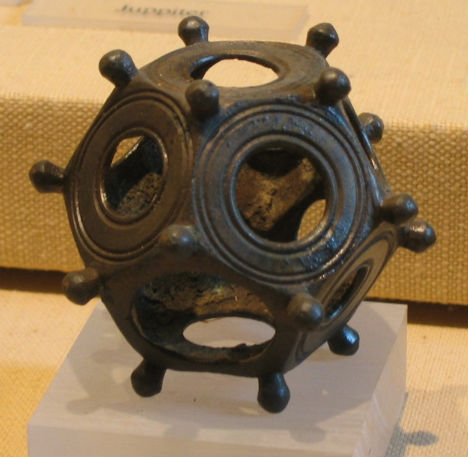
This is the Roman Dodecahedron. And it is one of the most maddening mysteries in archaeology.
Over a hundred of these have been found, scattered across the northern frontiers of the Roman Empire—from Wales to Hungary. They are typically made of bronze, hollow, and fist-sized. They have twelve flat, pentagonal faces. And each face has a circular hole in it, but the holes are all different sizes. To make it even weirder, each of the twenty vertices is adorned with a small, decorative knob.
They are complex. They are precisely made. They were clearly important. And we have absolutely no idea what they were for. None. Zero. Not a single contemporary Roman text, not one piece of writing, ever mentions them. It’s like they didn’t exist. But they do. So what gives?
The “Official” Story (And Why It Makes No Sense)
When faced with a puzzle, mainstream archaeology tends to reach for one of a few “safe” answers. With the dodecahedron, they’ve tried them all, and none of them stick.
Their first guess? A candlestick holder. Yes, really. The theory goes that you’d stick a candle in one of the holes. But this falls apart in seconds. For starters, not a single one of the 100+ dodecahedra ever found has shown any trace of wax residue. Not a drop. Plus, the varying hole sizes and its wobbly, unstable nature would make it the worst candlestick in history.
Okay, what about a surveying instrument? A tool for measuring distances on a battlefield or for construction. It sounds more impressive, but it’s just as weak. For a measuring device to work, it needs to be standardized. Every dodecahedron is a different size, with different-sized holes in different arrangements. It’s a tool with no fixed measurements. It’s useless.
Other guesses get even more desperate. A child’s toy? A paperweight? A die for a game we’ve never heard of? These objects were difficult and expensive to cast in bronze. You don’t go to that much trouble for a toy or a simple game piece. The Romans had simple, six-sided dice. This is something else entirely.
What They’re NOT Telling You: The Forbidden Theories
When the simple answers fail, you have to start looking at the forbidden ones. The ones that don’t fit into the neat little museum display case.
Could it be a weapon? Some modern reconstructions suggest it could be the head of a mace, but its hollow, light construction makes that unlikely. However, a fascinating theory that has gained traction online is that it was a rangefinder for Roman artillery. An artilleryman could look through two of the holes, align them on a distant object of a known size (like a barbarian shield or a fortification), and based on which holes provided the perfect view, could calculate the range. This explains the different hole sizes. It’s a brilliant idea. But it leaves one giant, gaping question: If this was a key piece of military technology for the greatest army in the ancient world, why isn’t it mentioned in a single Roman military manual? Why isn’t it shown on Trajan’s Column? Its absence from the records is deafening.
Let’s get practical. A recent internet theory, backed up by crafty YouTubers, is that it’s a knitting tool. Specifically, a device for making the fingers of Roman gloves. By wrapping yarn around the knobs, a perfect tube for a glove finger can be woven. People have 3D-printed replicas and proven that it works. It’s a clever idea. But again, were Roman army gloves so important that they required a custom-made, high-tech bronze casting? It feels like using a supercomputer to toast bread.
This leads us to the darkest, most compelling possibility. It was a religious object. A ritual device. The 12 faces could correspond to the 12 signs of the Zodiac, a massive preoccupation for the Romans. Some dodecahedra even have symbols that seem to relate to the Zodiac. The different holes could be used to track the sun’s path through the sky, acting as a sophisticated solar calendar to determine the right time for planting, for festivals, or for sacred rites. This would explain everything. It would explain the expense and care taken in its creation. It would explain why they are found in homes and graves, not just army camps. And most importantly, it would explain why no one ever wrote about them. If the dodecahedron was an artifact of a pagan mystery cult, its secrets would have been sworn to silence. As Christianity swept the empire, such “heretical” objects would have been buried and their knowledge erased. Deliberately.
We are looking at a piece of forbidden knowledge. An object so powerful, or so sacred, that its purpose had to be wiped from history itself.
Las Bolas: The Impossible Spheres at the End of the World
Deep in the jungles of Costa Rica, something is waiting. Something that defies explanation. They are known as the Stone Spheres of the Diquís Delta. Las Bolas. And they are perfect.

Hundreds of them. Ranging in size from a few inches across to over six feet in diameter. The largest weigh up to 16 tons. Many are so close to being perfectly spherical that the deviation is less than a fraction of an inch. Their surfaces are polished smooth. They are monolithic, carved from single blocks of a hard, volcanic rock called granodiorite.
They were made by the Diquís culture, a civilization that vanished shortly after the Spanish conquest, leaving behind no written language. We have no idea why they made them, how they made them, or what they meant. The people who held the answers are gone. All that remains are the silent, stone spheres.
How Did They Do It? The Mainstream Guess.
According to archaeologists, the spheres were painstakingly chiseled, pecked, and ground into shape using harder stones. They would slowly chip away at a massive boulder, then use sand and water to grind it smooth. This process, they say, would have taken years, maybe even a lifetime, for a single sphere. It’s a testament to the patience and skill of the Diquís people.
And their purpose? The “official” theories are disappointingly dull. They were probably status symbols for chieftains. The bigger your sphere, the more powerful you were. Or maybe they were placed at the entrances of homes, or used as elaborate grave markers. A simple, cultural expression. That’s the story, anyway.
The Glaring Problems with the Textbook Answer
The “patience and skill” explanation sounds nice, but it conveniently ignores two colossal problems. Problems so big, they shatter the entire theory.
First: The Quarry. The source of the granodiorite rock is over 50 miles away from where many of the largest spheres were found. Let me repeat that. Fifty. Miles. Through dense, mountainous jungle terrain. The Diquís people had no wheels. They had no beasts of burden like oxen or horses. So, how did they transport 16-TON blocks of solid stone across 50 miles of hostile geography? The official explanation is “log rollers and a lot of manpower.” It’s an almost laughable answer. It’s a logistical nightmare that would challenge modern engineers with heavy machinery, let alone a pre-industrial society.
Second: The Perfection. Forget the transportation for a moment. How did they achieve this level of precision? Modern analysis has shown some spheres possess a startling degree of sphericity. Creating such a perfect shape by just eye-balling it and hitting it with a rock is next to impossible. It implies a deep, almost supernatural understanding of mathematics and geometry. It suggests a technology, or at least a technique, that we can’t replicate and don’t understand.
Stepping into the Unknown: Weirder Possibilities
This is where the story truly begins. If they weren’t just giant lawn ornaments for chieftains, then what were they?
What if they were a map? The spheres were originally found in specific arrangements—straight lines, triangles, clusters. Most of these patterns were destroyed as the spheres were moved to be used as decorations. But what if those original alignments meant something? What if they were a massive, ground-level map of the constellations? A terrestrial observatory used to track the stars, to predict seasons, to navigate not the seas, but the cosmos itself.
Let’s go deeper. Legends from around the world, from Atlantis to ancient India, speak of lost energy technologies. Of crystals and harmonic resonance. Why a sphere? A sphere is a perfect resonator. It distributes energy and stress perfectly across its surface. What if these giant granodiorite balls were part of an ancient energy grid? Placed on specific points of telluric energy—ley lines—to harness the natural power of the Earth itself. It sounds like science fiction. But is it any more fantastic than the idea of dragging a 16-ton rock 50 miles through a jungle with nothing but vines and logs?
Or maybe, just maybe, they weren’t made for us at all. Maybe they are a message. A calling card. A silent, eternal monument left behind by a civilization far older and far more advanced than the Diquís. A silent testament, waiting for a future generation to find them and ask the right questions. They are proof that someone was here who could shape mountains and move the Earth. Someone we have forgotten.
The Viking Ghost in America’s Attic: The Maine Penny
History tells us Christopher Columbus discovered America in 1492. But history is wrong. We know Vikings, the Norse, landed in Newfoundland, Canada, around 1000 AD. That’s the accepted record. But what if they came further south? Much, much further south?
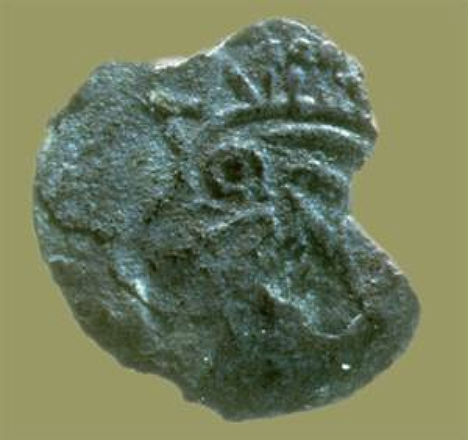
In 1957, an amateur archaeologist named Guy Mellgren was excavating the Goddard Site, the remains of a large Native American settlement on the coast of Maine. Amongst the arrowheads and pottery shards, he found something that had no business being there. Something impossible.

It was a small, silver coin. Decades later, experts at the University of Oslo confirmed its identity. It was a genuine Norse penny, minted in Norway during the reign of King Olaf Kyrre, between 1067 and 1093. The coin is real. The find is real. And its presence on the coast of Maine threatens to tear up every history book in every classroom in America.
The “Safe” Explanation: A Simple Piece of Trade
The establishment needed to explain this away. Fast. The story they came up with is neat, tidy, and utterly boring. They claim the coin was simply the result of a long chain of trade. A Viking in Newfoundland traded it to a member of the local Beothuk or Mi’kmaq tribes. That native then traded it to another tribe further south. And so on, and so on, hand to hand, mile by mile, over decades or even centuries, until this single coin ended its 600-mile journey in Maine, where it was eventually lost. It’s a nice story. It keeps the timeline intact. But it’s full of holes.
But What If It’s Not That Simple?
If there was a vast trade network stretching from the Viking settlements in the north all the way down to Maine, where is the other evidence?
This is the Lone Wolf Problem. Out of more than 30,000 artifacts excavated from the Goddard Site, the Maine Penny is the *only* object of European origin. Not one other Norse artifact. No iron rivets from a longboat. No axe heads. No scraps of smelted metal. No distinctive Norse carvings. Nothing. You don’t have a thriving trade network that transports only one, single, tiny coin. It makes no sense. This isn’t evidence of a trade route; it’s evidence of a bizarre, one-off event.
We also have to address the elephant in the room: the questionable nature of the discovery. An amateur find. A site that wasn’t professionally cataloged for years. Skeptics love to point out that it could have been a hoax, a coin “planted” at the site to create a sensation. And while there’s no proof of that, the murky provenance makes it impossible to dismiss entirely. It leaves the coin in a state of historical limbo—too real to ignore, but too questionable to be fully accepted by the mainstream.
Rewriting History: The Explosive “What If” Scenario
Let’s set aside the hoax theory and assume the coin’s discovery was legitimate. If it wasn’t trade, what’s left? The implications are staggering.
What if a Viking longship, on a journey of exploration or just blown horribly off course, shipwrecked on the coast of Maine? 500 years before Columbus. A small band of survivors, cut off from their world, would have been forced to interact with the local population. They would have tried to trade, to survive. And maybe, in a final exchange or as a gift, this one little silver penny changed hands. The last remnant of a lost expedition. The only proof they were ever there.
This coin is not just a piece of silver. It’s a ghost. A whisper from a lost chapter of American history. It suggests that the vast ocean was not a barrier, but a highway, and that the interactions between the Old World and the New were happening long before the “official” date on the calendar. It’s the ultimate out-of-place artifact, a clue that the map of our past is incomplete, with entire expeditions and encounters still lost in the fog.
These objects are more than just historical curiosities. They are challenges. They are cracks in the foundation of the official record. A bizarre bronze cage, impossible stone spheres, and a single silver coin—each one a persistent, nagging question mark. They remind us that the past is a wilder, stranger, and far more mysterious place than we can possibly imagine. The real story is still out there, waiting to be found.