Home Alien Life Alien Or Giant Skull Found In Peru

Alien Or Giant Skull Found In Peru

0
94

The Andahuaylillas Skull: Final Proof of Aliens or a Twisted Human Secret?

Some things, once seen, can’t be unseen. They burrow into your brain and challenge everything you thought you knew about the world, about history, about our own origins. Forget grainy UFO photos. Forget blurry Bigfoot videos. We’re talking about something tangible. Something real.

Something made of bone.

Deep in the heart of Peru, a land already humming with ancient mysteries, a discovery was made that could either rewrite our history books or expose one of the strangest rituals ever practiced by humanity. This isn’t a new story, but it’s one that refuses to die, whispered in the corners of the internet and debated furiously by researchers in and out of the mainstream. It is the story of the Andahuaylillas skull.

And it might just be the physical proof we’ve all been searching for.

A Discovery in the Sacred Valley

The story begins not in some sterile laboratory, but in the dust and altitude of Cusco, the former capital of the mighty Inca Empire. Here, history isn’t just in museums; it’s in the stones, in the air, in the very soil beneath your feet. It was here, in the southern province of Quispicanchi, that Renato Davila Riquelme, an anthropologist working with the Privado Ritos Andinos museum, stumbled upon something that would make the hair on the back of his neck stand up.

He found two skeletons. One was incomplete, nothing too out of the ordinary. But the other one… the other one was impossible.

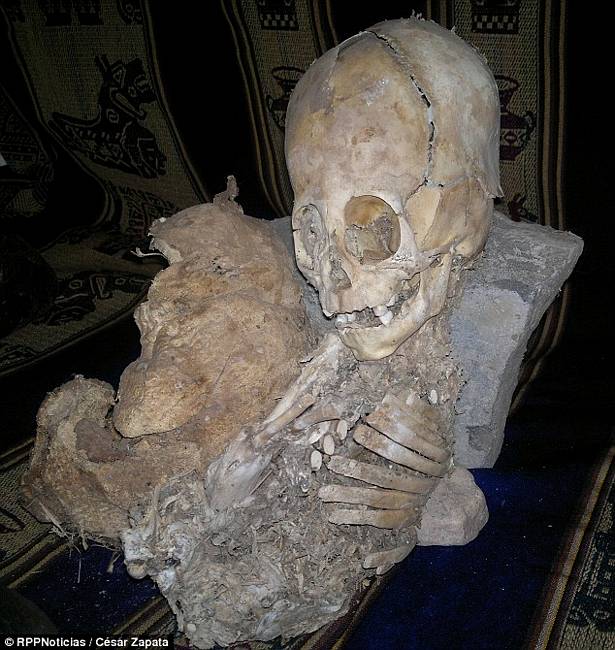
It was small, only 50 centimeters (about 20 inches) tall. The body of a child, perhaps? But the head. My god, the head. It was enormous, monstrously elongated, and almost as large as the tiny torso it was attached to. It looked less like a human and more like the classic “Gray” alien of modern folklore. The discovery was so shocking, so profoundly strange, that Riquelme knew this was no ordinary archaeological find. This was something else entirely.

Deep Dive: Analyzing a Biological Contradiction

When news of the skull broke, the world was captivated. Photos blazed across the internet, fueling a firestorm of speculation. Was this a hoax? A deformity? Or was it, as some immediately claimed, the remains of an extraterrestrial visitor? To understand the frenzy, you have to look closer at the skull itself. It’s not just the shape that’s bizarre; it’s a collection of features that, according to our understanding of biology, simply should not exist in the same body.

The Fontanelle Paradox

One of the first things scientists noticed was a soft spot on the top of the skull. This is known as an open fontanelle. Human babies are born with them; these gaps in the skull plates allow the head to compress during birth and expand as the brain grows. They typically close up completely by the time a child is about two years old. So, the Andahuaylillas skeleton had to be an infant, right?

Wrong. Because when they looked inside the jaw, they found two huge molars.

Molars don’t fully develop in humans until they are much older, usually around 6 to 13 years of age. So what are we looking at? A creature with the skull of a one-year-old and the teeth of a pre-teen. It makes no sense. This isn’t just unusual; it’s a biological contradiction, a puzzle box made of bone that defies a simple explanation.

Alien Or Giant Skull Found In Peru

Eyes Built for Another World?

Then there are the eye sockets. They are colossal. Far, far larger and wider set than any human’s. Proponents of the alien theory ask a simple question: why would a human evolve such massive eyes? Sockets of that size would have housed enormous eyeballs, perfect for seeing in low-light conditions. Was this a nocturnal creature? Or one that evolved on a planet orbiting a dim star, far from the light of a sun like ours?

The very structure of the skull seems designed for a different environment, a different existence. When you see it, you can’t help but picture the classic alien form: a frail body, a massive cranium, and deep, dark, all-seeing eyes.

The Official Story: A Lost and Brutal Ritual?

Of course, mainstream science wasn’t just going to jump on the alien bandwagon. They had a different explanation, one rooted in known, if disturbing, human history: artificial cranial deformation.

It sounds like something from a horror movie, but it was a very real practice. For thousands of years, cultures all over the world—from the Huns in Asia to the Mangbetu in Africa and, yes, many ancient tribes in South America—intentionally reshaped the skulls of their infants. The process was straightforward and brutal. Shortly after birth, while the skull was still soft and pliable, the baby’s head would be bound tightly with cloth and strapped between two wooden boards.

For years, the pressure would be constantly applied, forcing the skull to grow upwards and backwards into a dramatic cone shape. Why? The reasons varied. For some, it was a mark of nobility, a status symbol that set the elite apart from the common folk. For others, it may have had spiritual significance, an attempt to emulate the gods they worshipped.

But Does the Theory Hold Up?

This explanation seems plausible. It’s a known human practice, and it happened in the same part of the world where this skull was found. Case closed, right? Not so fast. This is where the mystery deepens.

The key argument against the cranial deformation theory is a matter of physics. Head-binding can change the *shape* of a skull, but it cannot change its *volume*. You can squeeze a balloon to make it longer, but you can’t put more air inside it by squeezing it. Researchers who have studied these elongated skulls, particularly the famous ones from nearby Paracas, insist that their cranial volume is up to 25% larger than a normal human skull. Some even claim the weight is 60% greater.

You cannot create more bone matter and a larger brain cavity just by wrapping it in cloth. It’s physically impossible. Furthermore, the Andahuaylillas skull has other anatomical quirks, like a different number of cranial plates and a strange foramen magnum (the hole where the spinal cord connects to the skull) that is positioned further back than a human’s. These are not features that can be changed by head-binding.

So if it wasn’t a ritual, what was it?

The Paracas Connection and Suppressed DNA Evidence

You can’t talk about the Andahuaylillas skull without mentioning its more famous cousins: the Paracas skulls. Discovered in the 1920s, this collection of over 300 elongated skulls presents the same baffling anomalies—larger volume, strange bone structures, and a look that is profoundly non-human.

In recent years, these skulls have become the focus of intense investigation by alternative researchers like Brien Foerster. What they claim to have found is explosive. Foerster and his team sent samples from the Paracas skulls for genetic testing. The initial results, which sent shockwaves through the conspiracy community, came back with a bombshell.

The lab reportedly found mitochondrial DNA (which is inherited from the mother) with mutations unknown in any human, primate, or animal known so far. The geneticist, who initially remained anonymous, allegedly stated that the creature he was looking at was so biologically different from humans that it wouldn’t have been able to interbreed. He said he was dealing with “a new human-like creature, very distant from Homo sapiens.”

Predictably, the mainstream scientific community was quick to dismiss these findings. They cited poor sampling methods, contamination, and the fact the results weren’t published in any peer-reviewed journal. They argued that the DNA was likely just degraded or corrupted. But for believers, this was proof of a cover-up. It was confirmation that we are not alone, and that these beings once walked among us—perhaps even ruled as gods—in ancient Peru.

What If? A Scenario from a Lost Age

Let’s step away from the lab coats and the skeptics for a moment. Let’s just imagine. What if it’s true?

What if, thousands of years ago, a ship from another world crashed in the Andes? Perhaps there were survivors—beings with frail bodies, massive heads, and dark, knowing eyes. They were intelligent, maybe possessing technology that seemed like magic to the local tribes. Were they worshipped? Did the natives see them as gods and, in a desperate attempt to be more like them, begin the practice of head-binding to emulate their divine appearance?

It would explain everything. It would explain why ancient cultures, separated by oceans and continents, all independently started this bizarre practice. Maybe they weren’t just making it up; maybe they were copying a template. A non-human template.

And what became of them? Did they die out, unable to adapt to Earth’s gravity and atmosphere? Did they repair their ship and leave? Or did they, as the DNA evidence might suggest, interbreed with humans, leaving behind a bloodline that is hidden among us to this very day?

This is the kind of question that keeps you up at night. The Andahuaylillas skull isn’t just a bone; it’s a doorway to a past that is far stranger and more complex than we could ever imagine.

A Mystery That Refuses to Be Buried

So, where does that leave us? The skull of Andahuaylillas remains in the museum in Peru, a silent testament to an unresolved enigma. One camp holds firm that it is nothing more than the tragic remains of a child who suffered from a rare medical condition, whose head was then artificially deformed in a primitive ritual.

The other camp sees something more. Much more.

They see the skeletal remains of a being not of this Earth. They see confirmation of the ancient astronaut theory. They see a government and scientific establishment desperate to suppress a truth so profound it would shatter our entire understanding of religion, science, and human evolution.

The “Spanish and Russian scientists” who were first cited as examining the remains and calling them “alien” have since faded into obscurity, their official reports nowhere to be found. Were they real? Were they silenced? Or were they just part of the myth-making machine of the internet?

Ultimately, the skull sits there, challenging you to decide. Look at the photo again. Look at the massive, elongated cranium, the impossibly large eye sockets, the frail-looking neck that would have strained to support it. Does it look human to you?

Is it a relic of a lost tradition, or a relic from a lost world? The answer is out there, perhaps buried in the same Peruvian soil, waiting for the next person brave enough to dig.

Originally posted 2016-03-14 17:13:51. Republished by Blog Post Promoter