The Ultimate Stronghold: Secrets, Lies, and the Gold That Might Be Gone
Gold. It drives men mad. It builds empires. It destroys them just as fast. With gold prices swinging wildly and trading well over $1,800 an ounce, you have to ask yourself a serious question. If you own a few ounces, you probably check on them. Maybe you have a safe. Maybe you buried a PVC pipe in your backyard. You know where your wealth is.
But what about the United States of America? Where is the “family silver”?
We are told it sits in a squat, ugly, terrifyingly secure concrete block in Kentucky. The United States Bullion Depository. You know it as Fort Knox. It is the most famous bank vault on the planet. It is a symbol of American strength. And it might be the biggest magic trick in human history.
Is the gold actually there? Or is the vault empty, filled with painted lead bars and dust?
Today, we are going to crack the doors open. We are ignoring the official press releases. We are looking at the dark corners of history, the math that doesn’t add up, and the terrifying possibility that the Emperor has no clothes—and no gold.
The Fortress of Silence
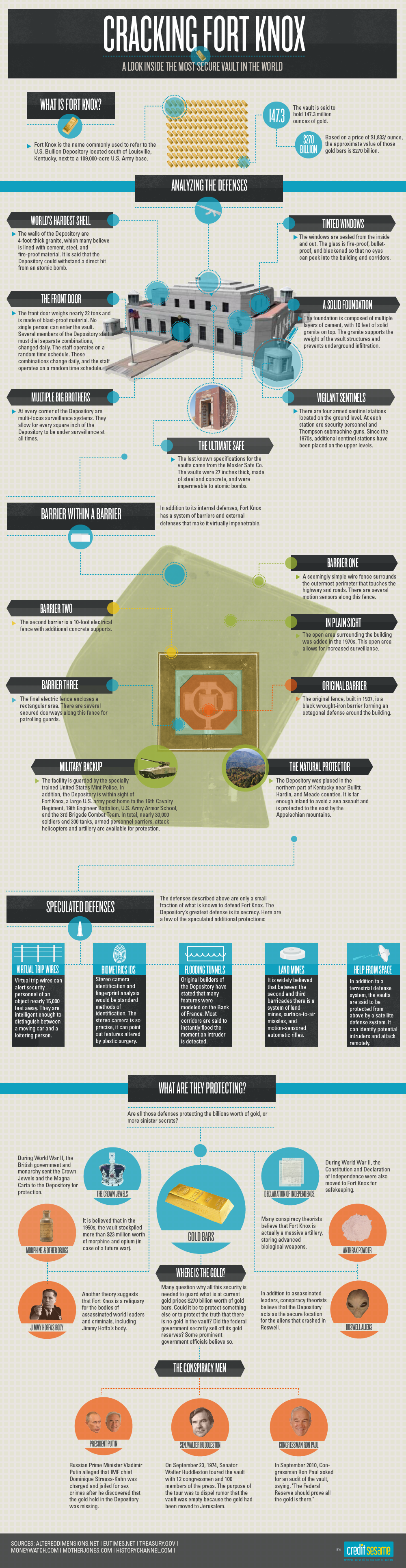
Before we get to the conspiracy, you need to understand the beast itself. This isn’t just a building. It is a weapon of denial. Built in 1936, the Depository was constructed with one goal: keep people out.
We aren’t talking about a security guard with a flashlight. We are talking about granite-lined concrete walls. We are talking about a blast-proof door that weighs 22 tons. Twenty. Two. Tons. No single person knows the combination. It takes a team of staff members, each knowing only a slice of the code, to even think about opening it.
And if you somehow get past the door? Good luck.
The facility is ringed by fences. Razor wire. Motion sensors. But the real security is the neighbors. The Depository sits right next to the Fort Knox military post. That means there are roughly 30,000 soldiers, tanks, attack helicopters, and artillery units sitting a few minutes away. If an alarm trips at the Depository, it doesn’t just call the cops. It calls an army.
It is the perfect place to keep something safe. It is also the perfect place to hide a secret. Because nobody gets in. Nobody looks. And nobody asks questions without a clearance level that doesn’t exist.

FDR’s Great Gold Grab
To understand why people think the gold is missing, you have to look at how it got there. It started with a robbery. A legal one.
In 1933, the Great Depression was crushing the soul of the country. President Franklin D. Roosevelt did something drastic. He signed Executive Order 6102. It made it illegal for regular American citizens to own monetary gold. That’s right. If you had gold coins in your mattress, you were a criminal.
The government demanded you turn it in. In exchange, they gave you paper cash. Then, once the government had all the gold, they raised the price of gold, instantly devaluing the paper money they just gave everyone. It was a masterstroke of economics. It was also a massive transfer of wealth from the people to the state.
They needed a place to put all that confiscated loot. They couldn’t leave it in New York or Philadelphia. Too close to the coast. Too vulnerable to foreign invasion. They needed somewhere inland. Somewhere behind the mountains. Kentucky was perfect.
Trains loaded with bars arrived under the cover of night. By the late 1930s, Fort Knox held a staggering amount of the world’s wealth. At its peak during World War II, it held over 20,000 tons of gold. It was the piggy bank for the entire free world.
The Last Time Anyone Actually Checked
Here is where the story gets dark. If you run a business, you have an audit. Someone counts the inventory. It’s boring, but it’s necessary. You would think the United States government would count the largest stockpile of wealth in the world every year, right? Maybe verify the serial numbers? Weigh the bars?
Wrong.
The last full, rigorous audit of Fort Knox happened in 1953. Eisenhower was President. Elvis was just a kid driving a truck.
Since then? Nothing. Silence. Red tape.
The government claims they audit it. They say they do “spot checks.” They say the gold is under “joint seal.” But independent experts have been screaming for decades that there has been no credible, third-party verification of the inventory for over 70 years. Imagine if a bank told you, “Trust us, your money is there, we checked it 70 years ago.” You would run.
The 1974 “Peep Show”
By the 1970s, rumors were flying. The dollar had just been taken off the gold standard by Nixon. People were panicking. Was the gold gone? Did they sell it to suppress the price?
To shut everyone up, the US Mint organized a media tour in 1974. They invited a few members of Congress and some journalists to enter the fortress. It was a PR stunt. A show.
They walked them down a hallway. They opened one vault compartment. The visitors saw stacks of glittering yellow bars. They took photos. Everyone smiled. The headlines the next day read: “Gold is Safe!”
But critics weren’t buying it. They pointed out the obvious problems:
- The visitors only saw a tiny fraction of the supposed hoard.
- Nobody drilled into the bars to test core purity.
- Nobody weighed the entire stack.
- It was a stage play. If you wanted to fake a vault, you would only need to fill the front row with real gold. The rest could be lead painted gold.
It silenced the public, but it fueled the fire for conspiracy theorists. Why show only one room? Why not do a full assay?
Theory #1: The Tungsten Switch
This is the most terrifying theory because it is scientifically possible. Gold is heavy. Very heavy. There are very few metals that match its density. Lead is actually too light. If you hold a gold bar and a lead bar of the same size, the gold bar feels nearly twice as heavy.
But tungsten? Tungsten is cheap. And tungsten has almost the exact same density as gold.
The theory goes like this: The Clinton administration (or maybe earlier) sold off the real gold to manipulate global markets and keep the dollar strong. To avoid panic, they manufactured fake bars. Blanks made of tungsten, coated in a thin layer of real gold.
Sound crazy? It has happened. In 2009, reports surfaced from Asia claiming that 400-ounce gold bars were found to be gutted and filled with tungsten. If it can happen in the private market, could it happen at the federal level?
If the bars in Fort Knox are salted with tungsten, the United States is technically bankrupt. The collateral for the world’s reserve currency would be nothing but industrial scrap metal.
Theory #2: The Super-Note & Drug Money Vault
Some researchers believe the vault isn’t empty, but that it’s hiding things much darker than metal. During the Cold War, rumors swirled that Fort Knox was used to store biological agents or dangerous chemicals. We know for a fact that the depository has held things other than gold.
During World War II, the original US Constitution and the Declaration of Independence were hidden there. The Holy Crown of Hungary was kept there for decades to keep it away from the Soviets. We also know that the government stockpiled massive amounts of morphine and opium there during the Cold War in case access to painkillers was cut off during a nuclear war.
But the modern theory? Some whisper that the vault is used to store “Super Notes”—perfect counterfeit bills used for black operations—or seized assets from international cartels that can’t be put on the books.
The 2017 Incident: Why Did Mnuchin Go Inside?
For 40 years, no Treasury Secretary had stepped foot inside the vault. It was just accepted that it was off-limits. Then, in 2017, Steven Mnuchin, the Treasury Secretary, made a bizarre visit.
He flew to Kentucky. He went in. He came out and tweeted a picture of himself holding a gold bar. His message? “Glad gold is safe!”
Why? Why then? Why the sudden need to verify it?
Internet detectives went wild. Was he checking to see if there was anything left to sell? Was he verifying the tungsten theory? Or was it just a selfie opportunity? The strange part was the informality of it. It didn’t feel like an official inspection. It felt like a tourist visit. And for a facility that guards the economic backbone of the Western world, “tourist visit” is a terrifying phrase.
The “Paper Gold” Trap
Here is the reality that scares economists more than fake bars. It’s called re-hypothecation. That’s a fancy word for selling the same thing to ten different people.
In the modern financial system, “gold” is traded as paper contracts. ETFs. Futures. Options. There is roughly 100 times more “paper gold” traded every day than there is physical gold to back it up.
The conspiracy is that the gold in Fort Knox has been leased out. The physical bars might still be there, sitting on the pallets. But the title to that gold? The ownership? It might belong to five different central banks and three hedge funds.
If everyone came to collect their gold at the same time, the US government would have to say, “Sorry. We owe it to Germany. And China. And JP Morgan.” The physical location of the metal is irrelevant if the ownership has been sold off to prop up the fiat currency system.
What If It Is Empty?
Let’s play a “What If” scenario. Let’s assume the worst. Let’s assume a brave whistleblower opens the doors tomorrow and reveals a giant, dusty, empty room.
What happens?
1. The Dollar Dies: The US dollar is a fiat currency, meaning it has value because the government says so. But the “faith” in the US government is backed by the assumption of assets. If the assets are gone, faith evaporates. Hyperinflation hits overnight. A loaf of bread costs $100.
2. Geopolitical Chaos: China and Russia have been aggressively buying physical gold for the last decade. They are hoarding it. If the US is revealed to have none, the balance of power shifts instantly to the East. The Yuan or a new BRICS currency becomes the global standard.
3. Civil Unrest: If the government lied about the people’s wealth for 70 years, the social contract is broken. It wouldn’t just be an economic crisis; it would be a revolution.
The Bitcoin Connection
We have to look at the modern angle. A new theory has emerged in the last five years. As Bitcoin rises to become “digital gold,” some wonder if the US government has quietly pivoted.
The US government is currently one of the largest holders of Bitcoin in the world (mostly seized from hackers and silk road busts). Are they purposely letting the physical gold stockpile rot because they know the future is digital? Is Fort Knox just a museum for a dead asset class?
It’s possible. Why spend billions guarding heavy rocks when you can secure billions in crypto with a private key? It sounds like science fiction, but so did a credit card in 1930.
The Verdict
So, is the gold there?
Probably. Most of it, anyway. The logistics of moving 5,000 tons of gold out of the most watched building on earth without anyone noticing are nearly impossible.
But “probably” isn’t good enough. Not when the entire global economy rests on it.
Until there is a full, public, televised, drill-core audit of every single bar in that facility, the shadow of doubt will remain. Fort Knox remains a black box. It sits there in Kentucky, silent and imposing. It asks us to trust. And in the world of government secrets and high finance, trust is the most dangerous currency of all.
Keep your eyes open. Watch the markets. And maybe, just maybe, buy a safe for your own house. Because if the doors of Fort Knox ever swing open to reveal an empty room, you won’t want to be the one holding paper dollars.
Originally posted 2013-04-14 20:54:52. Republished by Blog Post Promoter

Aloha, I’m Amit Ghosh, a web entrepreneur and avid blogger. Bitten by entrepreneurial bug, I got kicked out from college and ended up being millionaire and running a digital media company named Aeron7 headquartered at Lithuania.