Stop what you are doing. Look at the room you are sitting in right now. Look at the corners where the walls meet. Look at the window frame. Look at your desk.
What do you see?
Lines. Straight, sharp, aggressive, unnatural lines. We are trapped in boxes. We live in boxes, we work in boxes, we drive boxes, and eventually, they bury us in a box. But in the late 1990s, deep in the heart of Darmstadt, Germany, a rebellion happened. It wasn’t fought with guns or tanks. It was fought with trowels, ceramic tiles, and a radical refusal to obey the rules of geometry.
They built the Waldspirale.
The Rebellion Against the Grid
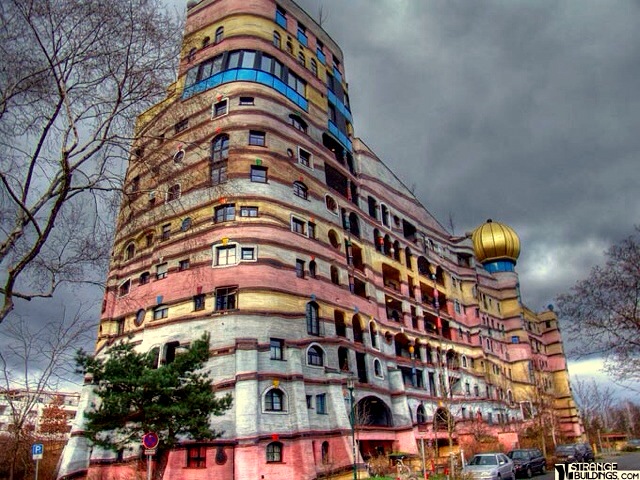
If you look at the photo above, your brain might try to reject it. It looks like a glitch in the Matrix. It looks like a Dr. Seuss illustration crashed into a brutalist German city block. This is the “Forest Spiral.”
Completed in the year 2000, this massive complex is the brainchild of the Austrian artist and architectural provocateur, Friedensreich Hundertwasser. He didn’t just design buildings; he declared war on the modern world’s obsession with standardization.
Hundertwasser had a manifesto. He famously called the straight line “godless.” He believed that the straight line was the tool of the devil, a symbol of a rotten society that forces humans into ant-like conformity. In nature, the straight line does not exist. Rivers curve. Trees twist. Horizons bend. Only humans—and our industrial overlords—force things into rigid grids.
The Waldspirale is his weapon. It is a fortress built to protect the human soul from the crushing weight of the architectural status quo.
A Building That Breathes
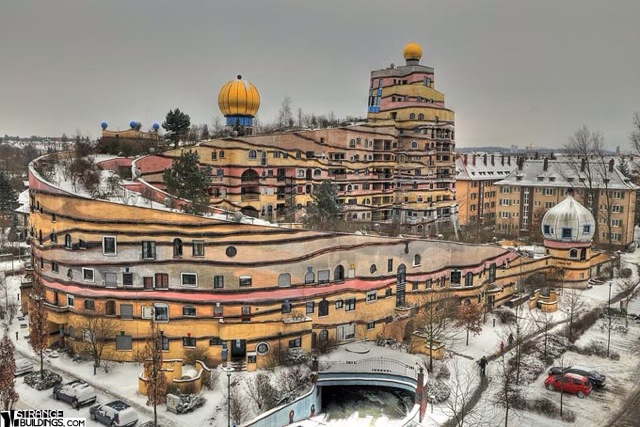
This isn’t just an apartment complex with 105 units. It is arguably a living organism. The name translates to Forest Spiral, and that isn’t a metaphor. The building rises from the ground in a U-shape, ramping up like a verdant mountain until it hits 12 floors at its peak. But the roof isn’t shingles or concrete.
It’s earth. Grass. Shrubs. Giant trees.
From a satellite view, you might not even see a building. You’d see a strange, spiraling park. This was intentional. Hundertwasser believed in a concept that sounds insane to modern developers: whatever land you take from nature to build a house, you must give back on the roof. The green roof isn’t just “eco-friendly” decoration; it is a repayment of a debt to the earth.
The Mystery of the 1,000 Eyes
Let’s get weird for a second. Think about a skyscraper. It has thousands of windows. And every single one of them is identical. Same size. Same glass. Same frame. It’s a copy-paste nightmare.
The Waldspirale breaks the copy machine. It has over 1,000 windows.
Here is the mind-blowing part: No two windows are the same.
Read that again. Over a thousand windows, and every single one is unique in shape, size, or placement. They are scattered across the facade in a chaotic, rhythmic dance. The Germans call this “aus der Reihe tanzen”—dancing out of line. It creates a sensation of movement, as if the building is shifting while you watch it.
Why go to this trouble? Why make the construction process a living hell for the architect, Heinz M. Springmann, and the builders? Because Hundertwasser believed that windows are the “eyes” of a house. If the eyes are dead and uniform, the house is dead. If the eyes are unique and expressive, the house has a soul.
The “Tree Tenants”
It gets stranger. You might notice something poking out of the windows in the images. Those aren’t potted plants sitting on a sill. Those are Tree Tenants.
In the Waldspirale, trees are legal residents. A “tree tenant” is a tree that grows out of a window from an inner container. They pay their rent in a special currency: oxygen, noise reduction, and dust filtration. They are the roommates of the human inhabitants. This brings up a wild “what if” scenario: imagine if every skyscraper in New York or London was required to have tree tenants. We wouldn’t need air purifiers. The city would be a forest.
Hundertwasser was decades ahead of the “Solarpunk” movement. He wasn’t just building a weird house; he was proposing a future where nature invades the city and takes it back.
Inside the Belly of the Beast
So, what happens when you walk inside? Does the madness stop?
Absolutely not.
If the straight line is godless on the outside, it is forbidden on the inside. In some of the apartments, the corners between the walls and the ceiling are rounded off. Hundertwasser hated corners. He believed that negative energy, dust, and “demons” hid in sharp corners. By rounding the edges, the energy flows like water.
Every handle on every door and window is different. You could visit your neighbor, reach for the bathroom door, and feel a completely different shape than the one in your own home. It forces you to be present. You can’t sleepwalk through your life when the doorknob surprises you.
The interior courtyard features a playground and an artificial lake, creating a micro-climate that feels miles away from the busy German city outside. It is a sanctuary. A bubble reality.
The Symbolism of the Golden Domes
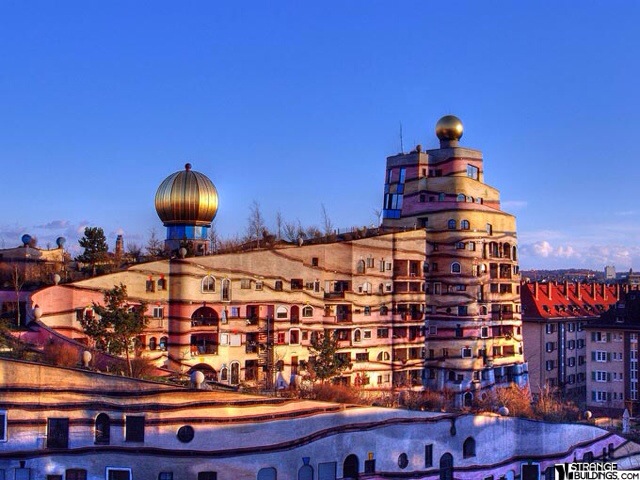
Look at the image above. See those gold onion domes? They look like they were ripped off a Russian Orthodox church or a fairy tale castle and pasted onto a modern apartment block.
This is pure psychological warfare against the mundane. Hundertwasser used these gilded cupolas to give the residents a sense of royalty. In a grey, democratic, industrial society, the individual feels small. Insignificant. A cog in the machine.
By topping the building with gold crowns, the artist is saying: “The person living here is a King. The person living here is a Queen.” It elevates the status of the everyday human. It suggests that housing shouldn’t just be warehousing for workers; it should be a palace for the people.
These ceramic columns you see? They aren’t structural in the traditional sense. They are totems. They are brightly colored, chaotic, and loud. They scream against the beige and grey that dominates our skylines.
The Conspiracy of the Straight Line
Here is where we have to ask the uncomfortable questions. Why are buildings like the Waldspirale so rare?
People love them. Tourists flock to them. The residents reportedly love living there. So why do we keep building glass boxes?
Some theorists—and Hundertwasser himself hinted at this—suggest that architecture is a form of control. If you put people in identical boxes, they think identical thoughts. They become easier to manage. A population living in grey cubicles is a population that follows orders.
A population living in a spiraling, tree-covered, gold-domed fantasy fortress? That is a population that might start thinking differently. They might start questioning the rules.
The construction of the Waldspirale was a nightmare of logistics. The Bauverein Darmstadt company had to figure out how to pour concrete into shapes that defied standard molds. Every step was a battle against the “efficiency” mindset of the construction industry. The fact that it exists at all is a miracle. It is a glitch in the system that wasn’t supposed to happen.
The “Window Right”
One of Hundertwasser’s most radical ideas was the “Fensterrecht” or Window Right. He argued that a tenant should have the right to lean out of their window and paint the facade of the building as far as their arm could reach.
Think about how anarchic that is. It violates every HOA rule, every property management law, and every aesthetic code in the modern world. But the philosophy is profound: it marks the territory. It says, “I live here. I am not just a number in apartment 4B. I exist.” While the Waldspirale doesn’t have residents painting the walls pink on a whim today, the spirit of that idea is baked into the mismatched windows and the ceramic chaos.
A Final Look at the Spiral
The Waldspirale remains one of the most unique residential buildings on the planet. It stands as a monument to what happens when you refuse to compromise with the grey, boring forces of the world.
It has a kiosk. It has a parking garage (which, rumor has it, is also not entirely straight). It has a bar and a café at the very top of the spiral, offering a view over the city that allows you to look down on the grid you have escaped.
But more than the amenities, it offers a question. Next time you walk into your office or your home, look at the wall. Is it flat? Is it white? Is it boring?
Ask yourself: Who decided it had to be that way? And what would happen if you planted a tree in your window and painted a spiral on your ceiling?
The Waldspirale isn’t just a building in Germany. It’s a challenge. It’s a reminder that the world doesn’t have to be grey. It can be gold, green, and spiraling toward the sky. The Matrix of the straight line is strong, but the forest is stronger.
Maybe it’s time we all danced out of line a little bit.

Aloha, I’m Amit Ghosh, a web entrepreneur and avid blogger. Bitten by entrepreneurial bug, I got kicked out from college and ended up being millionaire and running a digital media company named Aeron7 headquartered at Lithuania.