

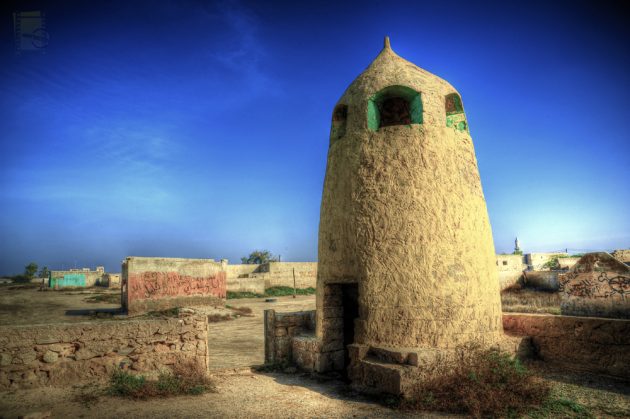
The desert has a memory. It remembers everything we try to forget. Just an hour’s drive from the futuristic, neon-soaked skyline of Dubai, where the Burj Khalifa pierces the clouds, lies a dark secret. A place that time didn’t just forget—it feared. This is Al Jazirah Al Hamra.
They call it the Ghost Town of Ras Al Khaimah. But that’s too simple. A ghost town implies it’s empty.
Ask the locals. Ask the taxi drivers who refuse to go there after sundown. They will tell you it is not empty. It is full. Crowded, even. Just not with people.
The Silence That Screams
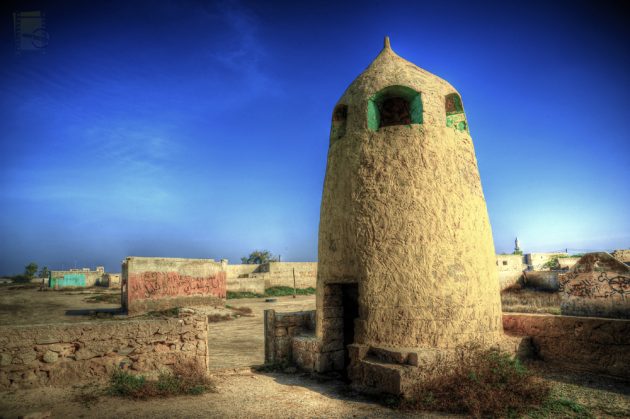
Step onto the sand-choked streets of Al Jazirah Al Hamra, and the first thing that hits you is the sound. There isn’t any. The wind off the Persian Gulf seems to die the moment it crosses the perimeter. It’s a vacuum.
Before the oil money flowed like water, before the Ferraris and the man-made islands, this was the heart of the pearl trade. It was alive. Rich. Vibrant. The Al Zaab tribe ruled this strip of land. For centuries, they dove into the black depths of the ocean, holding their breath until their lungs burned, hunting for the shimmering pearls that adorned the necks of queens in Europe and Maharajas in India.
It wasn’t a slum. It was a powerhouse.
By 1831, British records show over 4,000 people living here. A massive number for that era. They had a fortress. They had watchtowers. They had a bustling market that smelled of spices, fish, and wet sand. Portuguese traders docked here. Persian immigrants brought their culture. It was a melting pot of the Gulf.
So, what happened?
The Great Exodus of 1968
This is where the history books and the local legends start to fight. The official story is clean. Boring. Sanitary.
They say that when oil was discovered, the government offered the residents of Al Jazirah Al Hamra a deal: move to the new city, get free land, get modern concrete houses with air conditioning and running water. Who wouldn’t take that? The old houses were made of coral and mud. They were hot. They were crumbling.
So, the story goes, they packed up and left. A simple upgrade. A relocation project.
But look closer.
When you walk through the ruins today, you don’t see a place that was packed up. You see a place that was fled. There are rumors of dinner tables left set. Personal belongings abandoned in the dust. Doors left swinging open.
Towns usually die a slow death. People trickle out over decades. The young leave for jobs, the old stay and die. That is the natural cycle. Al Jazirah Al Hamra didn’t die. It was evacuated. Almost overnight, thousands of people vanished from the streets.
Why leave so fast? Why leave behind the land your ancestors bled for? Unless something pushed them out. Or scared them away.
The Architecture of Dread
The buildings themselves are strange. This is one of the last authentic examples of pre-oil architecture in the region, and frankly, it looks like a set from a horror movie. The walls are built from coral stone ripped from the sea floor, mixed with seashells and limestone.
Look at the textures. It’s organic. The walls look like they are breathing. It’s beautiful, in a decaying, skeletal way.
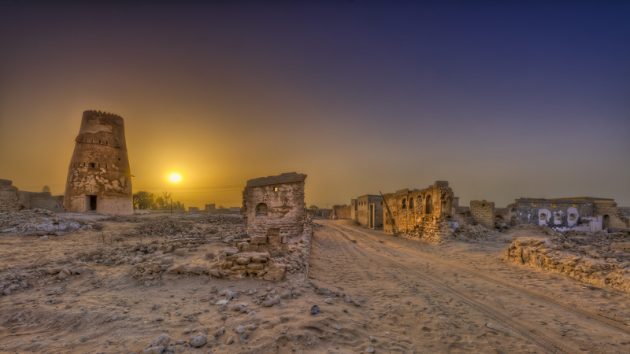
The village layout is a maze. Narrow alleyways twist and turn, designed to block the harsh desert sun and channel the breeze. But today, those alleys confuse the mind. You turn a corner and end up where you started. Shadows stretch longer than they should. The geometry feels… off.
For fifty years, the desert has been trying to swallow the town. Sand dunes rise halfway up the walls of living rooms. Roofs have caved in. But the mosque remains mostly intact. It stands there, watching, waiting.
Enter the Djinn
Forget the blue guy from Aladdin. Forget wishes. In Islamic mythology and pre-Islamic Arabian folklore, the Djinn (or Jinn) are not cartoons. They are terrifying.
They are made of “smokeless fire.” They lived on Earth before humans. They have free will. They have societies, kings, and wars. And they are extremely territorial.
The reputation of Al Jazirah Al Hamra isn’t a joke to the locals. It is serious business. The belief is that the village sits on a threshold—a thin spot between our world and theirs. When the humans left in 1968, the Djinn moved in. Or maybe, they were always there, and they finally got tired of sharing.
Umm Al Duwais is one name you might hear whispered. A female Djinn. Beautiful from a distance, surrounded by the smell of sweet perfume. But get close, and you see her eyes. You see the donkey hooves where her feet should be. She carries a sickle. She is the reason some men don’t walk alone at night.
The Handprints and The Warning
You want physical evidence? Explorers point to the walls.
Visitors have reported finding fresh handprints in the dust of houses that haven’t been entered in years. But not just any handprints. They are large. Distorted. Sometimes they have too many fingers. Sometimes, they are scorched into the stone itself.
Faisal Hashmi, a brave (or perhaps reckless) horror filmmaker, went there to see for himself. He didn’t go during the safety of the day. He went at night.
His report? Pure dread. It wasn’t just a feeling of being watched; it was a feeling of being hunted. He spoke of a heaviness in the air that presses down on your chest, making it hard to breathe. The temperature drops suddenly, defying the desert heat.
Hashmi isn’t alone. Go to the Reddit threads. Check the obscure forums of urban explorers in the UAE. The stories are consistent. Uncanny consistency is rare in folklore, which usually morphs and changes. But here? Everyone reports the same things.
- The Screaming Animals: Goats and stray dogs wandering into the village and then shrieking in pain, only to be found unharmed but terrified.
- The Phantom Lights: Orbs of orange fire floating through the mosque windows when there is no electricity for miles.
- The Chanting: Low, guttural voices speaking a dialect of Arabic that hasn’t been spoken for hundreds of years.
The “Red Island” Theory
The name Al Jazirah Al Hamra translates to “The Red Island.” Geographically, it was once an island, cut off from the mainland by tides. The “Red” refers to the reddish sand in the area.
But conspiracy theorists have a different take. Red is the color of blood. Red is the color of fire. The color of the Djinn.
Some alternative historians propose that the village was built on top of an ancient burial ground or a site of pre-Islamic ritual worship. By building homes of coral and stone on this land, the Zaab tribe might have inadvertently trapped something ancient. The prosperity of the pearl trade was the bait. The collapse was the trap snapping shut.
The Skeptic’s View (And Why It Fails)
Of course, there are the rationalists. They say the “hauntings” are just the wind whistling through the hollow coral rocks. They say the “uneasy feeling” is just infrasound caused by the ocean breeze hitting the structures at a specific frequency—a phenomenon known to cause hallucinations and nausea.
They say the lights are just campers or teenagers partying.
But that doesn’t explain why construction crews refuse to work there. There have been attempts to redevelop the area. Grand plans to turn it into a heritage resort. But machinery breaks down. Workers get sick. Accidents happen. The project stalls.
The land seems to reject modernization. It wants to stay broken.
A Modern Ghost Town
Today, the village sits in a bizarre limbo. It is protected by the government as a historical site, yet it is actively avoided by the superstitious.
It has become a magnet for “Legend Tripping.” This is a phenomenon where teenagers and tourists dare each other to enter a site associated with a tragic or supernatural history. They come looking for a scare. Most leave with more than they bargained for.
I read a report recently from a British expat who took his family there for a picnic during the day. Bright sunshine. Blue sky. He claimed that while exploring one of the larger courtyard houses, his five-year-old daughter started talking to an empty corner.
When he asked her who she was talking to, she pointed at the blank wall and said, ” The man with the burning head. He wants us to leave.”
They left.
The Final Verdict
Is Al Jazirah Al Hamra really the home of the Djinn? Or is it just a pile of rocks and a fascinating history lesson about the pre-oil Emirates?
Maybe it doesn’t matter. The power of the place is real. Whether that power comes from spirits or from the sheer weight of history pressing down on you, the result is the same. It forces you to look over your shoulder.
If you ever find yourself in Ras Al Khaimah, go there. Walk the streets. Touch the rough coral walls. But listen to the advice of the locals.
Don’t take anything with you. Not a rock. Not a shard of pottery. Not even a handful of sand.
And whatever you do, don’t look back when you leave.
The residents of 1968 left everything behind for a reason. Maybe we should take the hint.
Originally posted 2016-07-18 22:23:39. Republished by Blog Post Promoter

Arindam loves aliens, mysteries and pursing his interest in the area of hacking as a technical writer at ‘Planet wank’. You can catch him at his social profiles anytime.




)