Home Weird World Strange Stories 300 Million Year Old Alien Machinery Found

300 Million Year Old Alien Machinery Found

0
80

300 Million Year Old Machinery Found In Russia: Evidence of Aliens or a Lost Civilization?

alien machine

It shouldn’t exist. It defies geology. It mocks history. And yet, there it is.

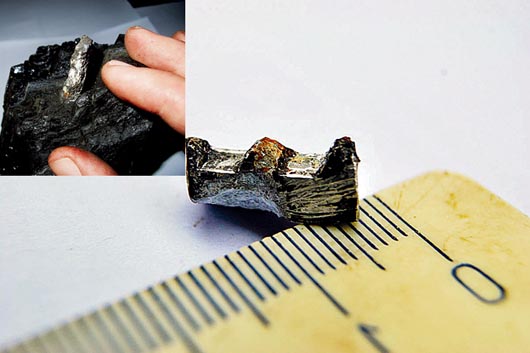
Imagine holding a piece of coal. Just a black, dusty lump of carbon intended for the furnace. You smash it open, expecting nothing but dust. Instead, something metallic falls out. It clatters against the floor. It has teeth. It has a shape. It was manufactured.

This isn’t the plot of a sci-fi movie. This is what Russian sources report happened in Vladivostok. A find so baffling, so utterly out of place, that it forces us to ask the most dangerous question in science: is our history wrong?

We are told civilization is a ladder. We started as cavemen, hit the Bronze Age, discovered iron, and eventually built iPhones. But anomalies like the “Vladivostok Gear” throw a wrench in that neat little timeline. If the dating is correct, someone was manufacturing high-tech machine parts when the Earth was ruled by giant insects.

The Discovery That Broke the Timeline

Vladivostok. A harsh, freezing port city on the edge of Russia and the Pacific. The winters here are brutal. Survival is the only priority. According to reports surfacing from the Primorye region, a local resident was doing a chore performed by millions of people throughout history: lighting a fire.

He picked up a chunk of coal. It was heavy. Dense. He was about to toss it into the flames when he noticed something odd. A protrusion. A foreign object embedded deep within the black rock.

Curiosity won out. He didn’t burn it. He broke it.

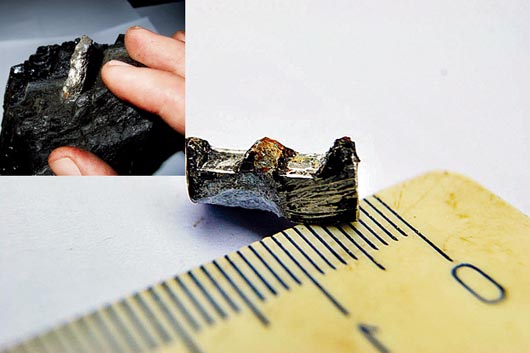
Inside wasn’t a fossilized leaf. It wasn’t a rock. It was a rail-shaped metal object. Toothed. Precise. It looked like a gear rail you might find inside a microscope or a modern car engine. But it was fused into the coal. It wasn’t stuck on it; it was part of it.

The man, mesmerized by the strange artifact, contacted scientists in the Primorye region. He needed answers. What he got was a mystery that refuses to die.

The 300 Million Year Problem

Let’s talk about the coal. Coal isn’t formed overnight. It takes eons. This particular coal deposit came from the Chernogorodskiy mines in the Khakasis region. The age of these deposits is well-documented. They date back to the Carboniferous period.

That’s 300 million years ago.

Let that sink in. 300 million years. Dinosaurs didn’t even exist yet. They wouldn’t show up for another 70 million years. There were no mammals. No birds. No humans. The Earth was a swampy hothouse covered in massive ferns and populated by insects the size of hawks.

If an object is embedded inside a piece of coal from that era, logic dictates the object must be the same age. It fell into the swamp mud, was buried, compressed, and turned to stone over millions of centuries. So, who dropped a metal gear into a swamp 300 million years before the first human walked upright?

The Metal That Shouldn’t Be There

Skeptics immediately jumped on the story. “It’s a hoax!” they cried. Or, “It’s just a strange rock!”

But the science tells a different, much stranger story. Leading experts, including anomaly researcher and biologist Valery Brier, didn’t just look at the object with a magnifying glass. They went molecular. They performed X-ray diffraction analysis to determine the chemical composition.

The results were shocking.

The object was composed of incredibly pure aluminum, with micro-impurities of magnesium (about 2 to 4 percent). This is where the skeptics start to sweat. Pure aluminum is extremely rare in nature. In fact, it’s basically non-existent.

Aluminum binds aggressively with other atoms. To get metallic aluminum, you need intense heat and electricity. We produce it today using the Hall-Héroult process, involving massive smelters and electrolysis. It is a hallmark of an industrial civilization.

Finding a chunk of refined aluminum in 300-million-year-old coal is like finding a plastic bottle in a dinosaur’s stomach. It proves one of three things:

  • Option A: Our dating methods are completely broken (unlikely).
  • Option B: Time travel is real, and a traveler lost a piece of their machine.
  • Option C: Someone—or something—was manufacturing metal on Earth long before we existed.

metal

The Alien Hypothesis: Evidence in the Isotopes?

The plot thickens. It always does. Russian scientists began looking closer at the alloy. Why magnesium?

It turns out, the specific composition offers a tantalizing clue. We know from studying meteorites that there is a specific isotopic signature called Aluminum-26. This isotope is radioactive and eventually decays into Magnesium-26.

The presence of that specific 2% to 4% magnesium impurity in the aluminum led some researchers to a wild conclusion: this might not be terrestrial metal at all. It could be space debris.

Could this gear be a fragment of an alien spacecraft that exploded over Earth during the Carboniferous period? Imagine a mothership, damaged in a stellar war, crashing into the prehistoric swamps of Russia. The wreckage sinks. The hull corrodes. But the internal components—made of exotic, high-purity alloys—survive.

Millions of years pass. The swamp turns to coal. The ship is forgotten. Until a man in Vladivostok tries to heat his home.

The “Silurian Hypothesis”: Was There a Civilization Before Us?

There is another theory. It is grounded here on Earth, but it is just as terrifying. It’s called the Silurian Hypothesis.

Proposed by scientists Adam Frank and Gavin Schmidt, this thought experiment asks: If an industrial civilization existed millions of years ago, would we find any trace of it today?

The answer is disturbing. Probably not.

Cities crumble. Iron rusts. Plastic degrades. Tectonic plates subduct, melting entire continents into the Earth’s mantle. After 300 million years, almost every trace of our current civilization would be ground to dust. We wouldn’t find their books. We wouldn’t find their bones.

What would we find? We would find odd chemical signatures. And we would find the hardest, most durable materials in the strangest places.

Like a machined aluminum gear inside a coal seam.

Writer Natalia Ostrowski at KP UA Daily noted that the object looks remarkably like a tooth-and-rail system used in microscopes or electronic devices. This implies precision. This implies a need to move small parts with accuracy. This implies science.

If this was a terrestrial civilization, they were masters of metallurgy. And then, they vanished. Did they destroy themselves? Did they leave for the stars? Or did a natural cataclysm wipe them out, leaving only this lonely gear to prove they ever existed?

Skeptics vs. Believers: The “Sea Lily” Defense

Of course, mainstream science fights back. It has to. If they admit this gear is real, they have to rewrite the textbooks. They have to admit they don’t know everything.

The primary counter-argument is the “Crinoid Theory.”

Crinoids, or sea lilies, are ancient marine animals that look like plants. They have segmented stems that can break apart into disk-like shapes. When fossilized, these segments can sometimes look like gears or screws. Skeptics point to the Vladivostok object and say, “Relax. It’s just a weirdly shaped fossil.”

But that explanation hits a brick wall.

Fossils are rock. When a crinoid dies, its organic matter is replaced by minerals like calcium carbonate or silica. It turns into stone.

The Vladivostok object is not stone. Valery Brier’s X-ray analysis was clear. It is metal. It is aluminum. Nature does not fossilize a sea creature into pure aluminum. You cannot explain away the metallurgy with biology. The shape might resemble a crinoid stem if you squint, but the chemistry screams “artificial.”

The Phenomenon of OOPARTs

The Vladivostok Gear is not alone. It joins a growing list of “Out of Place Artifacts” (OOPARTs) that haunt archaeologists.

The Coso Artifact

In the 1960s, a sparkly plug was found encased in a geode believed to be 500,000 years old. X-rays revealed a porcelain core and a magnetic pin. A 1920s Champion spark plug… inside a half-million-year-old rock. How?

The London Hammer

A hammer found in Texas, embedded in limestone claimed to be 400 million years old. The iron head is of a purity that modern techniques struggle to match, and it hasn’t rusted.

The Wolfsegg Iron

A cube of iron found in coal in Austria in 1885. Perfectly shaped. Strange composition. Lost to history, then found, then debated endlessly.

These objects are glitches in the matrix. They suggest that the history of Earth is cyclical, not linear. Perhaps we are not the first. Perhaps we are merely the latest in a long line of builders who rise, create wonders, and fall into the dust.

The Mystery Remains

The Vladivostok find remains one of the most compelling cases in recent history because of the aluminum. You can argue about shapes. You can argue about rock layers. But you cannot argue with chemical analysis.

Aluminum does not occur in that form in nature. Period.

So, we are left with the impossible choices. Did aliens visit the Carboniferous swamps? Did a prehistoric human-like species master electricity and metallurgy 300 million years ago? Or is the universe simply stranger than we can comprehend?

Further testing is needed. But will we get it? Or will this artifact, like so many others, disappear into a dusty museum basement, hidden away because it asks questions that science is too afraid to answer?

Keep your eyes open. The next time you pick up a rock, a piece of coal, or dig in your garden, look closely. You might just find the gear that restarts the clock on human history.


Originally posted 2013-11-15 22:33:59. Republished by Blog Post Promoter

Originally posted 2013-11-15 22:33:59. Republished by Blog Post Promoter