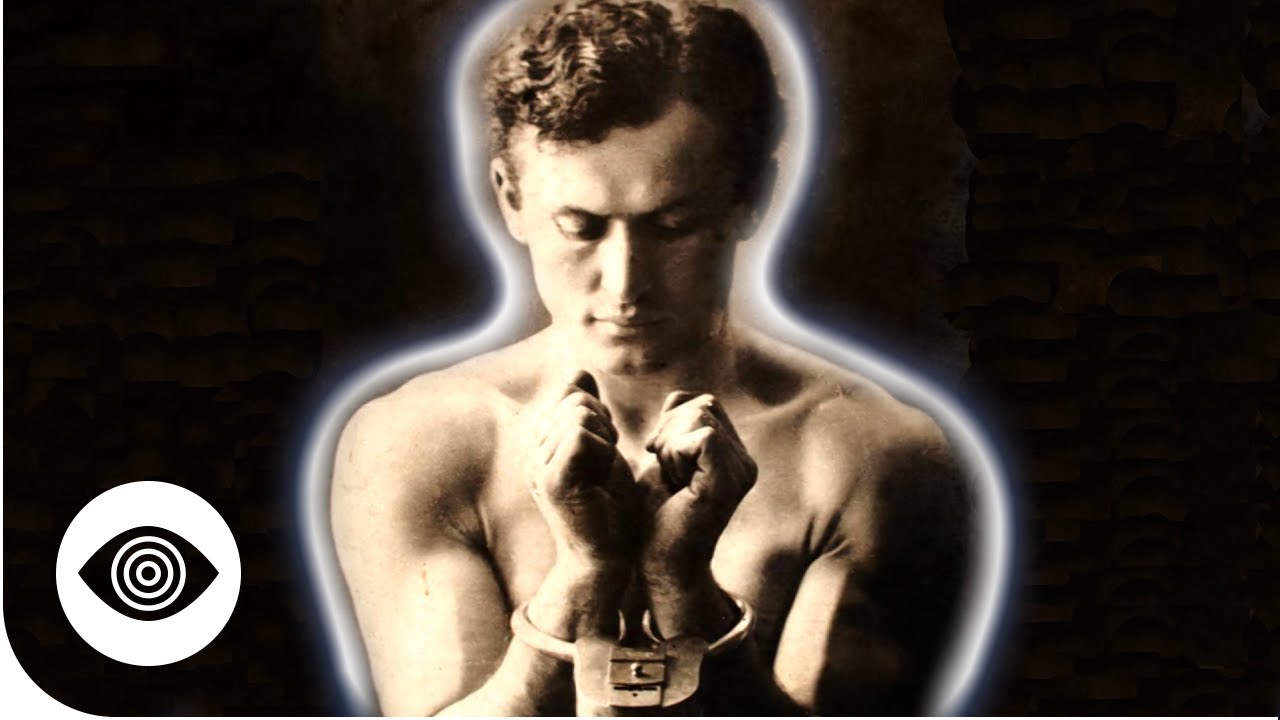
The date was October 31, 1926. Halloween. The one night of the year when the veil between the living and the dead is supposed to be at its thinnest. And on that specific night, in a hospital room in Detroit, the man who had spent his entire life cheating death finally lost the game.
Harry Houdini was dead.
The official story? It reads like a bad tragicomedy. We are told that the world’s strongest magician, a man who could escape straightjackets while dangling upside down from a skyscraper and hold his breath until his lungs screamed, was taken out by a sucker punch from a college student. A ruptured appendix. Peritonitis. The end.
But does that really add up? Does it make sense that a physical titan like Houdini would crumble because of a stomach ache?
For decades, whispers have circulated in dark corners of the internet and among historians who refuse to take the official narrative at face value. This wasn’t an accident. This wasn’t bad luck. Evidence suggests that the Great Houdini walked into a trap. He was a man with powerful enemies—enemies who claimed to talk to the dead, and who might have been willing to kill to keep their secrets.
Before we rip this cold case wide open, watch this summary to get up to speed on the basics:
The Official Story: A Punch in the Gut
Let’s look at the “facts” as the history books tell them. It’s October 22, 1926. Houdini is chilling in his dressing room at the Princess Theatre in Montreal. He’s tired. He’s 52 years old, but he’s still built like a tank. He prides himself on his abdominal strength. It was a party trick of his; he would let big, strong men punch him in the stomach to prove his muscles were like steel.
Enter J. Gordon Whitehead.
He’s a McGill University student. A nobody. He walks in with a couple of friends and asks Houdini if the rumors are true. Can he really withstand any blow to the torso? Houdini, reclining on a couch, barely looking up, nods. He’s reading mail. He’s distracted.
Without warning—and this is the key—Whitehead leans in and hammers Houdini with four or five rapid-fire, violent blows to the stomach. Houdini didn’t have time to brace. He didn’t tighten his core. He gasped. The pain was immediate.
Whitehead stopped, but the damage was done. Houdini performed that night in agony. He performed the next night in even worse pain. He traveled to Detroit, collapsing on stage, running a fever of 104 degrees. When doctors finally cut him open, his appendix was gangrenous. It had burst. Poison was flooding his system. He held on for a few days, fighting like the warrior he was, but on Halloween, he checked out.
Case closed? Not even close.
Medical Impossible: The Science Doesn’t Fit
Here is where the “punch theory” falls apart. Modern medicine has a bone to pick with this story. It is called “traumatic appendicitis,” and generally speaking, doctors say it is incredibly rare, if not impossible.
Your appendix is tucked away deep inside your gut. It isn’t sitting on the surface waiting to be popped like a balloon. While a punch can certainly cause bruising or internal bleeding, the idea that blunt force trauma caused his appendix to explode is medically dubious at best. Many surgeons today believe Houdini already had appendicitis before Whitehead walked into that room.
So, if the punch didn’t kill him, what did? Was it just a coincidence? Or was the punch a distraction? A cover story for something far more sinister?
The Motive: War on the Spirits
To understand who wanted Houdini dead, you have to look at what he was doing in the 1920s. He wasn’t just doing card tricks. He was on a crusade. A violent, loud, public crusade against Spiritualism.
In the wake of World War I and the Spanish Flu, millions of people were grieving. They were desperate to talk to their dead sons, husbands, and fathers. Enter the “mediums.” These were charlatans using cheesecloth, dim lights, and ventriloquism to fake messages from the beyond. They were raking in millions of dollars. It was a massive industry.
Houdini hated them. He loathed them with a burning passion. He used his knowledge of magic to expose them. He would go to séances in disguise, wait for the “ghost” to appear, and then shine a flashlight, revealing a fraud with a sheet on a stick. He testified before Congress. He put a bounty on their heads. He publicly humiliated the most powerful mediums in the world.
He wasn’t just annoying them; he was destroying their business model. He was taking food off their tables. He was making powerful people look like fools.
There is a massive list of people who wished him dead. And they didn’t keep it a secret. Spiritualist newsletters from 1926 are filled with “prophecies” predicting Houdini’s doom. They said the spirits were angry. They said his time was up. Was this a prediction? Or was it a threat?
Suspect #1: The Sherlock Holmes Connection
This is the weirdest part of the story. One of Houdini’s biggest rivals was none other than Sir Arthur Conan Doyle, the creator of Sherlock Holmes. You would think the man who invented the world’s most logical detective would be… well, logical. He wasn’t.
Doyle was a hardcore believer in fairies, ghosts, and ectoplasm. He was convinced Houdini was actually a powerful wizard who used psychic powers to escape handcuffs, and that Houdini was “traitor to the spirits” for denying his own gifts.
Their friendship turned into a bitter, public feud. Doyle wrote a letter just two years before Houdini’s death stating that Houdini would “get his just desserts” very soon. It was ominous. The spiritualist community surrounded Doyle. While it is hard to picture the author of Sherlock Holmes mixing poison, his circle of friends was fanatical. They believed they were fighting a holy war.
The “Margery” Affair
Then there was Mina Crandon, known as “Margery.” She was the blonde bombshell of the medium world. She was the wife of a wealthy Boston surgeon. She had a huge following. She was on the verge of winning a massive cash prize from Scientific American magazine for proving psychic powers were real.
Houdini blocked her. He sat in her séance box (a specially designed cabinet) and caught her manipulating the table with her foot. He published a pamphlet exposing her as a fraud. Her husband, Dr. Le Roi Crandon, was humiliated. Margery’s “spirit control” (a voice she did called Walter) screamed threats at Houdini during the séances, saying he would not live much longer.
These weren’t empty threats. These were people with money, medical access, and a fanatic following.
Deep Dive: The Poison Theory
Let’s revisit the hospital room. Houdini is dying. The symptoms of a ruptured appendix are severe abdominal pain, fever, and vomiting. Do you know what else causes those exact same symptoms?
Arsenic poisoning.
In the new biography The Secret Life of Houdini, authors William Kalush and Larry Sloman dropped a bombshell. They found evidence suggesting the “medical community” around Houdini might have been compromised. They propose that Houdini was being slowly poisoned by the Spiritualists leading up to his death.
Think about the “punch” again. If someone wanted to kill Houdini, but make it look natural, poisoning him is a great start. But you need a cover event. You need a reason for him to be in pain so he doesn’t go to the police. You need him to think, “Oh, it was that kid who hit me.”
Was J. Gordon Whitehead a plant? A hitman sent to deliver a physical blow to mask the chemical one?
We know almost nothing about Whitehead after the event. He lived a reclusive life, hoarding books, and vanished into obscurity. But the timing of his arrival in that dressing room was impeccable. He caught Houdini at his absolute weakest moment.
The Missing Autopsy
Here is the smoking gun that keeps conspiracy theorists awake at night. When Houdini died, there was no autopsy.
In a case involving traumatic injury, a sudden death of a celebrity, and weird circumstances, an autopsy is standard procedure. But Houdini’s body was embalmed almost immediately. Embalming fluid destroys blood evidence. It wipes away traces of poison.
Why the rush? His wife, Bess Houdini, was in shock. She was devastated. It would have been easy for doctors—or people posing as helpful advisors—to push for a quick process to “spare her the pain.”
Years later, when the poison theory gained traction, descendants of Houdini actually pushed to have his body exhumed to test for arsenic. But the legal hurdles were too high, and the internal politics of the family shut it down. The body remains in Queens, New York, guarding its secrets.
The “Experimental Serum”
There is another layer to this onion. While in the hospital, doctors injected Houdini with an “experimental serum” to fight the infection. This was 1926; antibiotics like penicillin weren’t widely available yet. Medicine was the Wild West.
Who supplied this serum? Was it legitimate? Or was it the final nail in the coffin? If an agent of the Spiritualists had access to the hospital, switching a vial would have been child’s play.
The Aftermath: The Séances That Never Worked
The irony of Houdini’s death is that he promised his wife, Bess, that if there was an afterlife, he would find a way to contact her. They had a secret code—”Rosabelle believe”—that only they knew. This was the ultimate lock-and-key test.
For ten years, on every Halloween, Bess held a séance. She waited. She lit a candle. She sat with the most prominent mediums (the ones Houdini hadn’t exposed yet). They tried everything.
Nothing happened.
In 1936, on the roof of the Knickerbocker Hotel in Hollywood, she held the final séance. After an hour of silence, she blew out the candle. “Ten years is long enough to wait for any man,” she said.
The Spiritualists tried to claim victory, saying Houdini was “stuck in purgatory” for his crimes against them. But to the rest of us, it seemed like final proof that Houdini was right all along. Dead is dead.
What Really Happened?
We have to look at the probabilities. What is more likely?
Scenario A: A freak accident where a punch perfectly ruptured an appendix, leading to death in an era before antibiotics.
Scenario B: A coordinated assassination by a powerful, wealthy, religious cult that felt threatened by Houdini’s activism. They used a “student” to inflict trauma or create a diversion, possibly administered poison, and ensured no autopsy was performed to cover their tracks.
The “Spiritualist Mafia” had the motive. They had the means. And the timeline of threats leading up to October 1926 is impossible to ignore.
Houdini spent his life escaping traps. He escaped safes, milk cans, jail cells, and rivers. But he couldn’t escape human treachery. It seems very possible that the man who could not be held by chains was ultimately stopped by a drop of poison or a calculated blow.
So, next Halloween, when you see a magician perform a trick, remember Harry. Remember that his greatest mystery wasn’t how he got out of the Water Torture Cell. It was how he ended up in a casket.
Was it natural causes? Or was it the perfect murder?
Dig Deeper into the Mystery
If you love unravelling history’s darkest corners, you need to stay tuned. We are constantly digging up the stories they don’t want you to know about.
Watch more from our archives:
- Who Really Killed Rasputin? – The Mad Monk who wouldn’t die.
- Was Heath Ledger Murdered? – A look at the dark side of Hollywood.
- Who Killed Biggie And Tupac? – The hip-hop cold case that never freezes.
This post has been updated with modern findings and historical analysis to give you the full picture of the Houdini conspiracy.