A 60,000-Ton Mystery at the Bottom of the Sea
It was supposed to be a routine survey. A simple sonar scan of the floor of the Sea of Galilee. A place steeped in history, yes, but a history we thought we knew. A history of miracles and fishermen, of ancient towns dotting its shores. No one was expecting to find a mountain.
But that’s what they found.
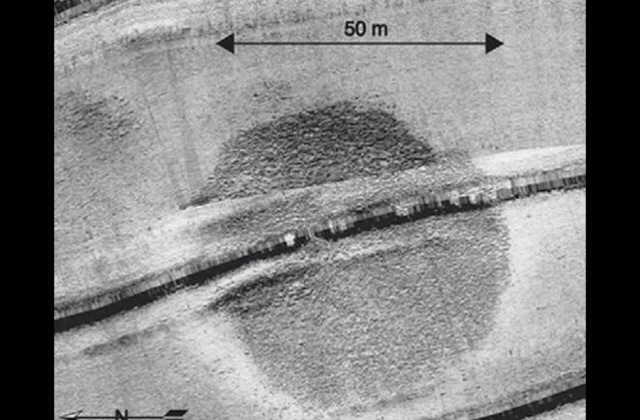
Hiding in the murky depths, a perfect, man-made cone rises from the seabed. A silent, colossal monument that has absolutely no business being there. This isn’t a natural formation. This isn’t a pile of rocks. This is a structure. Purposeful. Deliberate. And huge.
We’re talking about an estimated 60,000 tons of unhewn basalt boulders, stacked nearly 32 feet high and stretching 230 feet across its base. That’s twice the diameter of Stonehenge. Heavier than a modern aircraft carrier. It’s a structure so massive it warps our understanding of the ancient world. And for years, archaeologists have been asking one simple, chilling question: Who on Earth built it?
The Anomaly Beneath the Waves
Let’s get one thing straight. Building something like this on dry land today would be a major engineering project. It would require fleets of trucks, heavy cranes, and a small army of workers. Now, try to imagine constructing it thousands of years ago.
How do you quarry, transport, and stack sixty thousand tons of rock without wheels, without advanced machinery, without anything more than raw human power? The sheer scale of the effort is mind-boggling. The organization required is off the charts. Yet, there it sits. A silent testament to a forgotten people with an unknown purpose.

Researchers who first stumbled upon the sonar blip in 2003 thought it was a mistake. A ghost in the machine. But subsequent dives and analysis confirmed the impossible. It’s real. Made of basalt—the local volcanic rock—the boulders are fitted together with a precision that defies its crude appearance. This was no random dumping of stones. This was architecture.
Dr. Yitzhak Paz of the Israel Antiquities Authority has suggested the structure could be over 4,000 years old. This places it firmly in the Early Bronze Age. For context, this is the same period the Great Pyramids of Giza were being finished. It’s a time of the first great cities, the birth of empires. And right here, near the ancient city of Bet Yerah (one of the largest in the region at the time), someone was undertaking a project of pharaonic proportions. And then it vanished beneath the waves.
A Drowned City or a Tomb for a Giant?
So, what is it? The theories are as murky as the water it sits in.
The most conservative guess is that it’s a cairn. A monumental burial mound. Ancient cultures across the globe built massive stone piles to honor their dead kings or heroes. If this is a tomb, it was built for someone of immense importance. A legend. Perhaps even a giant, as the old tales of the region suggest. But whose tomb would require a monument that could dwarf nearly every other cairn found in Europe and the Middle East?
Another idea is that it was never meant to be underwater at all. What if 4,000 years ago, the water level of the Sea of Galilee was much, much lower? What if this massive cone was a prominent landmark, a central ceremonial site for a thriving lakeside community? Geologists confirm that lake levels have fluctuated wildly over the millennia. It’s entirely possible this structure was built on dry land, only to be swallowed by the rising waters in a dramatic climate shift or a catastrophic flood, its memory erased from history and preserved only in legend.
This idea is tantalizing. It hints at a lost landscape. A world buried right under our feet, or in this case, our boats. A world we can only glimpse through the electronic eyes of a sonar machine.
The Pattern Spreads: Works of the Old Men
Just when you think this underwater pyramid is a one-off anomaly, the story takes a hard left turn into the truly bizarre. Because it’s not alone. Not even close.
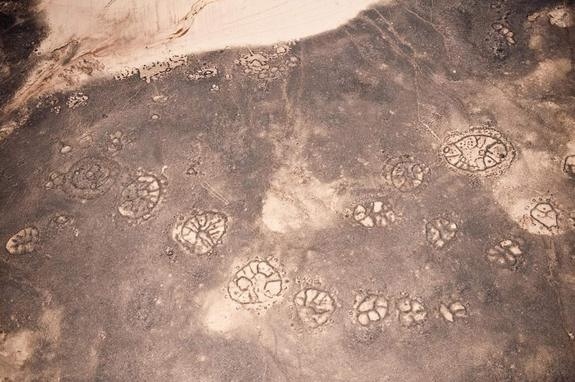
Zoom out. Look across the border into the lava fields of Jordan, Syria, and Saudi Arabia. For centuries, Bedouin tribes have walked past thousands of strange stone structures, giving them a haunting name: the “Works of the Old Men.” To them, they were just part of the landscape. Ancient. Unknowable. But from the air? They transform into something else entirely.
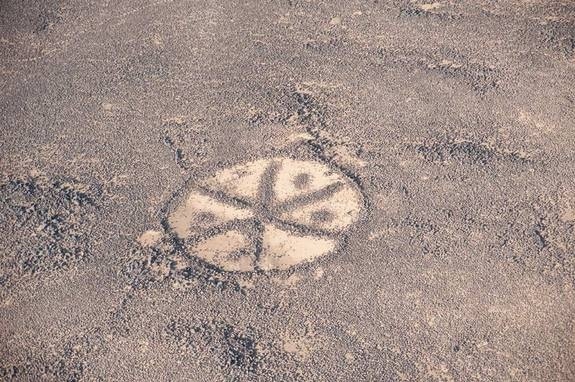
Pilots flying over the region in the early 20th century were the first to see the truth. The desert floor was covered in art. Intricate geometric patterns, vast chains of stone, and most curiously, hundreds upon hundreds of giant wheels.

These aren’t small formations. Many of these stone wheels are enormous, ranging from 80 feet to over 230 feet across—the exact same diameter as the submerged structure in the Sea of Galilee. It’s a stunning coincidence. Or is it a connection?
Decoding the Wheels in the Desert
These structures, best viewed from a god’s-eye perspective, are a silent enigma. Archaeologists used to believe they were ancient cemeteries. A convenient, simple explanation. But recent studies have thrown that theory into doubt. While some burial cysts have been found near them, they aren’t nearly enough to account for the sheer number and complexity of the wheels. This wasn’t just a graveyard.
It was something more.
The designs vary wildly. Some are simple circles of stone. Others have spokes, like a giant wagon wheel laid flat on the earth. These spokes often point in directions that seem to have astronomical significance, aligning with the sunrise on the winter solstice or with the rising of certain stars. Are we looking at a network of thousands of colossal, open-air clocks? A Stonehenge for the desert nomads?

The age of these wheels is even more shocking than their size. While some are dated to around 2,000 years ago, new dating techniques suggest the oldest of them could be an incredible 8,500 years old. That’s older than the pyramids. Older than Stonehenge. Older than writing itself. This is prehistory. A chapter of human existence we know almost nothing about, written in stone across a thousand miles of desert.
The Internet Archaeologists Join the Hunt
For decades, these sites were the exclusive domain of academics. But not anymore. With the advent of high-resolution satellite imagery from services like Google Earth, a new generation of digital explorers has joined the search. From their living rooms, armchair archaeologists are scanning the deserts, finding new wheels, kites, and pendants every single day. They are mapping a lost world the so-called experts never knew existed.
Online forums buzz with theories. Are the wheels marking sources of water? Are they territorial claims of forgotten tribes? Or is it something more esoteric? Some users trace lines between the major wheel clusters, suggesting they form a massive grid. A map. Or maybe, as the more fringe theories propose, an energy network, with the structures acting as focal points for forces we no longer understand.
And that brings us back to the anomaly at the bottom of the sea. Could the Galilee structure be the missing centerpiece? The capital city, the central temple, or the power source for this entire network of desert wheels? A structure so important it was built on a monumental scale, only to be lost to a great flood that severed it from the rest of its kind.
What If We’ve Got It All Wrong?
The official explanations feel safe. Burial mounds. Calendars. Ritual sites. They are comfortable theories that fit within our neat little box of history. But what if the box is wrong?
What if the people who built these weren’t simple Bronze Age farmers or Neolithic hunters? The sheer scale of this geo-engineering project suggests a society with a level of coordination that history tells us shouldn’t exist that far back. They were shaping the very surface of the Earth for a purpose we can no longer comprehend.
Imagine the scene 4,000 years ago. On the shores of a lower, smaller Sea of Galilee, a massive construction project is underway. Thousands of people are moving multi-ton boulders to erect a perfect cone, a man-made mountain that will dominate the landscape. At the very same time, across the deserts of Jordan, other groups are laying out giant stone circles with astronomical precision. Were they communicating? Were they part of the same culture? A forgotten kingdom of stone builders?
This isn’t just a local mystery. It’s a global one. From the Nazca Lines in Peru to the great circles of Southern Africa, ancient cultures all over the world felt compelled to create massive artworks only truly visible from the sky. Why? Who were they trying to signal? Their gods? Or someone else?
The Galilee Anomaly and the desert wheels are not just piles of rock. They are a question. A challenge. They are the faint echoes of a lost chapter of the human story, whispering to us from beneath the waves and across the sands of time. And the scariest part? We have only just begun to listen.