Tuesday, May 12, 2026
HomeUnexplained MysteriesHistorical MysteriesUnderwater Mystery - Lake Michigan’s Stonehenge

Underwater Mystery – Lake Michigan’s Stonehenge

The Abyss Stares Back: What Really Lies Beneath Lake Michigan?

Water covers seventy percent of our planet. We like to think we have mapped it all, that we have conquered every corner of the globe with our satellites and our sonar. We are wrong. We are so incredibly wrong.

Most people look at the Great Lakes and see a vacation spot. They see fishing boats. They see beautiful sunsets. But if you strip away the water, if you pull the plug on Lake Michigan, you reveal a landscape that has been frozen in time for thousands of years. A ghost world.

And sitting there, in the silence of the deep, is a circle of stones.

It shouldn’t be there. According to the history books taught in schools, the timeline doesn’t fit. The technology shouldn’t exist. And yet, there it is. A structure that whispers of a lost time, a lost people, and a civilization that vanished before history even began to record its name.

This isn’t just a pile of rocks. This is a challenge to everything we think we know about North American history. Welcome to the mystery of the Lake Michigan Stonehenge.

20140112-144854.webp

The Accidental Discovery that Shook the Archaeological World

It wasn’t supposed to happen like this. Great discoveries are supposed to be planned, right? Indiana Jones looking for the Ark. Expeditions with millions of dollars in funding.

But reality is stranger. It’s messier.

Rewind to 2007. Mark Holley, a professor of underwater archaeology at Northwestern Michigan College, was out on the water. He wasn’t hunting for ancient civilizations. He wasn’t looking for aliens or Atlantis. He was looking for old boat wrecks. The Great Lakes are a graveyard of ships; thousands of vessels have gone down in these treacherous waters over the last few centuries.

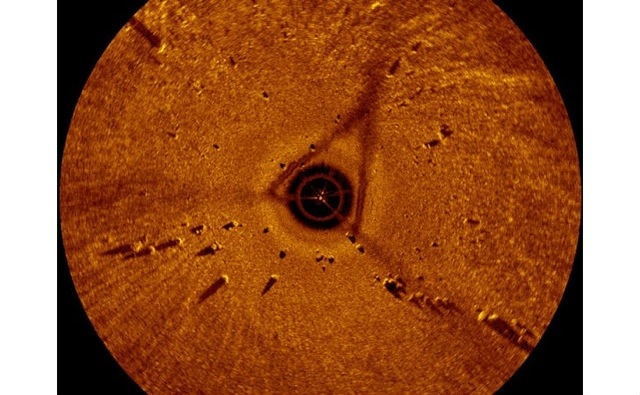
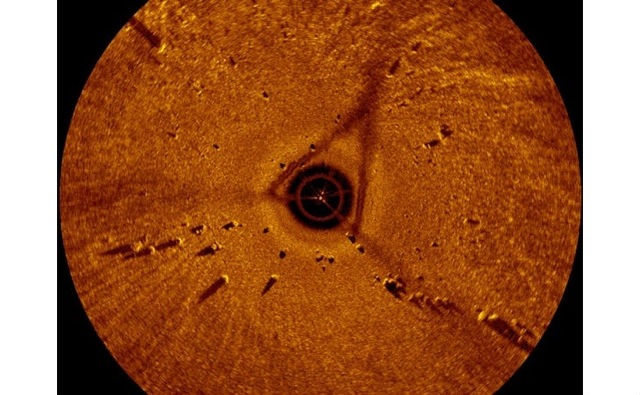
Holley and his colleague, Brian Abbott, were cruising Grand Traverse Bay. They were dragging sonar equipment, eyes glued to the monitors, expecting the jagged shape of a 19th-century schooner. A broken mast. A rotting hull.

Instead, the sonar painted something else. Something distinct. Something… organized.

40 feet down.

A row of stones. Not scattered by the chaotic currents. Not tumbled by a storm. They were arranged. A line. A circle. The stones were massive, some arranged in a way that immediately screamed “intentional” to the trained eye. Nature is chaotic. Nature breaks things. Nature doesn’t usually line up heavy boulders in a perfect geometric pattern.

The team was stunned. This was the bottom of a lake. Who builds a stone circle underwater?

Nobody. You build it on dry land. And that’s when the chill sets in. Because for that spot to be dry land, you have to go back a long, long time.

The “Stonehenge” Connection

The media immediately dubbed it “Lake Michigan Stonehenge.” It’s a catchy headline. It grabs you. But is it accurate? Yes and no.

It isn’t a replica of the famous site in England. It doesn’t have the massive lintel stones resting on top of pillars. But the layout is hauntingly familiar to anyone who studies megalithic sites. It is a henge-like structure. A circular or semi-circular arrangement of large stones, clearly placed for a specific purpose.

Ceremonial? Astronomical? A marker for a burial ground?

We see this pattern all over the world. From the stone circles of Scotland to the medicine wheels of the Native American plains. Humans, for some reason, are obsessed with circles. They represent the sun, the moon, the cycle of life and death. The discovery in Lake Michigan suggests that whoever lived in this region thousands of years ago shared this same universal human compulsion.

They wanted to mark their place in the universe. They dragged these heavy stones, aligning them with… what? The sunrise? A specific star? The questions started piling up immediately.

The Impossible Carving: A Ghost from the Ice Age

Finding rocks in a line is one thing. Skeptics can argue about that all day. “Oh, it’s just glacial deposits,” they say. “The glaciers pushed rocks into piles.”

Fair enough. Glaciers are powerful. They move mountains.

But glaciers don’t draw pictures.

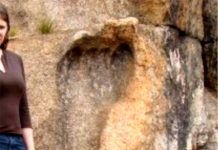
This is where the story takes a turn from “interesting geological oddity” to “mind-bending historical mystery.” On one of the stones, the divers found something. A petroglyph. A carving.

It wasn’t a fish. It wasn’t a deer. It wasn’t a boat.

It was a Mastodon.

Let that sink in for a second. A Mastodon. A massive, hairy, elephant-like creature with tusks that curved upward. These beasts were the tanks of the Ice Age. They roamed North America alongside saber-toothed cats and giant sloths.

But here is the kicker: Mastodons went extinct over 10,000 years ago.

This changes everything. If the carving is authentic, it acts as a timestamp. It’s a radiocarbon date etched in stone. You cannot carve a picture of an animal you have never seen. The artist had to be there. They had to look a Mastodon in the eye. They had to smell it, fear it, hunt it.

This implies that the stone arrangement was built when Mastodons were still walking the Earth. It means this structure is at least 10,000 years old. Probably older.

This puts the Lake Michigan site in the same league as Göbekli Tepe in Turkey—the site that rewrote human history. It suggests that while Europe was still clawing its way out of the ice, there were complex human societies in Michigan creating monumental architecture and art.

Deep Dive: When the Lake Was a Gorge

To understand how this is possible, we have to travel back in time. We have to erase the map we know today.

12,000 years ago, the world was ending. Or rather, the world of the Ice Age was ending. The climate was warming. The massive ice sheets that covered Canada and the northern US were melting. But it wasn’t a smooth process. It was violent. Water levels fluctuated wildly.

Geologists know that the basin we call Lake Michigan wasn’t always full of water. There were periods when the water levels were drastically lower. Much of what is now the lakebed was dry land. It was a tundra, a vast gorge rich with resources.

Imagine the Grand Traverse Bay not as a bay, but as a valley. A river ran through it. Herds of Mastodons migrated through the corridor. And humans followed them.

These Paleo-Indians were not just mindless brutes wandering aimlessly. They knew the land. They had culture. They had religion. This spot, now 40 feet underwater, might have been a sacred meeting place. A hunting ground? A temple?

Then, the water returned.

It didn’t happen overnight, but geological time moves fast. The glaciers melted. The basin filled. The “Lake Chippewa” phase ended, and the water rose, swallowing the valley. The stone circle was submerged. The village sites were drowned. The history was frozen in the cold, fresh water, waiting for Mark Holley’s sonar to ping it 10,000 years later.

The Silence of the Skeptics and the “Pareidolia” Defense

You might be asking, “If this is real, why isn’t it on the front page of every newspaper? Why aren’t we rewriting the textbooks right now?”

Great question.

Science is conservative. Archaeology, even more so. It moves at a glacial pace (pun intended). To claim that a site is 10,000 years old requires extraordinary proof.

The skeptics have a favorite word: Pareidolia.

This is the psychological phenomenon where the human brain sees patterns that aren’t there. It’s why you see a face on the moon, or a dragon in the clouds, or Jesus on a piece of burnt toast. Skeptics argue that the “Mastodon” carving is just scratches on a rock. They say the lighting underwater plays tricks on the eyes. They claim the “circle” is just a random cluster of boulders dropped by a melting glacier.

And to be fair, underwater archaeology is a nightmare. You can’t just walk up to the rock and brush it off. You are fighting currents. You are fighting murky visibility. The rocks are covered in algae and invasive mussels.

Since the discovery in 2007, the site has been kept relatively quiet. The exact coordinates are a closely guarded secret. This is partly to protect the site from looters, but also because the local Native American tribes consider the area sacred.

But the experts who have seen the sonar scans, and the few divers who have been down there, say the geometry is too precise. The “random glacier” theory falls apart when you look at the spacing.

Ancient Americas: A History Erased?

This discovery taps into a much larger, much more heated debate. How long have humans really been in the Americas?

For decades, the “Clovis First” dogma ruled. Scientists insisted humans arrived about 13,000 years ago across the Bering Land Bridge. But that theory is dead. It has been killed by discoveries like the Monte Verde site in Chile and the White Sands footprints in New Mexico, which push the date back to 23,000 years ago or more.

The Lake Michigan stones fit into this new, mysterious timeline. If humans were here 20,000 years ago, what were they doing? They weren’t just surviving; they were building.

We have found other anomalies in the Great Lakes.

  • The Lake Huron Hunting Drive: On the Alpena-Amberley Ridge beneath Lake Huron, researchers found stone lines used to funnel Caribou. This is confirmed. It’s a complex hunting structure underwater. If they built that in Lake Huron, why not a ceremonial circle in Lake Michigan?
  • Rock Lake Pyramids: In Wisconsin, stories of underwater pyramids have circulated for a century.
  • The Copper Connection: The Upper Peninsula of Michigan has ancient copper mines that were worked thousands of years ago. Tons of copper was extracted. Where did it go? Who took it? The trade networks of these ancient people were vast.

The Lake Michigan Stonehenge is not an isolated freak of nature. It is likely part of a massive, submerged cultural landscape that we are only just beginning to see.

The Anishinaabe Connection

We must listen to the people who have lived here the longest. The Anishinaabe tribes (Ojibwe, Odawa, Potawatomi) have oral histories that go back thousands of years. They speak of a time when the water levels were different.

They have stories of the “Great Flood.” Almost every ancient culture does, but here, the geology backs it up. The rising of the Great Lakes after the Ice Age was a great flood. It swallowed hunting grounds. It swallowed ancestors.

When shown the images of the underwater stones, tribal representatives weren’t shocked. To them, it’s not a “discovery.” It’s a memory. It’s confirmation of what their grandmothers and grandfathers told them around the fire.

There is a rock in the middle of the circle. Some theories suggest it could be an altar. Others suggest it’s a navigational point. But if you talk to those attuned to the spiritual history of the land, they tell you that these places were portals. Points of connection between the Sky World, the Earth, and the Underworld (the water).

What If It’s Not Just a Circle?

Let’s get speculative for a moment. Let’s push the boundaries.

If there is a stone circle, could there be more? A village? A burial complex?

Wood rots. Bone dissolves in acidic soil (though underwater preservation can be surprising). But stone endures. If we scanned the entirety of Lake Michigan with the latest LIDAR and high-resolution sonar, what would we find?

Are we looking at the North American equivalent of Doggerland? (Doggerland was the landmass connecting Britain to Europe that sank beneath the North Sea). In Europe, trawlers drag up mammoth skulls and ancient tools from the ocean floor constantly. The Great Lakes are our Doggerland.

Imagine a bustling civilization living in the valley that is now Grand Traverse Bay. Smoke rising from fires. Children playing near the river. Shamen carving the image of the great beast, the Mastodon, onto a sacred boulder to ensure a good hunt.

Then the water rises. Year by year. They retreat. They abandon the circle. The water covers the stone. The moss grows. The Mastodon dies out. The memory fades into myth. Then the myth fades into silence.

Until a sonar blip in 2007 brings it back from the dead.

The Final Mystery

So, where do we stand today? Is it proof of a lost advanced civilization? Is it a prehistoric hunting blind? Or is it the world’s biggest coincidence?

The carving of the Mastodon is the key. Experts are still analyzing it. But verifying a carving on a rock that has been underwater for ten millennia is incredibly hard. There is no carbon to date on a groove in a stone.

But consider this: Why would someone fake it? Why would someone dive 40 feet down into freezing cold water, scrub off a boulder, and carve a fake mastodon just to trick a sonar operator years later? It doesn’t make sense. The hoax theory is harder to believe than the ancient history theory.

The Lake Michigan Stonehenge remains a puzzle. It sits there, in the gloom, guarded by the cold fresh water.

It reminds us that we are tenants on this planet, living on top of the ruins of those who came before. The next time you look out at the sparkling blue waves of the Great Lakes, remember: you are looking at a roof. And underneath that roof, the ghosts of the Ice Age are waiting to tell their story.

The water holds its secrets tight. But every now and then, it lets one slip.

Originally posted 2014-01-12 14:52:26. Republished by Blog Post Promoter

Amit Ghosh
Amit Ghoshhttps://coolinterestingnews.com
Aloha, I'm Amit Ghosh, a web entrepreneur and avid blogger. Bitten by entrepreneurial bug, I got kicked out from college and ended up being millionaire and running a digital media company named Aeron7 headquartered at Lithuania.
RELATED ARTICLES
- Advertisment -

Most Popular

Recent Comments

Warren Pan Abbott on The legend of the Devil Monkey !
chris davies on The McPherson Tape Mystery
Reed Reedly on ET has Internet!
Bea Houseoffashion on Proof Of Time Travellers – Gallery
Marcus2012 on ET has Internet!
Reed Reedly on ET has Internet!
LaughsAtConspiracyNuts on The 9/11 Conspiracy – Myths and Facts
Alex Sliverman on Did the ancients fly?
Doctor Wholigan on Time Traveler in 1938 film
chris davies on The McPherson Tape Mystery
Archie1954 on 10 secret UFO hideouts
chris davies on Ghosts of flight 401
Marcus2012 on ET has Internet!
jason Macdonald on Proof of Time Travel? – China
chris davies on Long-Lost Pyramids Found?
Reed Reedly on ET has Internet!
Milkman on Connected Universe
Tenmiles on Baigong Pipes Mystery
Simon Foster on Sirius – The Documentary
From the 1st April on 2013 – Alien Contact date ?
SkyWatcher on Is ET ignoring us?
I Come From The Future on Obama to make UFO Alien disclouser soon ?
Just another person on 2013 – Alien Contact date ?
Malcolm Windowcleaner on The strange case of Rudolph Fentz
Mason Servio on Strange Things on Mars
Marke Wisdom Seeker on What will we find as arctic melts?
Andrea A Elisabeth Levyne on Aliens Captured in Varginha, Brazil
Mitch Grouyeki on Amazing Space Shuttle pictures