We think of the sun as a steady, reliable friend. It rises. It sets. It keeps us warm. But what if that friend is actually holding a loaded gun to our heads? On August 31, 2012, the sun didn’t just shine; it screamed. A whip of solar plasma, so large it defies human comprehension, snapped away from the surface of our star. It was a warning shot.
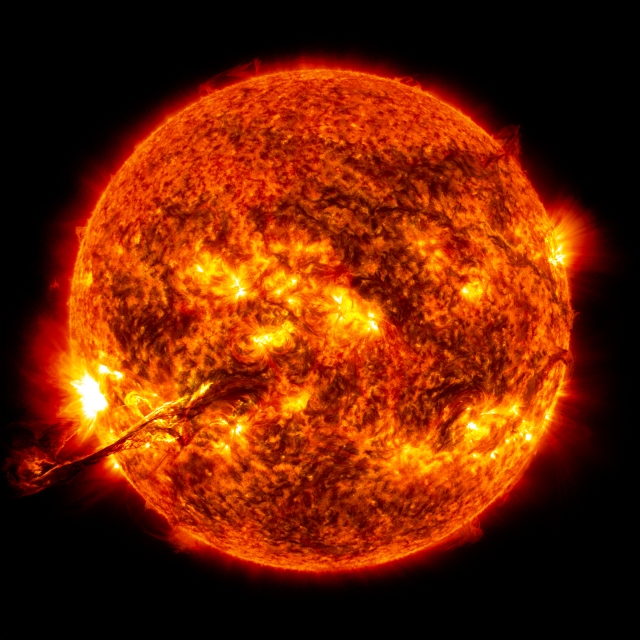
Look at this image. Really look at it.
That isn’t a small flicker. That filament of solar material you see exploding outward? It is hundreds of thousands of miles long. You could fit dozens of planet Earths inside that arc. If that whip had cracked in our direction, you wouldn’t be reading this on a computer. You wouldn’t be scrolling on a phone. You’d be wondering why the lights went out and why they aren’t coming back on.
This event on August 31 was a monster. An absolute beast. It was a reminder that we live in the atmosphere of a volatile, magnetic star that goes through moods. And in 2012, its mood was violent.
The Day the Sun Woke Up
NASA called it a “spectacular” event. That’s a nice, safe word. Scientists love words like that. It keeps people calm. But the reality of what happened that day is terrifying. The sun, approaching the peak of its 11-year cycle (known as Solar Maximum), decided to flex its muscles. This wasn’t just a solar flare. Flares are flashes of light. This was a Coronal Mass Ejection (CME) involving a massive filament eruption.
Think of a rubber band. Now, imagine that rubber band is made of superheated plasma and magnetic force fields. You twist it. You stretch it. You wind it up tighter and tighter until the tension is unbearable. That is what happens on the surface of the sun. Magnetic field lines get tangled. They cross over. They store energy like a cosmic bomb.
And then? SNAP.
On August 31, 2012, that snap released a long filament of solar material that had been hovering in the sun’s atmosphere (the corona). It didn’t just drift away. It was ejected into space at speeds that make a bullet look like it’s standing still. We are talking about millions of miles per hour. This material is radioactive. It is magnetized. And it is heavy.
The “Kill Shot” That Missed
Here is the part that keeps conspiracy theorists and alternative history buffs up at night. The timing. This happened in 2012. Remember the Mayan calendar? Remember the panic? Everyone was looking for a rogue planet or a shift in the poles. But the real threat was right there in the sky the whole time.
If this eruption had occurred just a week or two earlier, the rotation of the sun would have had the “barrel of the gun” pointed directly at Earth. We call this the Kill Shot scenario.
What happens if a CME of this magnitude slams into our magnetic field? It’s not like a sunburn. It’s an electromagnetic tsunami. The charged particles smash into our magnetosphere, compressing it. This induces massive electrical currents in the ground. Our power grid acts like a giant antenna, picking up this excess energy.
Transformers blow. Satellites fry. The internet? Gone. GPS? History. Modern banking, which relies on digital transactions and timing signals from space, would evaporate instantly. We aren’t talking about a power outage for a few hours. We are talking about months, maybe years, without electricity. A return to the 1800s, but with 8 billion people who don’t know how to farm.
The Carrington Echo
We have seen this before. History hides the clues. In 1859, the “Carrington Event” hit Earth. It was a massive solar storm. But back then, we didn’t have a sensitive grid. We had telegraph wires. Operators reported sparks flying from their equipment. Some telegraph papers caught fire. The Northern Lights were seen as far south as Cuba.
People thought the end of the world had arrived. And that was just with telegraphs. Imagine that same energy hitting our sensitive, microchip-dependent world today. The August 31, 2012 eruption was in that same weight class. It was a heavyweight contender. We just got lucky that the sun was looking the other way when it sneezed.
NASA’s Eye in the Sky
How do we know all this? Because we are watching. Always watching.
The image above comes from NASA’s Solar Dynamics Observatory (SDO). This spacecraft is a marvel. It stares at the sun 24/7, recording in different wavelengths of light that the human eye can’t see. The filament spotted by the SDO was described as “gigantic” by scientists. They don’t use that word lightly.
When the SDO captures these images, it creates a visual record of the violence of our star. The spacecraft, along with other sun-watching observatories like SOHO (Solar and Heliospheric Observatory), recorded video of this eruption. They saw the filament lift off, twist, and blast out into the black void of space. It’s beautiful, in a terrifying way.
These observatories are our early warning system. They give us a heads-up. Usually, we get about 15 to 72 hours of warning before a CME hits Earth. That’s enough time to put satellites in “safe mode” and maybe disconnect some grid transformers. But is it enough time to save civilization from a direct hit by a super-storm? The experts aren’t sure. The preppers say “no way.”
The Magnetic Dance
Let’s break down the science, but keep it simple. The sun is a ball of hot gas, right? Well, mostly plasma. Because the sun rotates, and because different parts of it rotate at different speeds (the equator moves faster than the poles), the internal fluids get messy. This movement generates magnetic fields. This is the sun’s dynamo.
But because the sun is fluid, these magnetic lines don’t stay straight. They get twisted. They poke through the surface. When they poke through, we see sunspots. These are the dark, cooler areas on the surface. But “cooler” is relative; they are still scorching hot.
Above these sunspots, you get arches of plasma. Prominences. Filaments. They hang there, suspended by magnetic force, defying gravity. The filament from August 31 had been hanging around for a while, unstable, waiting for a trigger. When the magnetic fields realigned—a process called magnetic reconnection—the energy was released instantly. It’s like cutting a taut rope.
The resulting CME didn’t just stay near the sun. It traveled outward, expanding as it went. By the time a CME reaches Earth’s orbit, it can be millions of miles wide. It’s a wall of particles.
Check out this thumbnail. It gives you a sense of the texture of the explosion.
The 2013 Peak vs. The Modern Cycle
The original report mentioned that flares were becoming more common as the sun approached a phase of “peak activity in 2013.” This is what astronomers call Solar Maximum. Every 11 years (roughly), the sun flips its magnetic poles. The north becomes south, and south becomes north. During this flip, the sun goes crazy. Sunspots everywhere. Flares daily. CMEs launching left and right.
2013 was indeed a peak. But here is where it gets interesting for those of us tracking the patterns. The 2013 peak was actually considered “weak” by historical standards. It was a double-peaked maximum, but it wasn’t the monster scientists feared. Some researchers think this is a lull before a bigger storm. A quiet sun can be deceptive.
Fast forward to today. We are now deep into Solar Cycle 25. And guess what? It is outperforming predictions. The sun is more active now than NASA thought it would be. The patterns we saw in 2012 are showing up again. The filaments are growing. The spots are multiplying. Are we due?
The “Terminator Event” Theory
There is a new theory floating around the internet called the “Terminator Event.” No, it’s not about robots. It’s about how solar cycles overlap. When the magnetic bands of the old cycle finally die off at the sun’s equator, the new cycle explodes into life with massive intensity. Some data suggests we trigger these Terminator events rapidly, leading to massive spikes in solar output.
Was the August 31, 2012 event a precursor? A symptom of these overlapping magnetic ribbons? We are still trying to figure it out. The sun is a chaotic system. It doesn’t follow a perfect clock.
The Electric Universe and Hidden History
Let’s step away from the mainstream narrative for a second. Why are ancient cultures obsessed with the sun? The Egyptians. The Aztecs. The Mayans. They all worshipped it, but they also feared it. Did they know something we forgot?
There is a growing community of researchers who believe in the Electric Universe theory. They argue that space isn’t an empty vacuum dominated only by gravity. They say space is filled with plasma and electric currents. In this view, the sun isn’t just a nuclear furnace; it’s a positively charged anode in a galactic circuit.
If this is true, then events like the August 31 eruption aren’t just random gas burps. They are electrical discharges. Short circuits on a cosmic scale. This would explain why the filament moved the way it did—snapping and twisting like a lightning bolt, not like a cloud of steam.
Did ancient civilizations witness a “Great Flash”? Some petroglyphs (rock carvings) around the world show stick figures with strange objects above their heads, or squatting figures with plasma-discharge shapes flanking them. Dr. Anthony Peratt, a plasma physicist, has noted that these carvings look exactly like high-energy plasma instabilities seen in laboratories.
Could the sky have looked like a glowing neon light thousands of years ago? Did a massive solar event reset civilization before recorded history? It’s a wild thought. But when you look at the power unleashed in 2012, it doesn’t seem so impossible.
What Would Have Happened?
Let’s play out the simulation. The date is August 31, 2012. The filament erupts. But this time, it flies straight at Earth. 18 hours later, the impact.
Phase 1: The Auroras. The sky turns green, then red, then purple. Not just in Alaska. We are talking about auroras over Florida, Texas, maybe even the equator. People run outside to take pictures. It’s beautiful.
Phase 2: The Blackout. The induced currents hit the high-voltage lines. Transformers overheat and melt. Safety trips blow. The hum of the city stops. Silence.
Phase 3: The Panic. Most people think the power will come back in a few hours. It doesn’t. Water pumps stop working (no electricity). Gas stations can’t pump fuel. Grocery stores are stripped bare within 24 hours. Without refrigeration, food rots.
Phase 4: The Long Dark. Replacing a high-voltage transformer isn’t like changing a lightbulb. These things are custom-built. They weigh tons. They take months to manufacture. And the factories that make them? They don’t have power either. It’s a catch-22. A feedback loop of collapse.
This is why space weather is included in national security assessments. It is a non-nuclear threat that could disable a nation without a single shot being fired.
The Mystery of the Missing Footage
Whenever big solar events happen, internet sleuths notice strange things. Sometimes, the SDO feeds cut out. Sometimes, hours of data go missing. NASA usually blames “calibration” or “glitches.” And hey, maybe that’s true. It’s complicated tech.
But suspicious minds wonder: What are they scrubbing? Are there objects near the sun? We’ve all seen the grainy YouTube videos claiming to show UFOs “refueling” by the sun. Is the sun a gas station for interstellar travelers? Or are these just artifacts and pixels acting weird?
The August 31 footage is remarkably clear. You can watch the full video (or what’s left of the archives) on various space weather sites. The sheer scale of the plasma rain falling back to the surface is mesmerizing. It looks like liquid light.
Conclusion: The Sleeping Giant
The filament of August 31, 2012, is a scar in our memory. It reminds us that we are small. We build our cities and our networks assuming the ground is stable and the sky is safe. But the universe is a violent place.
The sun is life-giving, yes. But it is also a machine of immense, chaotic power. It breathes. It snaps. And every once in a while, it throws a tantrum.
As we move through the current solar cycle, keep your eyes on the news. If you see reports of “X-class flares” or “CME impacts,” pay attention. The grid is more fragile than they tell you. The magnetic shield of our planet is currently weakening (that’s a whole other conspiracy for another day). We are more vulnerable now than we were in 2012.
So, enjoy the sunshine. But respect the fire. Because the next time a filament the size of Jupiter decides to break loose, it might not miss.
Originally posted 2016-04-01 16:29:38. Republished by Blog Post Promoter

Aloha, I’m Amit Ghosh, a web entrepreneur and avid blogger. Bitten by entrepreneurial bug, I got kicked out from college and ended up being millionaire and running a digital media company named Aeron7 headquartered at Lithuania.