The ocean is a vault. A massive, shifting, liquid vault that swallows history and rarely gives it back. We throw things in. Ships sink. Planes vanish. Secrets disappear into the crushing black pressure of the deep. But sometimes, just sometimes, the ocean decides to spit something back out.
And when it does, it changes everything we thought we knew about the passage of time.
Imagine walking on a beach. The wind is whipping your face. The salt spray stings your eyes. You are looking for sea glass or maybe a piece of driftwood. You look down, and there it is. Not a plastic soda bottle from last week. Not a beer bottle from a beach party. But a ghost. A vessel from a world that doesn’t exist anymore.
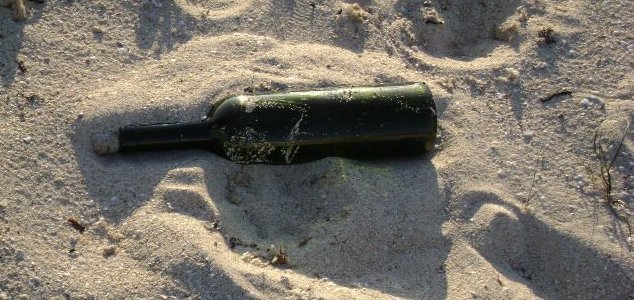
The bottle had been floating in the ocean for over a century. Image Credit: CC BY-SA 4.0 Dread83
The Discovery That Broke the Timeline
This isn’t fiction. This actually happened. A message in a bottle, a legitimate time capsule from the Edwardian era, washed up on the sands of Germany. It didn’t just survive a year or two. It survived 108 years.
Let that sink in.
One hundred and eight years.
When this bottle was thrown into the sea, the Titanic hadn’t been built yet. World War I was still a decade away. There was no plastic in the ocean. The Wright Brothers had only just figured out how to fly. And this glass traveler? It was just starting a journey that would outlast empires, kings, and entire generations.
The discovery happened on the North Sea island of Amrum. It’s a rugged, beautiful place where the waves hammer the coastline. Marianne Winkler and her husband Horst were taking a casual stroll. Just a normal day. They weren’t looking for fame. They weren’t looking for history.
Then, Marianne saw it.
It wasn’t like modern glass. Old glass ripples. It has imperfections. It feels different in your hand—heavier, more substantial. Inside, clearly visible through the clear glass, was a piece of paper. It wasn’t a pirate map. It wasn’t a love letter from a sailor to a lost wife. It was something far more calculating. Something scientific.
The “Break the Glass” Dilemma
“It’s always a joy when someone finds a message in a bottle on the beach,” Mrs. Winkler told reporters later. But this joy came with a problem.
How do you get the message out?
The paper had swelled. The humidity inside the sealed environment had expanded the fibers. Marianne and Horst tried to shake it out. They tried to tweak it with tweezers. No luck. The paper was wedged tight against the glass walls of its prison.
They had to make a choice. Preserve the bottle and never know the secret? Or destroy the vessel to read the words?
They chose the truth.
Carefully, they broke the bottle. The glass shattered, ending its century-long job as a guardian. They unrolled the paper. It was written in English, German, and Dutch. A true international SOS. But it wasn’t asking for rescue. It was asking for data.
The message asked the finder to fill in some information—where it was found and when—and return it to the Marine Biological Association in Plymouth, England.
The Mad Genius Behind the Bottle: George Parker Bidder
Who throws over a thousand bottles into the sea? A litterbug? No. A visionary.
The man behind this experiment was George Parker Bidder. In the modern world, we use satellites. We use GPS trackers that ping data to computers in real-time. We have drones that swim like sharks. But in 1904? They had glass, cork, and hope.
Bidder was a scientist at the Marine Biological Association (MBA). He was obsessed with the hidden highways of the ocean. He knew the water moved in massive, invisible rivers, but he couldn’t prove exactly how they flowed or how fast they moved.
So, he turned the ocean into a lottery.
Between 1904 and 1906, Bidder released 1,020 bottles. These weren’t just floating on the surface. These were “bottom drifters.” He weighted them specifically to sink just above the sea floor, trailing a wire to keep them drifting with the deep currents. He wanted to know what was happening down in the dark, where the flatfish lived.
His theory was that the deep currents in the North Sea flowed from east to west—the opposite of the surface currents. It was a bold guess. He needed proof.
The 108-Year Gap: Where Was It?
This is where the story gets spooky. This is the part that keeps conspiracy theorists and mystery lovers up at night.
Most of Bidder’s bottles were found relatively quickly. Fishermen trawled them up in nets within months. Within a few years, Bidder had his data. He proved his theory. He wrote his papers. He lived his life. He died in 1954.
But this bottle? Bottle number nearly-last?
It vanished.
Where was it for 108 years? If it was floating, it would have smashed against rocks decades ago. Glass is tough, but the ocean is brutal. A century of storms? Impossible.
The leading theory is that it was buried. Entimbed.
Imagine the bottle sinking in 1906. It settles into the soft mud of the North Sea floor. Over the years, sediment covers it. It is buried in a dark, cold grave. It sits there, motionless, while the world above burns.
- 1914: Submarines prowl the waters above it during WWI. The bottle sleeps.
- 1939: Destroyers and U-boats turn the North Sea into a graveyard during WWII. The bottle sleeps.
- 1969: Man lands on the moon. The bottle sleeps in the mud.
- 1990: The Berlin Wall has fallen. The internet is born. The bottle sleeps.
Then, something changed.
Maybe a massive storm churned up the seabed. Maybe the currents shifted due to climate changes (a scary thought on its own). Maybe a fishing trawler scraped the bottom and dislodged it without realizing. Suddenly, after a century of darkness, the bottle was free. Buoyant again. It floated up, caught a new current, and washed up at the feet of Marianne Winkler.
It’s like a time traveler stepping out of a portal.
The Message Returns Home
Marianne and Horst Winkler did exactly what the paper asked. They filled out the form. Found: Amrum. Date: 2015.
They put the fragile paper in an envelope and mailed it to Plymouth, UK. Imagine being the receptionist at the Marine Biological Association opening the mail that day. You get bills. You get junk mail. You get scientific journals.
And then you get a letter from 1906.
Guy Baker, the communications director at the MBA, described the moment. “It was a time when they were inventing ways to investigate what currents and fish did,” he explained. “The association still does similar research today, but we have access to technology they didn’t have, such as electronic tags. Many of the bottles were found by fishermen trawling with deep sea nets.”
But seeing one come back now? It was a shock to the system. It was the oldest message in a bottle ever recovered at that time (though others claim the title occasionally, this one has serious scientific provenance).
The Promise of a Shilling
Here is the most charming part of the whole mystery. The original note promised a reward.
In bold, formal print, George Parker Bidder promised one shilling to anyone who returned the bottle.
A shilling. In 1906, that was decent pocket money. It could buy you a meal or some tobacco. Today? It’s not even legal currency. The shilling was phased out when Britain decimalized its currency in 1971.
But the Marine Biological Association is a place of honor. They honor their debts. Even the old ones.
They tracked down an old shilling on eBay. They bought it. And they sent it to the Winklers in Germany. A promise made in the reign of King Edward VII was kept in the age of the iPhone.
“It’s always a joy,” Mrs. Winkler said. And she’s right. But it’s more than joy. It’s a connection.
Why This Matters: The Secrets We Haven’t Found
We think we have mapped the world. We think we have satellites that see everything. We think Google Earth has eliminated mystery. This bottle proves us wrong.
If a glass bottle can hide in one of the busiest seas on Earth for 108 years, what else is down there?
There are ships we haven’t found. There are planes we can’t locate. There are species we haven’t named. The ocean is 70% of our planet, and we have explored less than 5% of it. We know more about the surface of Mars than we do about the floor of the Pacific.
George Parker Bidder’s experiment was simple. Glass. Paper. Cork. Yet it outlasted the most advanced technology of its day. It outlasted the people who made it. It outlasted the nation that commissioned it.
The “Unrecovered” Percentage
Remember, Bidder released 1,020 bottles. He got about 55% back in the early years. Now, with the Winklers’ find, he has one more.
That means there are still hundreds of them out there.
Right now. As you read this. There are hundreds of 115+ year-old bottles sitting in the mud, or trapped in coral, or bobbing in an eddy in the Arctic Circle. Waiting.
Are they just trash? Or are they data points waiting to complete a graph started by a dead man?
The Modern Mystery: Is the Ocean Spitting Things Out?
Internet theorists and alternative history buffs have been buzzing about this find for another reason. Why are so many “lost” artifacts showing up lately?
We are seeing ancient ships emerging from melting glaciers. We are seeing WWII wreckage appearing on drying riverbeds. And we are seeing century-old bottles washing up on popular beaches.
Is the earth shifting? Is the climate crisis churning the deep water layers, forcing the bottom to the top? “Bottom Drifters” like Bidder’s bottle were never meant to surface unless dragged up. For this to wash ashore means the water column was disturbed violently or the seabed shifted drastically.
It’s a warning wrapped in a curiosity.
The Verdict
Marianne Winkler didn’t just find a souvenir. She found a ghost story. She found a scientific marvel. She completed a transaction that began before her parents were born.
The next time you are at the beach, don’t just look at the sunset. Look at the sand. Look at the tangled seaweed. Look at the trash.
Because amidst the plastic caps and cigarette butts, there might be a message waiting for you. A message from the past, waiting to be read. The ocean keeps its secrets well, but it doesn’t keep them forever.
“Others washed up on the shore, and some were never recovered,” the MBA stated. Until now.
So, keep your eyes open. The next shilling could be yours.
Originally posted 2015-08-28 16:18:50. Republished by Blog Post Promoter

Arindam loves aliens, mysteries and pursing his interest in the area of hacking as a technical writer at ‘Planet wank’. You can catch him at his social profiles anytime.