Imagine this. It’s the dead of night. The city sleeps. But inside the hallowed halls of the world’s most prestigious museums, shadows are moving. We aren’t talking about ghosts. We’re talking about the most daring, sophisticated, and frankly insane criminals to ever walk the earth. These aren’t just thefts. They are vanishings. Masterpieces worth more than the GDP of small island nations, gone. Poof. Into thin air.
How does a painting the size of a door just walk out of a building? Who buys a stolen Van Gogh? You can’t exactly hang it in your living room when the FBI, Interpol, and every art hunter on the planet is looking for it. That’s the mystery. That’s the hook. Today, we are cracking open the cold case files on the most expensive, mind-bending art heists in human history. Buckle up. This gets weird.

The 81 Minutes That Shook the Art World
March 18, 1990. Boston. St. Patrick’s Day celebrations had just wrapped up. The streets were filled with the smell of spilled beer and the echo of bagpipes. But at the Isabella Stewart Gardner Museum, things were quiet. Too quiet. At 1:24 AM, a buzzer rang at the side entrance. Two men in police uniforms stood there. They said they were responding to a disturbance.
The guard, a young guy, maybe bored, maybe naive, buzzed them in. Big mistake. Within minutes, both guards were handcuffed and duct-taped to pipes in the basement. They weren’t cops. They were ghosts. For the next 81 minutes, these thieves didn’t run. They didn’t rush. They took their sweet time.
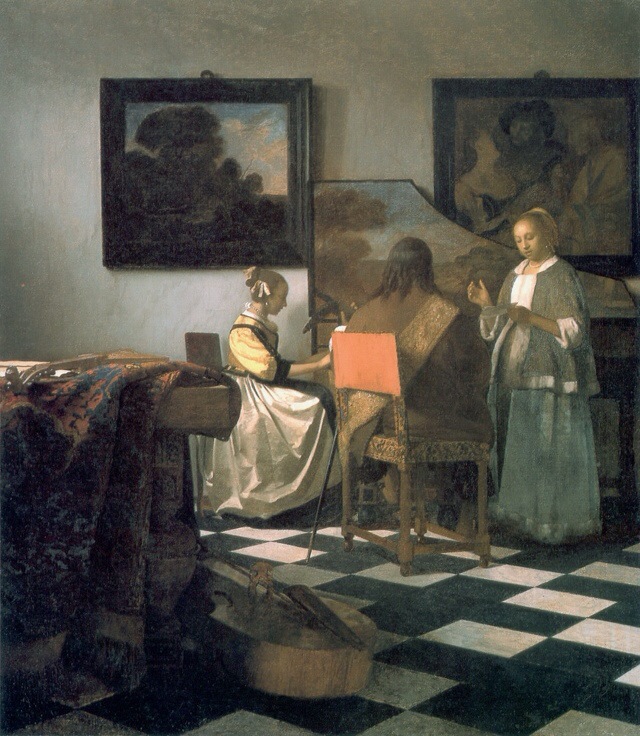
The Holy Grail: Vermeer’s The Concert
They smashed glass. They used box cutters. They sliced canvases right out of their gilded frames. Brutal. Efficient. When the sun came up, thirteen pieces were gone. The haul? A cool $500 million. Half a billion dollars. It remains the single largest property theft in the history of the world.
The crown jewel of this heist was the painting you see above: Johannes Vermeer’s The Concert. Why is this specific painting so important? Because Vermeer is the unicorn of the art world. There are only about 34 confirmed works by him in existence. Losing one is like losing a planet from our solar system. This isn’t just paint on canvas; it’s a snapshot of the Dutch Golden Age that we can never get back.
Where Is It Now?
This is where the rabbit hole goes deep. Theories abound. Some say the Boston mob orchestrated the hit to use the art as a bargaining chip—a “get out of jail free” card to trade with the FBI. Others whisper about connections to the IRA in Ireland. Was the painting shipped across the Atlantic in a fishing trawler? Is it sitting in a climate-controlled bunker in South America? Or, and this is the nightmare scenario, was it destroyed? A $5,000,000 reward sits on the table today. Nobody has claimed it. Silence. Just silence.

The Sea of Galilee: A Storm That Never Ends
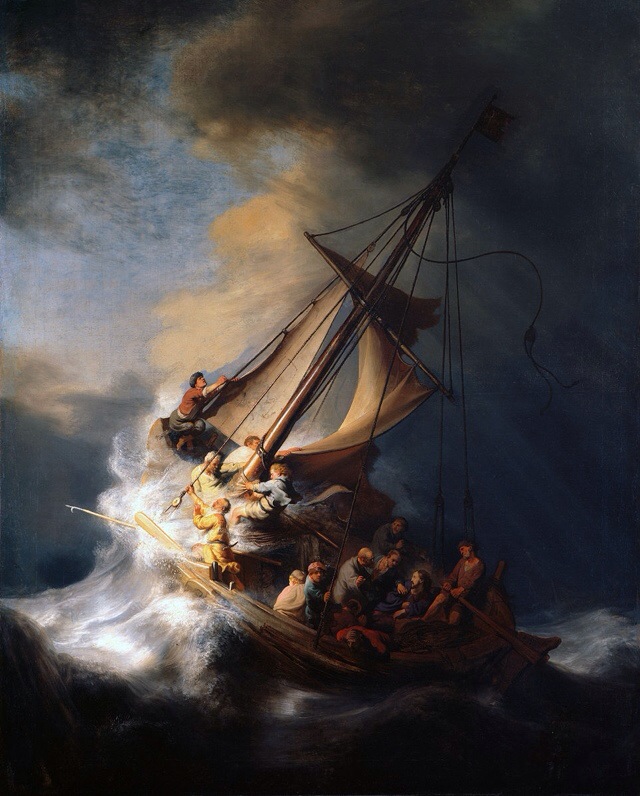
The thieves weren’t done with Vermeer. They wanted Rembrandt. They walked up to The Storm on the Sea of Galilee, Rembrandt’s only seascape, and cut it out. Look at this image. It’s chaotic. Violent. Beautiful.
Painted in 1633, this piece depicts the biblical scene from the Gospel of Mark where Jesus calms the waves. But look closer. Count the people. There are fourteen men in that boat. Twelve disciples. One Jesus. Who is the fourteenth man? Art historians have been screaming about this for years. The man looking straight out at you, clutching his hat, staring into your soul? That’s Rembrandt himself. He painted himself into the panic.
The Psychological Profile of the Theft
Why steal this? It’s huge. It’s cumbersome. This tells us something about the thieves. They weren’t just grabbing whatever glittered. They had a hit list. They knew exactly where this hung. They knew the layout. This screams “inside job” or highly sophisticated surveillance. You don’t just stumble upon a Rembrandt in the dark.
Today, if you visit the Gardner Museum, you’ll see something heartbreaking. They didn’t replace the paintings. They left the empty frames hanging on the walls. It’s a memorial. A ghost story you can touch. Those empty rectangles are a promise: We are waiting for you to come home.

The Curse of the Poppy Flowers
Now, let’s leave Boston and head to Cairo, Egypt. This story is so ridiculous you might think I’m making it up. I’m not. Vincent van Gogh’s Poppy Flowers (sometimes called Vase and Flowers) is a small, vibrant masterpiece worth an estimated $50 million to $55 million. Van Gogh painted it as a tribute to Adolphe Monticelli. The colors vibrate. The contrast is deep. It’s pure emotion.
But here is the kicker: This painting has been stolen from the Mohamed Mahmoud Khalil Museum not once, but twice.
The Comedy of Errors
The first time was in 1977. It vanished. Ten years later, it mysteriously surfaced in Kuwait. Okay, fine. Recovered. Case closed. But then came August 2010. In broad daylight, someone walked in, cut the canvas from the frame, and walked out.
How? How does that happen in a major museum? Well, brace yourself. Reports surfaced later that out of 43 security cameras, only seven were working. The alarms? Dead. The guards? Nowhere to be found. It was less of a heist and more of a “come in and take what you want” sale.
The Fake Victory
Here is where it gets spicy. Hours after the theft, Egyptian officials announced, “We got it!” They claimed they caught two Italians at the Cairo airport trying to smuggle the painting out in their luggage. The world cheered. Champagne corks popped. But then, the Minister of Culture had to go on live TV and admit… oops. False alarm. They didn’t have the painting. The suspects had nothing.
Was the false announcement a stall tactic? A cover-up? To this day, the painting is gone. Some conspiracy theorists think it never left Egypt. Is it hanging in the private villa of a corrupt official? The incompetence was so high that nearly a dozen museum officials ended up on trial for negligence. But the Van Gogh? Still missing.

The Theft That Created a Legend
You know her. You love her. The Mona Lisa. But here is a truth bomb that art history classes often skip: Before August 21, 1911, the Mona Lisa wasn’t the painting. She was just a painting. A good one, sure. A Leonardo da Vinci, absolutely. But she wasn’t the global icon of mystery she is today. It took a thief to make her a superstar.
It was a Monday. The Louvre was closed for maintenance. Vincenzo Peruggia, an Italian handyman who had been working on the museum’s protective glass cases, did something incredibly simple. He hid in a broom closet. He waited until the coast was clear, stepped out, took the painting off the wall, wrapped it in his smock, and walked out the door. That’s it. No lasers. No acrobatics. Just a guy in a closet.
Suspect #1: Pablo Picasso?
The investigation was a circus. The French police were desperate. They dragged in anyone who looked suspicious. And guess who they arrested? The poet Guillaume Apollinaire. He then fingered his friend, a young, radical artist named Pablo Picasso. Can you imagine? Picasso, sitting in a police interrogation room, suspected of stealing the Mona Lisa. Both were eventually cleared, but the drama sent the painting’s fame into the stratosphere.
For two years, the Mona Lisa sat in a trunk in Peruggia’s apartment, just blocks from the Louvre. He claimed he did it for Italy—to return the masterpiece to its homeland. A patriot? Or a crook looking for a payday? When he finally tried to sell it to an art dealer in Florence, the game was up. He went to jail (briefly), and the Mona Lisa went back to the Louvre, now the most famous woman in the world.

The Y2K Phantom
Fast forward to the turn of the millennium. December 31, 1999. The entire world was staring at clocks, worried about Y2K bugs, and preparing to party. In Oxford, England, the sky was exploding with fireworks. The noise was deafening. The crowds were cheering.
Perfect cover.
At the Ashmolean Museum, thieves used the noise of the Millennium fireworks to mask the sound of breaking in. They went straight for Paul Cézanne’s View of Auvers-sur-Oise. This wasn’t a finished, polished piece. Cézanne never signed it. He didn’t date it. He thought it was incomplete. But the thieves knew its worth. Estimated at around £3 million at the time, its value has only skyrocketed since.
The “Art-Napping” Phenomenon
This brings us to the dark reality of modern art crime. Why steal a Cézanne? You can’t sell it at auction. Sotheby’s isn’t going to touch it. This is where “Art-Napping” comes in. The theory is that gangs steal these works to hold them ransom. They demand the insurance company pay a “finder’s fee” (usually 10% of the value) to get it back. It’s a business transaction.
But sometimes, the deal goes sour. The heat gets too hot. And the painting? It gets destroyed to destroy the evidence. Is View of Auvers-sur-Oise sitting in a damp basement, rotting away? Or was it burned in a panic? The empty space on the wall is a reminder that even as we celebrated a new era, history was being stolen from right under our noses.
The Final Question
These aren’t just stories about canvas and oil. They are stories about greed, obsession, and the dark underbelly of culture. Somewhere, right now, the Concert is sitting in the dark. The Storm on the Sea of Galilee is waiting for the waves to settle. And the people who know where they are? They aren’t talking.
Keep your eyes open. You never know what you might find at a garage sale.
Originally posted 2014-02-26 01:20:48. Republished by Blog Post Promoter