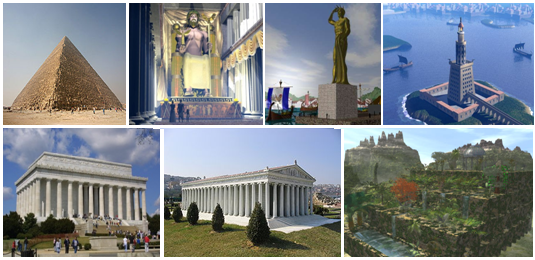
Stop scrolling for a second. Look at that image above. Really look at it.
You’ve seen these structures in textbooks since you were a kid. You’ve memorized their names for quizzes. But have you ever stopped to ask the question that drives historians and engineers absolutely crazy?
How?
We are talking about civilizations that supposedly didn’t have the wheel, didn’t have steel, and didn’t have computers. Yet, they built things that our modern cranes and lasers would struggle to replicate today. The narrative we’ve been fed is simple: “They had a lot of slaves and a lot of time.”
I don’t buy it. And neither should you.
The “Seven Wonders of the World” isn’t just a list of tourist attractions from antiquity. It is a crime scene. It is a collection of impossible anomalies that suggest our ancestors knew things—physics, geology, maybe even acoustics—that we have completely forgotten. They were tapping into something else.
Today, we are ripping up the history books. We are going back to the sand and the stone to figure out what was really going on with the Ancient Seven.
The Sacred Number: Why Seven?
First off, let’s address the math. Why seven? Why not ten? Why not five?
The Greeks didn’t just pick a number out of a hat. In the ancient world, math wasn’t just counting; it was a language of the gods. The number Seven (7) was the indicator of prosperity, specific cosmic alignments, and what they considered “perfection.”
Think about it. Seven seas. Seven continents. Seven musical notes. Seven days of the week. The ancients believed this number vibrated with the universe itself. By grouping these massive structures into a set of seven, they weren’t just making a travel guide. They were creating a circuit. A grid.
Some alternative historians believe these sites were placed on specific ley lines—invisible energy currents running through the Earth. When you map them out, the geometry gets weird. Really weird. But let’s look at the structures themselves.
1. The Great Pyramid of Giza: The Power Plant Theory
This is the big one. The only Wonder that is still standing. And frankly, it’s the one that makes the least amount of sense.
Mainstream Egyptologists say it’s a tomb. A fancy grave for Pharoah Khufu. But here is the problem: They never found a body.
No mummy. No hieroglyphics on the walls praising the king (except for one questionable graffiti mark found in a crawl space). No treasure. Just a massive, empty stone box.
The Impossible Engineering
The Great Pyramid consists of 2.3 million blocks of stone. Some weigh as much as 80 tons. That is the weight of 50 Toyota Camrys fused together.
To build this in the 20-year timeframe historians claim, the Egyptians would have had to quarry, cut, transport, and set one massive stone block every two and a half minutes. Day and night. Without stopping. For twenty years.
Does that sound like guys with copper chisels and hemp ropes? No way.
Christopher Dunn and other researchers have proposed a wilder theory: The Giza Power Plant. They suggest the pyramid wasn’t a tomb, but a machine. The specific type of granite used in the King’s Chamber is highly conductive. The pyramid is aligned to true north with higher accuracy than the Meridian Building in London. Why do you need that kind of precision for a dead guy?
You don’t. You need that precision if you are channeling energy.
2. The Hanging Gardens of Babylon: The Phantom Wonder
This one is my favorite because it might not have even existed. At least, not where they say it was.
King Nebuchadnezzar II supposedly built this mountain of greenery in the middle of modern-day Iraq to cheer up his wife, who missed the green hills of her homeland. It was a marvel of hydraulic engineering. Water needed to be pumped up hundreds of feet to keep these trees alive in a scorching desert.
The Lost Tech of Archimedes?
How did they move the water against gravity? Ancient texts describe an “Archimedes Screw” type of pump used centuries before Archimedes was even born. This implies a level of mechanical sophistication that shouldn’t have been there.
But here is the twist: Archaeologists have dug up Babylon for decades. They found the walls. They found the palaces. They found zero evidence of the gardens.
Some theorists think the gardens were actually in Nineveh, built by the Assyrians. Others think the “Gardens” were actually a hydroponic food production facility—ancient biotechnology designed to feed a city during a siege. If it existed, it defied the laws of the desert.
3. The Statue of Zeus at Olympia: The Throne of Giants
Imagine a statue so big that if the guy stood up, he would have unroofed the temple. That was the Statue of Zeus.
Created by Phidias (the Michelangelo of the ancient world), this wasn’t just a stone carving. It was a “chryselephantine” sculpture. That means it was made of wooden plates overlaid with gold and ivory panels. It shimmered. It glowed.
The vibe inside this temple wasn’t peaceful. It was terrifying. The sheer scale was designed to crush the human ego. But what happened to it?
It was moved to Constantinople and… destroyed by fire. Notice a pattern? Almost all of these wonders were destroyed by fire or earthquakes. It’s almost as if someone—or something—wanted to wipe the slate clean.
4. The Temple of Artemis at Ephesus: The Cosmic Magnet
This wasn’t just a church. It was a marketplace, a bank, and a sanctuary. It was destroyed and rebuilt three times. The final version was a forest of 127 marble columns, each 60 feet high.
The crazy part? The site itself. The temple was built on marshy ground. Engineers usually hate swamps. You don’t build heavy stone on mud.
Unless you are trying to dampen vibrations.
Some modern architects suggest the marsh was chosen intentionally to act as a seismic isolator, protecting the temple from earthquakes. That is seismic engineering roughly 2,000 years before we “invented” it in the 20th century. How did they know?
The tragedy of Artemis is that it was burned down by a guy named Herostratus, who did it just so his name would be famous. The ancient government executed him and made it illegal to say his name (oops, sorry). But think about the layout. A massive forest of stone columns. Was it tapping into atmospheric electricity? We may never know.
5. The Mausoleum at Halicarnassus: The Aesthetics of Death
This is where we get the word “Mausoleum.” It was the tomb of Mausolus, a Persian satrap. But it wasn’t Egyptian, and it wasn’t Greek. It was a bizarre mash-up of styles.
What makes this structure stand out is the art. It was covered in hundreds of life-sized statues of people and animals. It wasn’t just a building; it was a crowded frozen city.
The Knights of St. John eventually tore it down to build a castle (the Castle of St. Peter is still there, and you can see the shiny green stones from the Mausoleum stuck in the walls). This is the ultimate recycling—stripping down the high-tech past to build a crude fortress for war. It’s a perfect metaphor for the Dark Ages.
6. The Colossus of Rhodes: The Iron Man of Antiquity
Forget the Statue of Liberty. The Colossus was the OG. A 108-foot tall statue of the sun god Helios, standing guard over the harbor of Rhodes.
But here is the engineering puzzle: It was made of bronze plates over an iron framework. Do you know how hard it is to cast that much bronze?
The Weaponization of Light
The Colossus fell during an earthquake only 54 years after it was built. It snapped at the knees. But for centuries, it lay on the ground, and people traveled just to see its giant thumbs.
There is a theory that the statue held a massive flame or a mirror system in its hand, acting as a lighthouse. But consider the metallurgy. To create a freestanding bronze structure of that height required forges and casting techniques that rival the Industrial Revolution. Where did the tech go? Why did we lose the ability to build like this for a thousand years?
7. The Lighthouse of Alexandria: The Death Ray?
This is the one that keeps me up at night. The Pharos of Alexandria.
It was tall—maybe 400 feet. But the height isn’t the mystery. The mystery is the mirror.
Ancient records say the mirror at the top of the lighthouse was so powerful it could reflect the light of a fire to be seen 30 miles away. Some legends go even further. They claim the mirror could focus the sun’s rays to burn enemy ships before they even reached the harbor.
Sound familiar? That’s exactly what Archimedes was rumored to have done with his “Death Ray” mirrors.
If the Lighthouse of Alexandria possessed a lens or mirror capable of weaponizing light, we are looking at advanced optics. Was it just a lighthouse? or was it a defensive weapon platform protecting the greatest library on Earth?
And speaking of that library… when the Library of Alexandria burned, we lost the blueprints. We lost the math. We lost the truth about how all of these things were built.
The Great Reset
Look at the timeline. These wonders stood for centuries, beacons of human capability. Then, earthquakes, fires, and religious fanatics took them down one by one.
By the medieval period, humanity was living in mud huts in the shadow of these broken giants, wondering who the “gods” were that built them. We forgot who we were.
Are We Next?
There is a concept called the “cataclysm cycle.” The idea that civilization rises to a peak of technology (like the Ancient Seven), and then gets wiped out by a natural disaster or war, forcing the survivors to start over from scratch with stone tools.
When you look at the precision of the Great Pyramid or the optics of the Lighthouse, you have to wonder: Are we the first advanced civilization on Earth? or are we just the latest?
The evidence is right there in the ruins. They left us clues in stone because they knew stone was the only thing that would last.
So, the next time you see a picture of the Pyramids or the ruins of Greece, don’t just think “pretty old buildings.” Think about what was lost. Think about the silence. The Seven Wonders are a warning.
History isn’t a straight line. It’s a circle. And we might be coming around to the end of ours.
What do you think?
Was the Great Pyramid a power plant? Did the Lighthouse have a laser? Drop a comment below. I want to hear your craziest theories. Nothing is off the table here.
Originally posted 2016-04-19 00:27:56. Republished by Blog Post Promoter