The Flickering Screen: Are Your Childhood Cartoons a Secret Brainwashing Tool?
Remember it? That feeling. Waking up on a Saturday morning, the sun barely creeping through your window. You’d race to the living room, pour a mountain of sugary cereal into a bowl, and plant yourself in front of the TV. The world outside didn’t exist. For the next few hours, your reality was a world of talking animals, superheroes, and impossible physics. It was magic.
It was innocent.
Or was it?
What if I told you that while you were laughing at the wacky antics on screen, something else was happening? A second, invisible conversation. A stream of data being downloaded directly into your developing mind. Symbols, messages, and ideas, all designed to shape your view of the world, your beliefs, your very personality. For decades, this has been the stuff of late-night talk radio and grainy internet forums. But the evidence is piling up. The patterns are becoming harder to ignore. The big question looms, more terrifying than ever: are cartoons a sophisticated, generation-spanning tool for mass brainwashing?
The Golden Age of Hidden Messages You Can’t Unsee
Let’s start with the classics. The ones you grew up with. The titans of animation at Disney and Warner Bros. For years, we’ve been told the “hidden messages” in these films were just cheeky pranks by overworked animators, jokes never meant to be caught in real-time.
Plausible. Until you actually look.
The advent of VCRs and DVDs gave us a powerful new weapon: the pause button. And with it, we found things. Things that make the “animator prank” theory feel awfully thin. We all know the legends. The dust cloud in The Lion King that seems to spell out “SEX.” The minister in The Little Mermaid who appears to have an inappropriate bulge under his robes at the wedding. The original VHS cover for that same movie, featuring a castle spire that looks… well, you know what it looks like.
The official explanations are always ready. The dust cloud spells “SFX” as a nod to the special effects team. The minister’s knee is just bunched up. The castle was drawn by a disgruntled artist who was about to be fired.
Okay. Fine. But what about the whisper in Aladdin, where the hero supposedly mutters “Good teenagers, take off your clothes”? Disney insists he’s saying “Good tiger, take off and go.” Listen for yourself. What do you hear? What about the countless other examples, from a topless woman in a window in The Rescuers to Jessica Rabbit’s infamous wardrobe malfunction in Who Framed Roger Rabbit, visible for only a few frames on the laserdisc?
One or two could be a coincidence. A handful could be pranks. But when you see the same kind of material appearing across different decades, different films, and different studios, you have to start asking a different question. Is this a pattern? Is it a method?
Decoding the Symbols: A Secret Language for the Subconscious
This rabbit hole goes so much deeper than a few racy jokes. The truly disturbing part isn’t what’s designed to shock you; it’s what’s designed to seep into your mind unnoticed. We’re talking about the language of symbols. Ancient, powerful images associated with secret societies and occult traditions are absolutely everywhere in children’s media. And they’re hiding in plain sight.
The All-Seeing Eye of the Pyramid
You know the symbol. The Eye of Providence. The single, watchful eye floating atop a pyramid. It’s on the American dollar bill. It’s the go-to logo for the Illuminati, the shadowy group that conspiracy researchers believe secretly pulls the strings of global power. So why is it a recurring motif in cartoons?
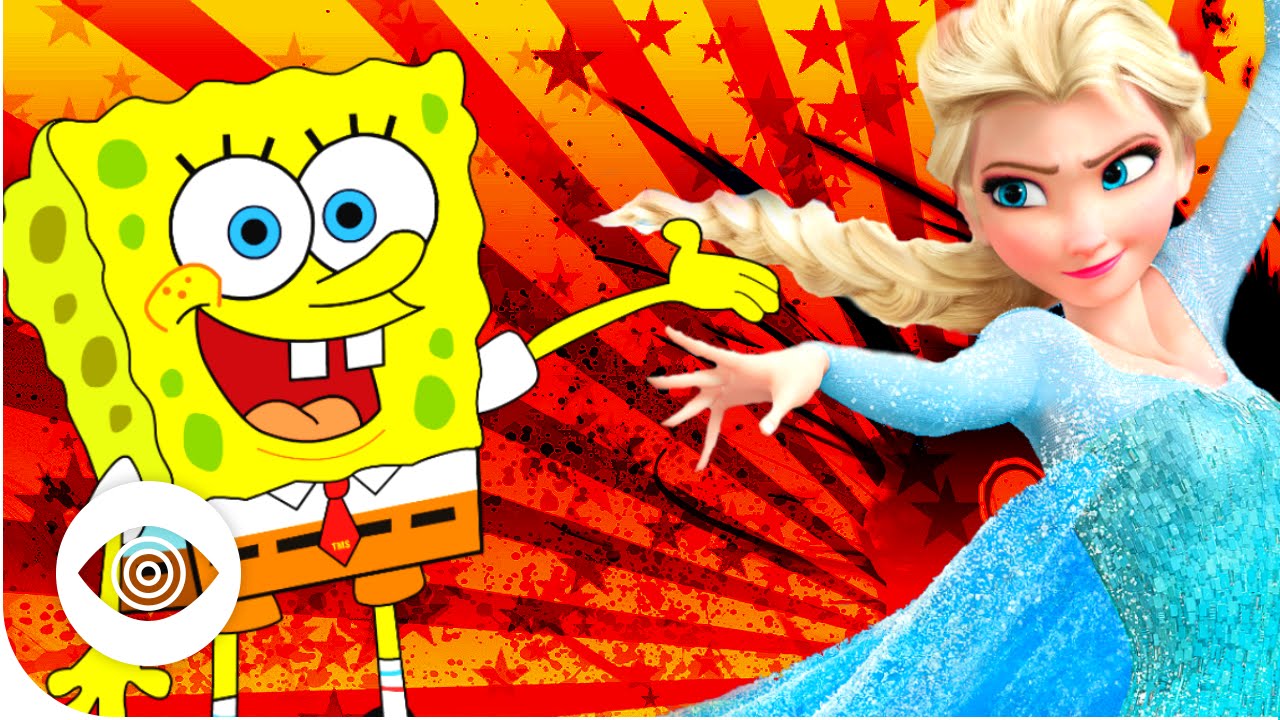
Once you start looking for it, you can’t stop seeing it. Watch an episode of SpongeBob SquarePants and pay attention. Pyramids are a constant background element. Characters often form pyramid shapes. Sometimes, a single, dominant eye will be the focus of a shot. A whole episode of Disney’s Gravity Falls—a show that brilliantly plays with these very ideas—is called “The Hand That Rocks the Mabel,” featuring a dream demon who is literally a walking, talking pyramid with a single eye. Is it all a meta-joke for the adults in the room? Or is it something called “revelation of the method”—hiding the truth so openly that people dismiss it as fiction?
Masonic Floors and Esoteric Stars
It’s not just the eye. Look for the black and white checkerboard floor, a key symbol in Freemasonry representing the duality of good and evil. It appears in key scenes in countless films and shows, often in places of power or transformation. Look for the pentagram, the five-pointed star, another powerful esoteric symbol. Look for characters making specific hand gestures, mirroring signs used by secret orders. These aren’t just random design choices. They are a visual language. The theory is that by plastering these symbols all over kids’ entertainment, the architects of this plan are normalizing them. They are conditioning future generations to accept these symbols of power without question, embedding them into the collective subconscious as familiar and non-threatening.
Deep Dive: The Hypnotic State of Childhood
Why target children? The answer is terrifyingly simple. A child’s brain is a recording device. It is not a filter. It is a sponge.
From birth until about age seven, the human brain operates predominantly in theta and alpha brainwave states. This is a low-frequency, trance-like state. It’s the same state of mind adults achieve during deep hypnosis or meditation. In this state, information bypasses the critical, analytical parts of the mind—which aren’t even fully developed yet—and flows directly into the subconscious.
This is basic, accepted neuroscience. A child watching a cartoon isn’t critically analyzing the plot. They are in a state of near-hypnosis, downloading everything they see and hear directly into their core programming. Their emotional states, their foundational beliefs, and their understanding of the world are being built, brick by brick, by what they consume on that screen.
So forget the old myths about single-frame “subliminal” ads. That’s child’s play. What we’re talking about is far more potent. It’s about holding a child in a suggestible, hypnotic state for 22 minutes at a time, day after day, and feeding them a narrative filled with specific symbols and ideological themes. It is, quite possibly, the most effective form of psychological conditioning ever conceived.
It’s Not the Pictures, It’s the Programming
Let’s say you’re still skeptical. You think the symbols are a stretch, just artistic flair. Fine. Let’s talk about the stories themselves. The actual plot. The messages being explicitly taught. Modern children’s programming is often a Trojan horse for complex social and political agendas, simplified into a good-vs-evil narrative for kids.
Consider the mega-hit Paw Patrol. On the surface, it’s about heroic pups. What’s not to love? But analyze the structure. The official government, represented by the clumsy and incompetent Mayor Goodway, is utterly useless. Every single problem, from a lost pet to a major emergency, is solved by a private, for-profit corporation run by a 10-year-old tech wiz named Ryder. This private entity has better funding, better technology, and total authority. The message, repeated in every episode, is clear: government is inept, and our salvation lies in the hands of privatized tech organizations that operate outside of public accountability. Is that an accidental theme, or a deliberate lesson in political theory for six-year-olds?
This is just one example. It’s everywhere. Shows that subtly (or not so subtly) promote consumerism, that redefine social norms, or that push a specific viewpoint on complex issues like environmentalism or social justice. The goal isn’t just to tell a story. It’s to build a consensus. To manufacture the consent of the next generation before they’re even old enough to ask questions.
The Modern Nightmare: Elsagate and the Algorithmic Abyss
If the era of Disney and network TV was about subtle programming, the modern YouTube era is a full-blown psychological assault. The gatekeepers are gone. The censors have been replaced by a cold, unfeeling algorithm whose only goal is to maximize watch time. And this led to one of the most disturbing phenomena in the history of the internet: Elsagate.
It began a few years ago. Parents would search for videos of popular characters like Elsa from Frozen, Spider-Man, or Peppa Pig. The algorithm, designed to serve up similar content, started directing them to bizarre, mass-produced videos from anonymous “content farms.” These videos used the beloved characters but placed them in deeply disturbing, nonsensical, and often violent or fetishistic situations. Spider-Man giving a pregnant Elsa a C-section with a giant syringe. Peppa Pig’s family being terrorized by monsters. Mickey Mouse getting his ears cut off.
These videos, rendered in cheap 3D animation and set to cheerful nursery rhymes, amassed hundreds of millions, sometimes billions, of views. There was no human logic behind it. It was simply an algorithm learning that this combination of familiar characters and shocking situations kept toddler eyes glued to screens. For years, millions of children were mainlining this digital poison.
Was it just a cynical, soulless ploy for ad revenue? Or was it something worse? An experiment in mass desensitization and trauma, using the world’s biggest video platform as the delivery system. The worst of Elsagate has been cleaned up, but the machine that created it is still there, learning, optimizing, and feeding content to our children.
What If It Worked? A Glimpse of the Programmed Future
Let’s indulge in a thought experiment. Let’s assume the conspiracy is real. The symbols, the thematic programming, the algorithmic sludge—it all had a purpose, and it all worked. What would a generation raised on this diet look like as adults?
They would be a generation strangely comfortable with symbols of power and surveillance, having seen them as background noise their entire lives. They would be a generation that instinctively distrusts public institutions while placing their faith in private corporations and tech moguls. Their political and social views would be deeply entrenched, not from experience or debate, but from emotional narratives absorbed in childhood. They might carry strange anxieties and behavioral tics, the subconscious echoes of the bizarre digital content they consumed. They would be the perfect, pliable population. Easy to market to, easy to govern, easy to predict.
A chilling thought. Is it a dystopian sci-fi story? Or is it simply the logical outcome of the world we’re building right now?
The Final Frame: Your Call to See
So, where does the truth lie? Are millions of parents and online researchers just seeing patterns in the static? Are we over-analyzing the innocent fun of childhood entertainment? Is it all just a series of animator pranks, coincidences, and the bizarre but meaningless output of a computer algorithm?
Maybe. That’s the simple answer. The comfortable one.
But the patterns persist. The questions linger. The feeling that something is just not right won’t go away. The most sophisticated propaganda isn’t the kind that’s shouted from a podium. It’s the kind that’s whispered in your ear while you’re laughing. It’s the kind that’s dressed up in bright colors and sold as entertainment.
The next time you rewatch a childhood favorite, or see what your kids are watching, try to look past the surface. Look for the symbols. Analyze the message. Question what is being taught.
What are they really showing you?