The Earth Is Watching You: The Unsolved Riddle of the Fairy Circles
Imagine standing in the middle of a wasteland. The silence is heavy. It presses against your ears. The heat shimmers off the ground in waves, distorting the horizon until the sky and the earth look like they are melting into one another. You look down at your feet.
The ground isn’t just dry. It is patterned.
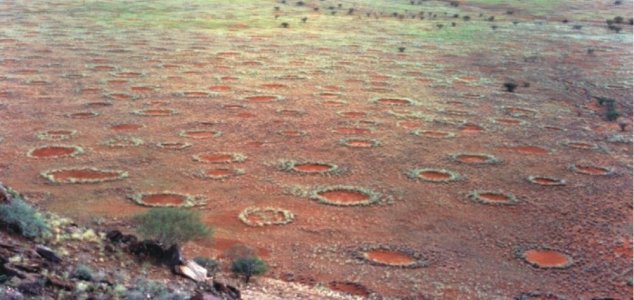
Stretching out for miles—farther than your eyes can actually see—are thousands upon thousands of perfect red circles. They look like polkadots stamped onto the planet by a giant hand. Inside the circles? Nothing. Just bare, red dust. Around the edges? A fringe of tall, stiff grass.
They look manufactured. They look engineered. But there are no machines here. There are no humans for hundreds of miles.
These are the “Fairy Circles.”
For decades, scientists, mystics, and locals have stared at these geometric oddities with a mix of awe and frustration. What creates them? Is it bugs? Is it weather? Is it something… else? Just when researchers thought they had a handle on the situation in the deserts of Africa, a shocking discovery on the other side of the world threw every single theory into the trash can.
Buckle up. We are going deep into the dirt to uncover a mystery that Mother Nature seems determined to keep hidden.
The Namibian Anomaly: Where It All Began
For a long time, if you wanted to see a Fairy Circle, you had one option: Go to Namibia. specifically, the pro-Namib regions on the edge of the desert. This is one of the oldest, driest places on Earth. It is a landscape that looks more like Mars than it does our home planet.
Here, millions of these circles scar the landscape. They aren’t random. That’s the part that messes with your head. If you fly a drone over the area, you don’t see a chaotic mess. You see a grid.
The circles are spaced out with eerie precision. They don’t touch. They don’t overlap. They range from a couple of meters wide to nearly 15 meters in diameter. They grow. They live. And after decades, they vanish, only to be replaced by new ones.
The Breath of the Dragon
Before Western scientists arrived with their clipboards and soil testing kits, the Himba people—the indigenous pastoralists of the region—already knew about the circles. They didn’t need a degree in botany to know something powerful was at work here.
According to oral tradition, these aren’t just bare patches of dirt. They are footprints.
The local legend speaks of the god Mukuru. The Himba believe that these circles are the footprints left behind by their original ancestor deity. It is sacred ground. But there is another, darker legend that circulates in the region.
Some say that deep beneath the crust of the desert, a dragon lives.
They say the dragon’s poisonous breath bubbles up through fissures in the rock, killing the vegetation above in perfect, circular vents. It’s a terrifying image: the earth exhaling poison from a sleeping monster. While modern science dismisses dragons, the idea of “poisonous gas” wasn’t actually that far off from some early scientific guesses.
But for years, the Himba were the only ones asking the questions. The rest of the world treated it as a curiosity. Until the scientists started fighting.
The “Sand Wars”: Termites vs. The Hive Mind
If you want to see a fistfight at a botany conference, bring up Fairy Circles. The academic world split into two violent factions trying to explain this phenomenon.
For a long time, the reigning champion of theories was The Termite Hypothesis.
It makes sense on paper. Norbert Jürgens, a biologist from the University of Hamburg, staked his reputation on this. He claimed to have found sand termites (Psammotermes allocerus) in nearly all the circles he investigated.
The Theory: The termites are geniuses. They are eco-engineers. By eating the roots of the grass in a circle, they create a water trap. Rain falls on the bare circle, sinks deep into the sand (because no plants are there to drink it), and stays humid. The termites live in this cool, damp bunker, surviving the brutal heat. The grass around the edge grows tall because it’s feeding off the moisture stash the termites created.
It’s a perfect system. A biological oasis.
But there were problems. Big ones. Critics screamed that there wasn’t always a termite nest under the circles. Sometimes the circles were there, and the bugs were nowhere to be found. Plus, why were the circles so perfectly spaced? Termites are smart, but are they “mathematical grid” smart?
The 2016 Plot Twist: The Australian Discovery
Then, everything changed.
In 2016, the scientific community got rocked. The phenomenon, previously thought to be exclusive to the deserts of Namibia, was for the first time spotted thousands of miles away in a remote part of the Australian outback.
This was the “smoking gun” that changed the investigation.
Deep in the Pilbara region of Western Australia, near the mining town of Newman, Bronwyn Bell (a wilderness expert) noticed something weird. The ground looked like it had the chickenpox. She snapped photos. She sent them to Stephan Getzin, an ecologist in Germany.
Getzin probably fell off his chair.
Here were the exact same circles. Same spacing. Same hexagonal grid pattern. Same bare center. Same grass ring.
But here is the kicker: There were no sand termites in Australia.
The termites that Jürgens blamed for the African circles? They don’t exist in the Pilbara. There were plenty of other termite species, sure, but none of them built nests that correlated with the circles. They were just random bugs doing random bug things. They weren’t the architects.
This discovery was a sledgehammer to the Termite Theory. If the circles in Australia are identical to the ones in Namibia, but the “cause” (termites) is missing from one of them, then termites cannot be the primary cause.
The Turing Pattern: Nature’s Secret Code
So, if it’s not bugs, and it’s not dragons, what is it?
Stephan Getzin and his team proposed something much stranger. Something that borders on the idea that plants… can think. Or at least, that they can do math.
It’s called Self-Organization.
The theory relies on a concept discovered by the famous codebreaker Alan Turing. Yes, the guy who cracked the Enigma code in World War II. Turing predicted that nature uses simple math equations to create complex patterns. It’s how zebras get their stripes. It’s how leopards get their spots.
Getzin argues that in these super-dry, hostile environments, plants are locked in a brutal war for survival. They are fighting for every single drop of water.
The “Umbrella” Effect
Think of it like this. You are in a crowded stadium and it starts to rain. Everyone pops open an umbrella. If everyone stands too close, the umbrellas bump. To fit, people have to step back. They naturally space themselves out to maximize their cover.
The grass is doing the same thing.
The “bare patch” is necessary. The huge, mature grasses on the edge of the circle are sucking all the water out of the center. They are literally starving the soil in the middle to feed themselves. The gap—the circle—is the resource reservoir that keeps the ring alive.
The plants are “organizing” themselves in an effort to maximize their access to water and nutrients in these hot and dry environments. It creates a tension pattern. A grid.
Ecologist Stephan Getzin believes that this is most likely to be the case given the evidence. It explains why the circles are so perfectly spaced. It’s simply the physics of competition.
“You should never claim to put an end to the mystery,” he said, remaining cautious. “We’ve just made one significant step forward in solving the problem.”
Fringe Files: What Science Won’t Touch
Of course, not everyone buys the “plants doing math” explanation. It’s too clean. Too clinical.
When you look at the aerial photography, the resemblance to other unexplained phenomena is striking. We aren’t talking about crop circles made by guys with planks of wood in England. We are talking about geological strangeness.
The Radioactive Theory:
Some early researchers in the 1950s tested the soil for radiation. They theorized that localized deposits of radioactive material were killing the vegetation from below. While Geiger counters didn’t go crazy, the theory persists in conspiracy circles that the soil composition is fundamentally “wrong” in these spots.
The UFO Connection:
Internet sleuths love to point out the spacing. It looks like a landing grid. While there is zero evidence of little green men parking in Namibia, the visual similarity to sci-fi landing zones keeps the forums buzzing. Why circles? Why not squares? Why the perfect hexagon distribution?
The Fungus Among Us:
Another biological theory that refuses to die is the fungal infection hypothesis. The idea is that a circular fungus kills the roots as it expands outward (like ringworm on skin). But if that were true, the circles would keep getting bigger forever. They don’t. They stop. They maintain a size. Then they die.
The Living Soil
What makes the Australian discovery so vital is that it proves the Earth acts the same way in different places, regardless of the local insects.
Recent studies in 2020 and 2023 have used heavy-duty AI to analyze the patterns. The computers confirm that the pattern matches “Turing structures” almost perfectly. It seems that when the Earth is stressed—when it is thirsty and hot—it breaks out in a rash.
It’s a survival mechanism. The landscape is trying to keep something alive, so it sacrifices patches of ground to funnel water to the strongest plants.
In Australia, however, there was little evidence of insect nests in or around the circles. This absence is the loudest clue we have.
The Hunt Continues
Are there more of them?
This is the question keeping geologists up at night. If they are in Namibia, and they are in Australia, where else are they hiding? The Gobi Desert? The American Southwest? The surface of other planets?
The hunt is now on for fairy circles in other countries to help confirm this theory once and for all. Satellites are scouring the driest parts of the globe, looking for that tell-tale polka-dot pattern.
Until we find a third location, or until someone catches a plant “talking” to its neighbor, the Fairy Circles remain one of the beautiful, quiet mysteries of our world. They are a reminder that even with all our satellites and AI, nature can still draw a circle around us and say, “You don’t know everything yet.”
Watch the video below to see the uncanny structure of these formations from the air. It’s hard to believe this is natural.
Originally posted 2016-03-30 20:12:39. Republished by Blog Post Promoter

Arindam loves aliens, mysteries and pursing his interest in the area of hacking as a technical writer at ‘Planet wank’. You can catch him at his social profiles anytime.