Space is loud. Visually loud. It is a riot of color, a chaotic splash of violent nebulas, exploding stars, and swirling galaxies. When you look up at the night sky, or browse through the latest high-definition dumps from the James Webb Telescope, you get the impression that the universe is crowded. Jam-packed. A kaleidoscope of matter fighting for elbow room.
We take comfort in that clutter. It makes us feel like we are part of a busy, thriving cosmic neighborhood.
But there are places where the lights go out. Places where the noise stops. There are patches of the universe that are so terrifyingly empty, they defy the laws of physics as we understand them. They are the dark closets of the cosmos.
And the biggest, scariest closet of them all? It’s called the Bootes Void.
The Great Nothing: A Cosmic Horror Story
Imagine you are driving cross-country. You pass cities, towns, gas stations, and farmhouses. The scenery changes, but there is always something. Now, imagine you hit a patch of road where, for three thousand miles, you see nothing. No cars. No birds. No trees. No grass. Just flat, black asphalt and gray sky. You drive for days, and the isolation starts to gnaw at your mind.
That is the Bootes Void. But on a scale that will break your brain.
Astronomers often call it “The Great Nothing.” It is a massive, spherical chunk of emptiness located near the constellation Bootes (hence the name, pronounced Boo-oh-tez, like a frantic herdsman shouting into the dark). But “chunk” is too small a word. This thing is a monster. It is a behemoth of absolute zero.
When we talk about “voids” in space, we usually mean the relatively empty spaces between the filaments of the cosmic web. The universe looks a bit like Swiss cheese or a sponge; galaxies cluster together in strands, and there are holes in between. But those holes are usually small. Manageable. Predictable.
The Bootes Void is not manageable. It is an anomaly that screams that something is wrong with our map of the universe.
The Shock of Discovery
Let’s rewind to 1981. The world was listening to synth-pop, and astronomers were feeling pretty good about how much they understood the structure of the universe. Enter Robert Kirshner and his team of researchers. They were doing a survey of galactic redshifts, mapping out how far away things were in the deep sky.
They hit a dead zone.
At first, they probably thought their equipment was broken. Or maybe they were looking through a dust cloud. But the data held up. They had found a seemingly perfect spheroid of emptiness. It wasn’t just a gap; it was an abyss.
Kirshner and his colleagues were stunned. They published their findings, essentially telling the scientific community, “Hey, we found a hole in the universe.”
The Impossible Math of Emptiness
Let’s talk numbers, because the numbers are where the true horror sets in. The Bootes Void spans roughly 250 to 330 million light-years in diameter.
Read that again.
330 million light-years. To put that in perspective, the distance from Earth to the Sun is about 8 light-minutes. The distance to our nearest star, Proxima Centauri, is roughly 4 light-years. Our entire Milky Way galaxy is about 100,000 light-years across.
You could fit nearly 3,300 Milky Way galaxies lined up edge-to-edge inside this void. It is roughly 0.27% of the entire observable universe. That sounds small, but when you consider how much stuff is out there, it’s a colossal amount of missing real estate.
The Galaxy Count Doesn’t Make Sense
Here is the kicker. In a region of space this size, based on the average density of the universe, we should see galaxies everywhere. It should be teeming with life, stars, and light.
The math predicts there should be approximately 10,000 galaxies inside the Bootes Void.
Do you know how many we have found? After decades of scanning with better and better telescopes? After peering into the dark with the most advanced sensors humanity can build?
Sixty.
Not sixty thousand. Just sixty. Six-zero.
Imagine walking into a packed stadium for the Super Bowl. You expect 100,000 screaming fans. Instead, there are six people sitting alone in random seats, miles apart from each other, staring blankly at the field. That is the Bootes Void. It is a ghost town on a galactic scale.
To make matters worse, the Milky Way (our home) has at least 24 neighbor galaxies within just 3 million light-years. That’s practically walking distance. We are crowded. We are bumping elbows. So why is the Bootes Void so empty? If you were dropped into the center of the Bootes Void, looking out a spaceship window, you wouldn’t see any stars. It would be total, suffocating blackness. You wouldn’t even know other galaxies existed until you invented extremely powerful telescopes, because the neighbors are so far away.
Standard Theories: Why Science Struggles to Explain It
Scientists hate mysteries. They want an equation to fix it. So, since 1981, they have tried to come up with natural explanations for why this hole exists.
The leading theory is the “Merger Theory.” Think of soap bubbles in a sink. You have lots of little bubbles. Over time, the walls between them pop, and they merge into one giant, wobbling mega-bubble. Cosmologists think that perhaps smaller voids collided and merged over billions of years to form this super-void.
It sounds plausible, right? Just a cosmic coincidence.
But there is a problem. Time. The universe is about 13.8 billion years old. That sounds like a long time, but in cosmic terms, it’s not enough time for bubbles to merge on this scale. To get a void of 330 million light-years, the universe would need to be much, much older. The expansion rate doesn’t match the size of the hole. It’s like finding a 500-year-old oak tree in a garden that was planted last Tuesday. It shouldn’t be there.
This failure of standard physics opens the door. It cracks the window just enough for the cold draft of “alternative” theories to blow in. And this is where things get really interesting.
The “Deep Dive”: Is Someone Turning Out the Lights?
If nature didn’t clear out those 10,000 galaxies… then what did?
This brings us to the most chilling, goosebump-inducing theory on the internet today: The Kardashev Scale and the Expanding Empire.
Nikolai Kardashev proposed a scale to measure a civilization’s technological advancement based on energy consumption.
- Type I: Harnesses all the energy of their home planet.
- Type II: Harnesses all the energy of their star (Dyson Spheres).
- Type III: Harnesses all the energy of their entire galaxy.
But what happens after Type III? What if a civilization gets so hungry, so advanced, and so desperate for energy that they don’t just encase one star? What if they encase all of them?
The Dyson Swarm Theory
Here is the nightmare scenario: The Bootes Void isn’t empty. It’s full. It is absolutely packed with galaxies, stars, and civilizations. But we can’t see them.
Why? Because a super-advanced civilization has built Dyson spheres around every single star in that region. They have wrapped their stars in solar-collecting shells to feed their insatiable machines. These shells block visible light from escaping.
To an outside observer (us), it would look like the stars are simply vanishing. One by one, the lights go out. A creeping darkness spreading across the sky.
If this theory holds any water, the Bootes Void isn’t a desert. It is the most urbanized, industrialized region of the universe. It is a sprawling empire of a Type III+ civilization that has conquered a space 330 million light-years wide. And the scariest part? The void is spherical. It looks like an explosion—or an expansion—radiating outward from a central point.
Are we looking at the borders of an alien kingdom? And if so, is it still growing?
Some theorists suggest that if we look closely at the edges of the void, we might see stars “blinking out” as the construction projects advance. It’s a terrifying thought. We are sitting here wondering where the neighbors went, while an intergalactic predator is quietly eating the stars.
The “Bruised Universe” and the Multiverse
If aliens aren’t your cup of tea, how about a collision with another dimension?
Some theoretical physicists have floated the idea that our universe is just one bubble in a boiling pot of a “multiverse.” Occasionally, these bubbles might bump into each other. If another universe collided with ours, it could push matter away, leaving a “bruise” or a dent in the fabric of spacetime.
The Bootes Void could be the scar from a cosmic fender bender. A place where gravity went haywire because another reality slammed into us billions of years ago. It wiped the slate clean, scattering galaxies like billiard balls after a break.

Connecting the Dots: The Eridanus Supervoid
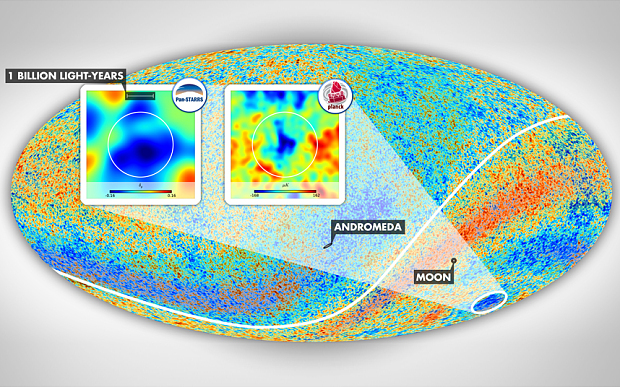
The Bootes Void isn’t the only suspect in the lineup. Look at the image above. That is the “CMB Cold Spot,” also linked to the Eridanus Supervoid. It’s another massive patch of sky that makes no sense.
The Cosmic Microwave Background (CMB) is the leftover heat from the Big Bang. It should be uniform. Smooth. Consistent. But the Cold Spot is, well, freezing. It is significantly colder and emptier than it has any right to be.
When you start connecting the Bootes Void with the Eridanus Supervoid and other anomalies like the “Great Attractor” (a mysterious gravity well pulling our galaxy toward it), a pattern emerges. The universe is not the neat, orderly place we were taught in school. It is scarred. It has holes. It has currents that flow toward invisible drains.
The Simulation Hypothesis: Glitch in the Matrix?
Let’s get into the modern “internet lore” that has Reddit threads buzzing. Simulation Theory.
If we are living in a computer simulation, a massive void makes perfect sense. Think about video games. When a game engine tries to render a massive open world, sometimes it uses “procedural generation” to save memory. It creates trees and rocks only when the player looks at them.
But sometimes, code is lazy. Sometimes, to save processing power, the developers leave chunks of the map empty until they are needed. Why render billions of galaxies in a sector where no “players” exist?
Is the Bootes Void a resource-saving measure? A corrupted file? A chunk of the hard drive that got wiped? Maybe the “Creators” didn’t think we’d ever build telescopes strong enough to see that far, so they didn’t bother filling in the texture map.
It’s the “Lazy Loader” theory of the cosmos. The universe simply didn’t load that part of the level.
The Von Neumann Probe Scenario
Let’s double back to the aliens for a second, because the “Von Neumann” theory is too good to ignore. A Von Neumann probe is a theoretical self-replicating spacecraft. You launch one. It goes to a star system, mines resources, builds two copies of itself, and moves on.
The math of exponential growth is terrifying. If the probes travel at even 5% of the speed of light, they could colonize (or dismantle) an entire galaxy in a few million years.
The shape of the Bootes Void is spherical. This fits the pattern of an expansion starting from a single origin point and spreading outward in all directions simultaneously. If a civilization launched a fleet of “star-eater” probes a billion years ago from the center of Bootes, the result would look exactly like what we see today: a perfectly round hole where the galaxy light used to be.
The 60 galaxies remaining? Maybe they were the ones that fought back. Or maybe they were just missed. Crumbs on the dinner table.
Why This Matters to You
You might be thinking, “Okay, cool, a big hole in space 700 million light-years away. Who cares? I have bills to pay.”
But it matters. It matters because it challenges our place in reality. The Bootes Void is a reminder of how little we actually know. We act like masters of the universe because we landed on the Moon and built the iPhone. But we are looking at a hole in the sky that could swallow our entire galaxy 3,000 times over, and we have absolutely no clue what it is.
It brings up the “Dark Forest” theory. The idea that the universe is a dark forest full of silent hunters. The smart animals stay quiet. The loud ones (like us, broadcasting radio waves into space) get eaten.
The Bootes Void might be a clearing in the forest where a predator has already finished its meal.
The Final Question
As we continue to scan the skies, the mystery of the Great Nothing only deepens. Is it a flaw in the Big Bang? A merging of vacuum bubbles? A rendering error in our simulation? or the expansive home of a civilization so advanced they view stars as batteries?
Next time you look up at the stars, enjoy the light. Enjoy the clutter of the Milky Way. Be thankful for the noise.
Because out there in the direction of the herdsman constellation, there is a silence so loud it deafens the astronomers. And whatever made that silence… might still be out there.