The Impossible Rock: 15-Tonne Underwater Monolith Shatters History
Forget everything you think you know about the Stone Age. Seriously. Throw the textbooks out the window. We have been told a specific story about human history for decades, and that story usually goes like this: 10,000 years ago, our ancestors were simple hunter-gatherers. They were nomads. They lived in small bands. They definitely didn’t build massive, multi-ton engineering marvels.
But the ocean has a way of keeping secrets. And sometimes, it spits them back out.
Deep beneath the rolling blue waves of the Mediterranean Sea, specifically in the Sicilian Channel, lies a discovery that is causing absolute chaos in the archaeological world. It is a monolith. A massive, single-piece stone structure that has no business being there. It’s too big. It’s too heavy. And it is far, far too old.
This isn’t just a rock. It’s a smoking gun.
The Discovery That Shouldn’t Exist
Let’s set the scene. You are 37 miles (60km) off the coast of Sicily. You dive down into the darkness, about 131 feet (40 meters) below the surface. The water is murky. The currents are strong. This is the Pantelleria Vecchia Bank. Today, it’s a submerged ridge, a hazard for submarines and deep-sea trawlers. But thousands of years ago? It was paradise.
Researchers Zvi Ben-Avraham from Tel Aviv University and Emanuele Lodolo from the National Institute of Oceanography and Experimental Geophysics in Trieste, Italy, were mapping this underwater landscape when they found it.
A monolith. Broken in two, but unmistakably artificial.
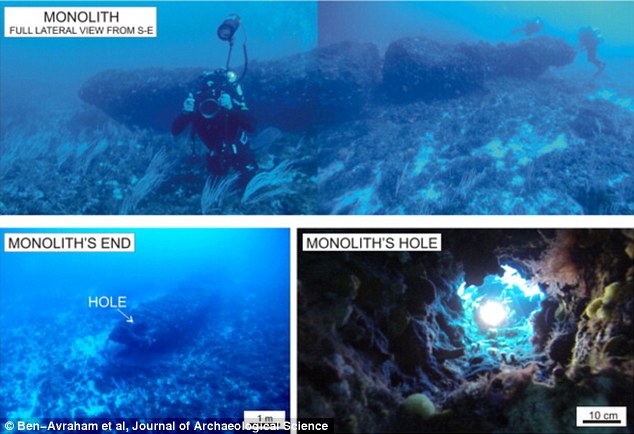
This thing is a beast. We are talking about a single block of stone weighing 15 tonnes. It measures 39 feet (12 meters) in length. To put that in perspective, that is taller than a three-story building. And it was hewn, cut, transported, and erected by people who—according to mainstream historians—should have been worrying about sharpening flint spears, not moving mega-tonnage.
The discovery forces us to ask a terrifying question: What else is down there?
The “Impossible” Engineering of the Abyss
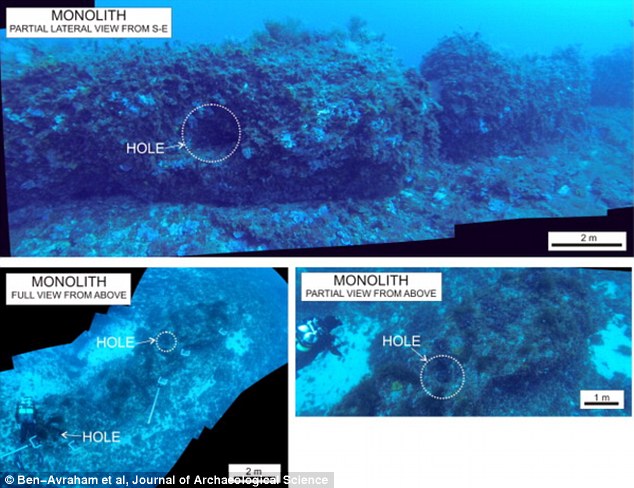
Look at the image above again. Really look at it. You see a massive stone column broken into two sections. But look closer at the details. This wasn’t just a rough rock dragged into place.
The researchers found three distinct holes. One of them is a “through-hole,” bored completely through the rock. The others are on the sides. These aren’t random erosion marks. They are clean. They are functional. The authors of the study, published in the Journal of Archaeological Science, were blunt about this. They stated clearly: “There are no reasonable known natural processes that may produce these elements.”
Nature doesn’t drill straight holes through 15-tonne rocks.
This implies distinct Mesolithic engineering. They needed a way to move this monster. Did the holes serve as anchor points for ropes? Were they part of a pulley system? Or did they have a function we haven’t even guessed yet?
The logistics alone are mind-bending. The nearest source for this specific type of rock wasn’t right next door. It had to be quarried. Extracted. Then, somehow, dragged or rolled to this specific spot on what was then an island. We struggle to move 15 tonnes today without a crane and a flatbed truck. How did a “primitive” tribe do it 10,000 years ago?

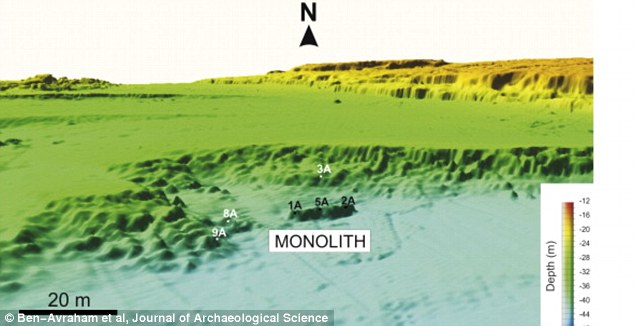
The archaeological site has been surveyed using geophysical and geological methods. This 3D map shows how the monolith is elevated in the Mediterranean Sea
The Lost Island of Pantelleria Vecchia
To understand why this rock is here, you have to rewind the clock. You have to go back to a time when the Earth looked totally different. This is the era of the Last Glacial Maximum.
The ice caps were huge. They locked up so much of the planet’s water that sea levels were drastically lower—over 300 feet lower than they are today. The Mediterranean wasn’t a wide-open sea; it was a series of smaller basins, disconnected lakes, and massive land bridges.
Sicily was connected to the mainland. You could almost walk from Italy to North Africa. And right there, in the Sicilian Channel, sat the island of Pantelleria Vecchia.
It was a strategic sweet spot. A high plateau in the middle of a fertile region. The people who lived there weren’t just surviving; they were thriving. They had a society organized enough to commission public works projects. You don’t build a 39-foot tower for one family. You build it for a community.
Dr. Lodolo notes that this discovery reveals a level of “technological innovation and development” that is totally off the charts for the Mesolithic period. These islanders were skilled workers. They were traders. They were engineers.
And then, the water came.
The Great Flood is Not Just a Myth
Around 9,500 years ago, the climate snapped. The ice melted. The sea levels surged. This wasn’t a slow creep over thousands of years; in geological terms, it was a flash flood. The “meltwater pulse” drowned millions of square miles of coastline around the world.
For the people of Pantelleria Vecchia, it must have been an apocalypse. Watch the water rise. Year after year, the shoreline gets closer. The hunting grounds disappear. The homes flood.
This monolith, which stood proudly on the island, was swallowed by the waves. It sat there, in the dark and the silence, for nine and a half millennia. Until now.

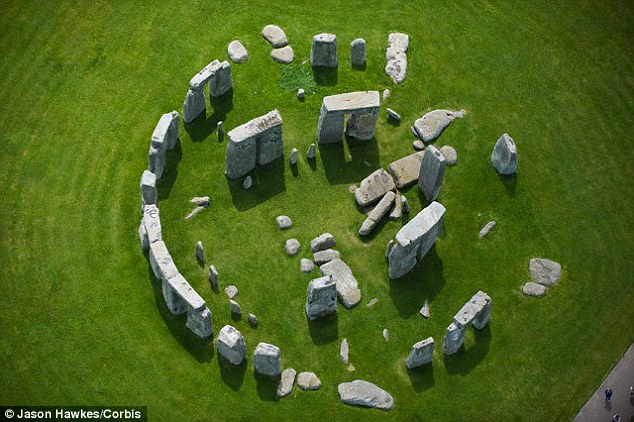
Comparison: Stonehenge (pictured above) was built around 2,600 BC. The Sicilian Monolith is over 5,000 years older.
Older Than Stonehenge? Try Double.
Let’s play the comparison game. When most people think of ancient stone circles, they think of Stonehenge in the UK. Stonehenge is incredible. It is mysterious. It is iconic.
But Stonehenge was built around 2,600 BC. The Pyramids of Giza came along roughly around the same time.
The Sicilian Monolith? It was crafted around 10,000 years ago. That makes it more than twice as old as Stonehenge. It is twice as old as the Pyramids.
This completely upends the timeline of civilization. We are taught that “civilization” (farming, cities, big stone structures) started in the Fertile Crescent roughly 6,000 years ago. Yet here we have evidence of high-level organization 4,000 years before that.
This connects the Sicilian find to other “impossible” sites like Gobekli Tepe in Turkey. Gobekli Tepe is another massive stone complex dating back to the end of the last Ice Age. For years, skeptics called Gobekli Tepe an anomaly. A fluke. But now, with the Sicilian Monolith, we have a pattern.
There was a lost chapter of human history. A time of great builders who lived before the seas rose. And most of their work is likely exactly where this one was found: underwater.
What Was It For? The “Lighthouse” Theory
Why go to the trouble? Why cut a 15-tonne rock, drag it, and stand it up? You don’t do that for fun. It had a purpose.
The leading theory from Dr. Lodolo and his team is fascinating. They believe it served as a primitive lighthouse or a visible landmark for navigation.
Imagine the ancient Sicilian Channel. It was a busy waterway even back then. The islanders caught fish. They traded with neighboring islands. They needed to navigate the treacherous currents. A massive tower, perhaps topped with fire or simply distinct against the horizon, would have been essential for sailors trying to find their way home.
Another theory involves the holes. Could they have been used to anchor ships? If the water levels were rising, maybe the rock was used as a mooring point for the boats that were becoming increasingly vital for survival.

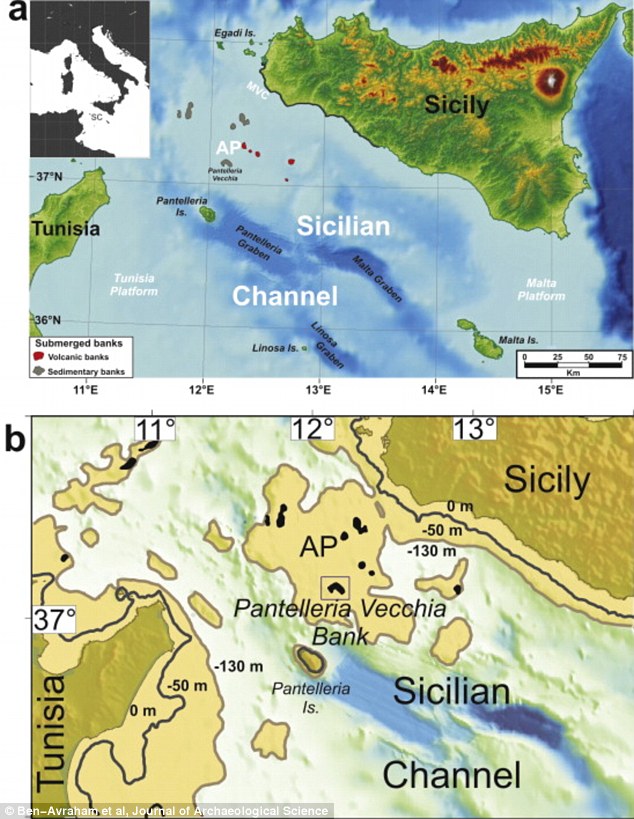
The shifting sands of time. Map ‘B’ illustrates the dramatic loss of land. The brown line is the coast during the Ice Age; the grey is the island right before it drowned.
The Science of the Submerged World
The maps above show the tragedy in stark detail. Look at the brown contour lines. That represents the coastline when the sea was 393 feet (120 meters) lower. Sicily wasn’t an island; it was a peninsula of Europe reaching out to touch Africa.
Then look at the grey area. That is the 164-foot (50 meter) mark. This is when Pantelleria Vecchia was an island. It was the last stand before the water took over completely.
‘The Sicilian Channel is one of the shallow shelves of the central Mediterranean region where the consequences of changing sea-level were most dramatic and intense,’ the experts explained in their report.
It changes how we view the Mesolithic people. We usually picture them in caves, hiding from the cold. But in the Mediterranean basin, they were living on a coastline that was constantly moving. They were adapting to climate change on a scale we can barely imagine. They weren’t just reacting; they were building monuments to defy it.
A Missing Link in the Mediterranean?
We know almost nothing about the culture that built this. We don’t have their name. We don’t have their written language (if they had one). All we have is this stone.
But the stone speaks volumes. It tells us they were:
- Organized: You need a hierarchy and leadership to command a workforce to move 15 tonnes.
- Skilled: The cutting and hole-boring required specialized tools and knowledge of geology.
- Maritime: They were islanders who likely relied on the sea for trade and food.
The discovery suggests that the Mediterranean wasn’t just a barrier between Africa and Europe. It was a bridge. A highway. And these islands were the rest stops along the way.

A closer look at the “impossible” holes. The precision required to bore these out of solid rock without modern power tools is baffling.
The Mystery of the Three Holes
Let’s get back to those holes. They are the detail that keeps researchers up at night. In the image above, you can see the side profile. One hole goes straight through. The others are on the sides.
If this was a lighthouse, how did it work? Was the “through-hole” used to hoist a burning brazier to the top? Did they pull a basket of fire up a pole?
Or is there a more celestial alignment? At Stonehenge, the stones are arranged to catch the solstice sun. Was this monolith aligned to a specific star? Perhaps it pointed the way north, or marked the sunrise on the longest day of the year. Since the monolith has fallen and broken, checking the original alignment is difficult, but not impossible. Geologists can look at the base to see how it was oriented.
The precision is the key. You don’t accidentally make a hole like that. You don’t “sort of” drill through rock. You do it with intent.
Why Is This Ignored?
Discoveries like this usually get a small headline and then vanish. Why? because they are uncomfortable. They mess up the timeline. If people 10,000 years ago were building 15-tonne towers, we have to rewrite the chapter on human evolution.
Dr. Lodolo is pushing for more. He believes that the secrets of our past aren’t buried in the sand of the desert, but in the silt of the continental shelves. “Submerged settlements in the Mediterranean Sea may help fill in gaps in understanding about ancient cultures in the region,” he says.
He’s right. The vast majority of human history happened near the water. And the water rose. Which means the vast majority of human history is currently underwater.

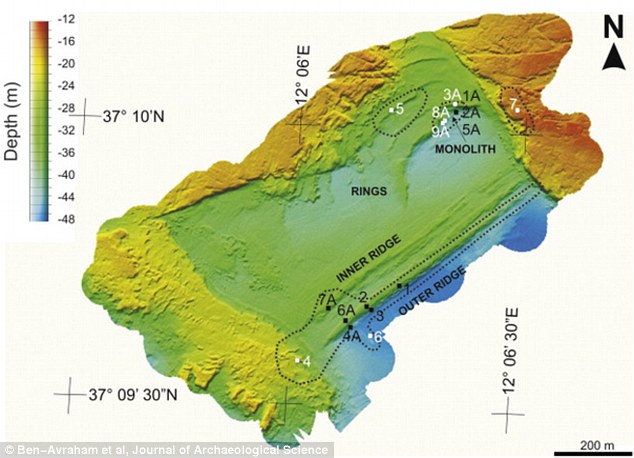
The final resting place. The sea floor map shows the isolation of the site. A lonely sentinel in the deep.
The Verdict: We Are Not the First
So, what are we looking at? A religious totem? A lighthouse? A warning sign?
Whatever it is, the Sicilian Monolith stands (or lies) as undeniable proof that the ancients were not simpletons. They were masters of their environment. They had culture, trade, and engineering that rivaled the Pharaohs, thousands of years before the first pyramid was sketched in the sand.
The ocean is vast. This was found 37 miles off the coast. How many other islands are down there? How many other monoliths? How many cities?
The next time you look at the Mediterranean, remember: it’s not just water. It’s a graveyard of civilizations. And they are waiting to be found.
Stay curious. Keep digging.