The world is not what you think it is. We walk through our daily lives, sipping coffee, checking emails, staring at screens, completely oblivious to the darkness that bubbles just beneath the surface. Real darkness. The kind that doesn’t just scare you—it changes you.
You might think you know “haunted.” You’ve seen the movies. You’ve heard the campfire stories. But the truth? The truth is stranger, colder, and infinitely more disturbing than any fiction Hollywood could dream up.
We are going on a journey. A descent. We are peeling back the shiny veneer of modern tourism to look at the places that shouldn’t exist. Places where death isn’t a memory, but a decoration. Places where the silence screams.
Are you ready? Keep the lights on. Let’s go.

The Island of the Dolls: A Kingdom of Nightmares
Mexico City. A vibrant, bustling metropolis. But drift south, away from the noise, and you hit Xochimilco. The ancient Aztec canals. Chinampas. Floating gardens. It sounds peaceful, doesn’t it? Serene water reflecting the sky. Tourists drinking beer on colorful boats.
Don’t be fooled.
Deep in this labyrinth of waterways lies La Isla de las Muñecas. The Island of the Dolls. And this isn’t some cute roadside attraction. It is a shrine to madness.
The Tragedy of Julian Santana Barrera
The story begins half a century ago. A man named Julian Santana Barrera lived alone on this tiny patch of land. He was a loner. A recluse. One day, the water washed something up against his shore. It wasn’t a log. It wasn’t trash.
It was a girl. A young girl, drowned. Her eyes open, staring at nothing.
Julian couldn’t save her. She was gone. But shortly after, he saw something else floating in the same spot. A doll. Just a regular toy.
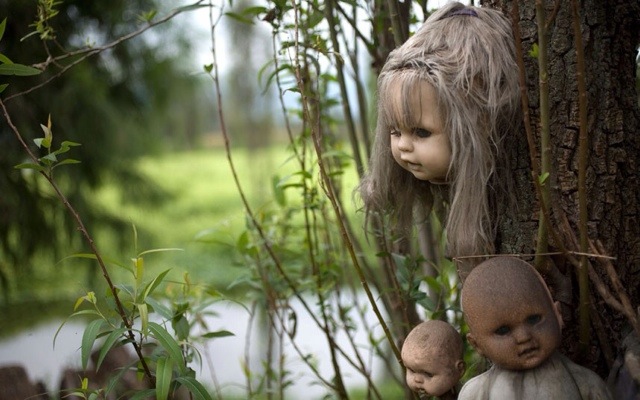
Julian’s mind snapped. Maybe just a little. He believed the doll belonged to the dead girl. He fished it out. To show respect? To appease her angry spirit? He hung it on a tree.
But the feeling didn’t stop.
The Obsession Takes Hold
One doll wasn’t enough. The spirit was still restless. Or maybe Julian was the one who was restless. He began to scavenge. He dug through trash heaps. He bartered with locals. He pulled grime-covered plastic limbs from the murky canal water.
He didn’t clean them. He didn’t fix them. That’s the horror of it. He hung them up exactly as he found them.
Missing eyes. Torn limbs. Heads filled with wasps and spiders. Mold growing on plastic skin, turning it green and black.
For fifty years, he did this. Fifty years. Covering every inch of the island in decaying toys. Thousands of them. Watching. Waiting. The sun blistered their paint. The wind made them sway. Imagine being there at night. The sound of plastic bumping against wood. The feeling of a thousand glass eyes tracking your movement.
The Final Twist
Here is where it gets truly weird. In 2001, Julian Santana Barrera died. Old age? A heart attack? No.
His body was found floating in the canal. In the exact same spot where he claimed to have found the little girl decades earlier.
Coincidence? Or did the spirits finally come to collect their keeper? Today, locals say the dolls come alive when the sun goes down. They whisper to each other. They move their heads. You can visit by boat, but the boatmen are superstitious. Some refuse to go near it. Can you blame them?
Hashima Island: The Concrete Battleship
Jump on a plane. Fly over the Pacific. We are landing in Japan. Nagasaki. About 15 kilometers offshore, a jagged silhouette rises from the waves. It doesn’t look like an island. It looks like a fortress. A battleship made of grey concrete.
This is Hashima. Gunkanjima. The Ghost Island.
From 1887 to 1974, this wasn’t a ruin. It was the most densely populated place on Earth. Seriously. More crowded than Tokyo. More crowded than New York. It was a coal mining facility owned by Mitsubishi. They packed workers onto this rock to dig black gold from beneath the ocean floor.
Life in the Pressure Cooker
Imagine 5,259 people living on a piece of rock the size of a football field. That’s 216,264 people per square mile. They built up, not out. Massive concrete apartment blocks. High-rise schools. A hospital. A shrine. All connected by a maze of narrow staircases and dark corridors.
It was a city without soil. No trees. No grass. Just grey walls and coal dust. The air was thick with it.
And then? Silence.
The Great Vanishing
In the 1960s, petroleum took over. Coal was dead. In 1974, Mitsubishi closed the mine. This is the part that gives me chills. They didn’t move out slowly. It was an exodus.
People left everything behind. They packed a suitcase and ran.
Go there today—if you can get permission—and you see a world frozen in 1974. There are teacups still sitting on tables, covered in fifty years of dust. Children’s shoes left in the school hallway. Television sets from the 70s with their screens smashed in. Calendars on the wall still turned to the month everybody left.

The sea is reclaiming it. Typhoon waves crash over the sea walls, smashing into the buildings. The concrete is crumbling. Iron rebar sticks out like rusted ribs.
You might recognize it. It was the villain’s lair in the James Bond movie Skyfall. But the real place is scarier than any movie set. It’s a monument to how quickly human civilization can just… stop. One day it’s booming. The next day, ghosts.
The Hill of Crosses: A Forest of Prayers
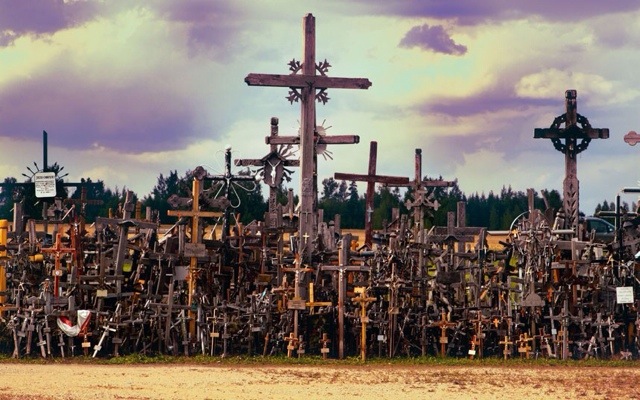
Now, we head to Northern Europe. Lithuania. A place with a history of being crushed between empires. Just outside the city of Šiauliai, there is a small hill. From a distance, it looks like it’s covered in bristling fur. Or thorns.
Get closer. Those aren’t thorns.
They are crosses. Thousands. Hundreds of thousands. No one knows the exact number. 100,000? 200,000? They stopped counting years ago.
Defiance in the Face of Tyranny
This isn’t a graveyard. There are no bodies buried here. It’s a statement.
It started in the 1830s after a failed uprising against the Russian Empire. Relatives couldn’t find the bodies of the rebels, so they planted crosses on this hill. One by one.
But the real story happens later. During the Soviet occupation. The Soviets hated this place. It was a symbol of faith and Lithuanian identity. They wanted it gone.
They brought in bulldozers. They leveled the hill. They burned the wooden crosses. They melted down the metal ones. They turned the site into a garbage dump. They thought that was it. Game over.
But the next morning? The crosses were back.
People snuck in under the cover of darkness. Risking arrest. Risking the Gulag. They planted fresh crosses. The Soviets bulldozed it again. The people came back again. This happened at least three times. A silent war between tanks and wooden sticks. And the sticks won.

The Sound of the Hill
Pope John Paul II visited in 1993. He called it a place of hope, peace, and love. And sure, during the day, with the sun shining, it has a holy vibe.
But have you ever been there when the wind picks up?
The crosses aren’t secured. They hang off each other. Giant crucifixes draped with thousands of tiny rosaries. When the wind blows, the hill makes a sound. A clattering. A wooden, hollow rattling noise. Like a million bones shaking together.
You wouldn’t want to spend the night here alone. The shadows lengthen. The rattling gets louder. It feels heavy. Charged. Whether you are religious or not, the sheer weight of human emotion concentrated on this one tiny hill is enough to bring you to your knees.
Sedlec Ossuary: The Church of Bones
We end our tour in the Czech Republic. A sleepy town called Kutná Hora. In the suburb of Sedlec, there is a gothic chapel. From the outside? Totally normal. Boring, even.
Step inside. Look up.
Your brain takes a second to process what you are seeing. You think it’s wood? Plaster? No.
It’s bone. Human bone.
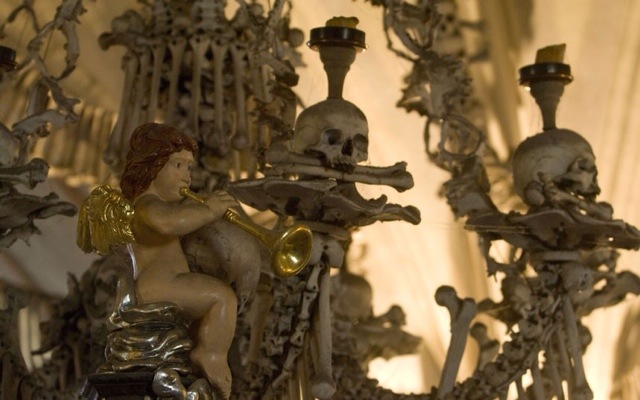
This is the Sedlec Ossuary. The final resting place—if you can call it resting—of up to 70,000 people. And they aren’t in coffins. They are the furniture.
The Holy Soil and the Plague
Why? Why would anyone do this?
It goes back to 1278. An abbot went to Jerusalem and brought back a jar of “holy soil” from Golgotha. He sprinkled it on the cemetery. Suddenly, this was the VIP section of graveyards. Everyone in Central Europe wanted to be buried here.
Then came the Black Death. Then the Hussite Wars. Thousands died. The cemetery was bursting at the seams. They had to dig up the old bones to make room for the fresh bodies. They stacked the skulls in the basement. Pyramids of them.
The Mad Artist
Fast forward to 1870. The Schwarzenberg family (local aristocrats) hired a woodcarver named František Rint to “organize” the bones. They probably expected him to just stack them neatly.
Rint had other ideas. Rint had a vision.
He didn’t just stack them. He built with them.
He created a massive chandelier. It is said to contain at least one of every single bone in the human body. Think about that. A jawbone clamping onto a femur. A pelvis forming the curve. It hangs directly over your head.
He made giant chalices out of hips and femurs. He even made the family coat of arms—a bird pecking the eye out of a severed head—entirely out of bone.
And in the corner, he signed his name. Not in ink. In finger bones.
Memento Mori
It attracts 200,000 tourists a year. People take selfies next to the skulls. But stop and look. Really look. Those empty sockets used to hold eyes that saw the sun rise in the 1300s. That jawbone used to laugh, eat, and kiss. That femur carried someone through a plague.
It is grotesque, yes. But it is also beautiful in a dark, twisted way. It is the ultimate message: Memento Mori. Remember you will die. You can be a king or a peasant, but in the end, you’re just part of a chandelier.
The World is Watching
So, what ties these places together? Why do we care? Why did you read this far?
Because we are obsessed with what comes next. We are obsessed with the things we can’t explain.
The dolls of Xochimilco. The empty concrete of Hashima. The clattering crosses of Lithuania. The bone art of Sedlec. They are reminders. Cracks in the simulation. Places where reality feels thin.
The next time you travel, don’t just go to the beach. Don’t just go to the museum. Go where the shadows are. Go where the air feels colder. You might find something terrifying. Or, you might find something true.
Just don’t touch the dolls. Seriously. Don’t touch them.