Home Weird World Strange Stories The unexplained mystery of Frederick Valentich

The unexplained mystery of Frederick Valentich

0
58

The date is October 21, 1978. The world is looking at the stars. Star Wars had dominated the box office the year before. Close Encounters of the Third Kind was still fresh in the collective consciousness. But down in Australia, over the dark, churning waters of the Bass Strait, something was happening that no Hollywood scriptwriter could invent. Something real. Something terrifying.

It started as a routine cargo run. It ended as one of the most chilling cold cases in the history of aviation.

We aren’t talking about a crash. Crashes leave debris. Crashes leave oil slicks. Crashes leave bodies. This? This was an erasure.

Frederick Valentich didn’t just die. He was deleted.

 Frederick Valentich

The Pilot and The Plan

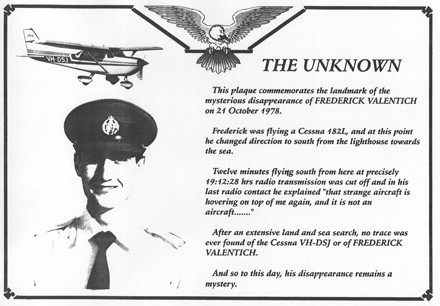
Let’s look at the man behind the yoke. Frederick Valentich. Twenty years old. Ambitious. He had his eyes on the sky, literally and metaphorically. He was an enthusiastic flyer, logging hours in a single-engine Cessna 182L, registration VH-DSJ (Delta Sierra Juliet). He was racking up flight time for his commercial license, chasing a dream.

But there was another side to Frederick. A side the media latched onto later. He was obsessed with UFOs. His father, Guido, later admitted that Frederick studied the phenomenon extensively. Skeptics love this detail. They use it to paint him as a fantasist. Someone looking for trouble. Someone hallucinating.

But does an obsession with UFOs make you hallucinate metallic scraping sounds? Does it make your engine stall in mid-air? Does it make you vanish from the face of the earth while radar tracks nothing?

On that Saturday evening, Valentich filed a flight plan from Moorabbin, Victoria, to King Island. The trip is about 130 miles south over the Bass Strait. If you know anything about Australian geography, you know the Bass Strait is treacherous. Rough waters. Unpredictable winds. It’s often called the “Bermuda Triangle of the South.” Ships go missing here. Planes drop off radar.

But not that night.

October 21 was pristine. The weather was perfect. Visibility? Unlimited. A mild breeze. It was the kind of night pilots dream of. There was no storm to fight. No fog to get lost in. Just the pilot, his little Cessna, and the endless horizon.

19:06: The Nightmare Begins

The timeline is tight. It happens fast.

At 7:06 PM (19:06), Valentich keys his microphone. He calls Melbourne Flight Service. Steve Robey is the air traffic controller on duty. Valentich asks a simple question. A question that starts the clock on his own disappearance.

“Is there any known traffic below five thousand?”

Robey checks his screens. “No known traffic.”

Valentich pushes back. He insists. He sees something. A large aircraft. Four bright green landing lights. And it’s not just passing him. It’s toying with him.

This is where the hair on your arms should stand up. This wasn’t a confused pilot seeing Venus. Venus doesn’t fly at impossible speeds. Venus doesn’t orbit a Cessna.

Valentich reports the object is approaching from due east. He says it seems to be “playing some sort of game.” Think about that phrasing. A game. It implies intelligence. Intent. It implies a cat toying with a mouse before the pounce.

Robey asks for identification. Valentich can’t give it. He says the speed is impossible to estimate. The object zooms over him three times. Then, the description gets specific. Terrifyingly specific.

“It’s not an aircraft.”

He describes a long shape. Metallic. Shiny. Four bright green lights. And then, the killer detail: It vanishes. Then reappears. Not from the side. But from above.

“It is orbiting above me,” Valentich stammers, his voice cracking with rising panic. “It has a green light and sort of metallic. Like it’s all shiny on the outside.”

The Sound of Abduction?

The Cessna 182 is a workhorse. It’s reliable. But suddenly, the engine starts to cough. Valentich reports rough idling. He’s in trouble. The object is hovering right on top of him now. Oppressing him.

Robey asks one last time: “Identify your intentions.”

Valentich says, “Ah… intentions to go to King Island. Ah, Melbourne, that strange aircraft is hovering on top of me again… it is hovering and it’s not an aircraft.”

Those were his final words to a human being.

“It is not an aircraft.”

What followed was not a scream. It wasn’t the sound of a crash. It wasn’t the splash of water. For 17 agonizing seconds, the open microphone broadcast a sound that has baffled audio engineers for decades. A metallic, scraping, grinding noise. Like metal tearing against metal. Or high-frequency pulsing jamming the frequency.

Then? Dead air.

Silence.

The link was broken. Permanently.

The Search That Found Nothing

When a plane goes down, especially a light aircraft, it floats for a bit. There’s fuel. There are seats. There are charts. Even if it sinks, things bob to the surface.

The Royal Australian Air Force (RAAF) didn’t wait. They launched a massive search operation immediately. They scoured the Bass Strait. They had P-3 Orion maritime patrol aircraft. They had ships. They covered over 1,000 square miles of ocean. They knew exactly where he was when the radio cut out. They went right to the spot.

Result? Zero.

No oil slick. No wreckage. No body. Not a single cushion from the cockpit.

It was as if the plane had been plucked out of the sky by a giant hand. The weather remained perfect. The sea was calm. If he had ditched, he should have been able to get out. He had life vests. He had training.

The official investigation by the Australian Department of Transport dragged on. In the end, they threw up their hands. The verdict? “The reason for the disappearance of the aircraft has not been determined.”

That is bureaucratic speak for: “We have no clue.”

The Witnesses: He Wasn’t Alone

Skeptics want you to believe Valentich was hallucinating. Maybe hypoxia? Maybe disorientation? They say he flew upside down and saw his own reflection in the water. That’s the “official” debunking theory.

But that theory ignores the witnesses.

Valentich wasn’t the only one looking at the sky that night. While the search was underway, police phones started ringing. Reports flooded in from the Cape Otway area. Farmers. Tourists. Fishermen. They all saw something.

Green lights. Fast-moving objects. Erratic movements.

Some witnesses reported a green light trailing a small plane. Think about that. Ground witnesses confirmed exactly what Valentich was screaming about on the radio. A erratic green light stalking a small aircraft.

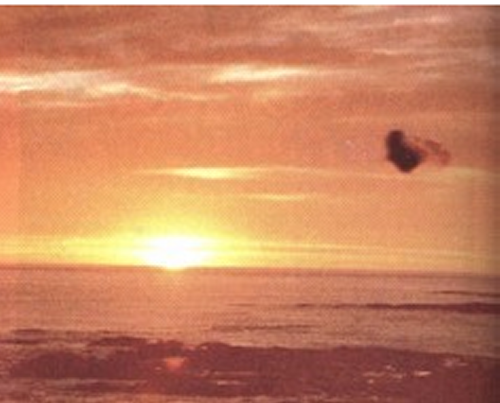
Even more disturbing? A plumber named Roy Manifold set up a time-lapse camera on the coast that evening to photograph the sunset. He wasn’t looking for UFOs. He just wanted nice pictures of the ocean. When he developed the photos later, they showed something fast moving out of the water and shooting into the sky. Blur motion analysis suggested speeds of up to 20,000 miles per hour.

Was this the object? Did it come out of the ocean? Is the Bass Strait a hiding spot for trans-medium vehicles—craft that can move from water to air to space without breaking a sweat?

The Father’s Belief

Guido Valentich never gave up. Until the day he died, he refused to believe his son crashed. He knew Frederick was a capable pilot. He knew the plane was sound. Guido became a fixture in the Australian media, a grieving father holding onto a bizarre hope.

He believed his son was alive.

Guido theorized that Frederick was “taken.” That the metallic noise was the sound of the Cessna being magnetically clamped to a larger vessel. It sounds crazy, right? But what’s the alternative? A plane that disintegrates into atoms upon hitting the water? A crash that leaves zero forensic evidence?

Guido’s conviction was fueled by the strange nature of the final transmission. The “game” the object was playing. The intelligence behind the movements. This wasn’t a weather balloon. It was a capture.

ufo-picture

The Tenerife Twist: A Glitch in Time?

Here is where the story shifts from a tragic mystery to absolute high-octane strangeness. Fast forward twelve years. The year is 1990. The location is the other side of the planet.

Plaza del Charco. Tenerife. The Canary Islands. A holiday destination for Europeans. Sun, sand, and sangria.

According to persistent reports and witness testimonies that surfaced in UFO research communities, a man appeared at this resort. He looked young. About 20 years old. He spoke with an Australian accent.

He produced an Australian passport.

The name on the passport? Frederick Valentich.

The witnesses who spoke to him were stunned. If this was Frederick, he should have been 32 years old. He should have aged. He should have had gray hairs, wrinkles, the wear and tear of a decade lost at sea or in hiding.

But this man? He looked exactly like the photos from 1978. Exactly.

He reportedly told the people he spoke with a story that sounds like pure science fiction. He claimed he had been “recruited.” He said he belonged to a group of humans who were working with extraterrestrials. He wasn’t a prisoner. He was a pilot for them.

Then, just as quickly as he appeared, the man vanished again. No trail. No hotel check-in records. Just a ghost story in a sunny plaza.

Let’s break this down. Is it a hoax? Possibly. Someone finding a lost passport and playing a cruel prank? Maybe. But why Tenerife? Why 1990? And how do you explain the lack of aging?

Einstein gave us the theory of relativity. Time dilation. If you travel at the speed of light—or if you are aboard a craft that manipulates gravity fields (like the ones described by Bob Lazar or in recent Pentagon UAP reports)—time moves differently for you. A decade on Earth might be a few days on the craft.

Could Frederick have been taken on a journey that felt like a weekend to him, while twelve years ticked by for his grieving father?

The “Tic Tac” Connection

For years, the Valentich story was dismissed as folklore. But look at it through the lens of 2024.

We now have the US Navy admitting that UAPs are real. We have the “Tic Tac” incident from 2004, where Commander David Fravor engaged a white, oblong object that had no wings, no exhaust, and moved with impossible physics.

Compare Fravor’s report to Valentich’s.

  • Valentich: “Flying at a speed I find impossible to estimate.”
  • Fravor: “Accelerated like a bullet.”
  • Valentich: “Hovering on top of me… playing a game.”
  • Fravor: “It mirrored my movements.”
  • Valentich: “Shiny… metallic.”
  • Fravor: “White… smooth… no windows.”

The parallels are undeniable. Valentich described a modern UAP encounter decades before the terminology existed. He wasn’t crazy. He was just the first to broadcast it live.

What Really Happened?

Did Frederick Valentich fake his own death? It’s the “rational” explanation. He was a mediocre pilot with average grades. Maybe he wanted to start over. But flying a Cessna into the night and disappearing without a trace is a hell of a way to quit your job. And how do you fake the metallic scraping sound on the radio?

Did he crash? Statistically, this is probable. But the lack of debris is the nagging splinter in the mind. The Bass Strait is rough, but big pieces of airplanes usually wash up eventually. Luggage washes up. Seat cushions float. Nothing ever did.

Or is the third option the truth?

Was he hunted? Was he a specimen? Was he recruited?

The green lights. The engine failure (a classic sign of electromagnetic interference from UAPs). The silence. The reappearance in Tenerife.

We are left with the haunting transcript. A young man, alone in the dark, realizing that the laws of physics he learned in flight school were being broken right in front of his eyes. His final realization wasn’t fear of death—it was the shock of discovery.

“It is not an aircraft.”

Forty-plus years later, the ocean keeps its secrets. The sky is silent. And somewhere, maybe, just maybe, Frederick Valentich is still flying. Not for us. But for them.

Keep your eyes on the skies.

Read More HERE

Originally posted 2013-11-28 23:41:06. Republished by Blog Post Promoter