The Forbidden Island in the Heart of New York City
Can a place be forgotten? Truly, utterly erased from the public mind, even while millions of people pass it by every single day?
Look closer. In the churning waters of New York City’s East River, caught between the concrete sprawl of the Bronx and the notorious Rikers Island, lies a secret. A pair of islands, really. North and South Brother. South Brother is small, unassuming, just six acres of land that was finally bought by the city in 2007. But its northern sibling… that’s a different story.
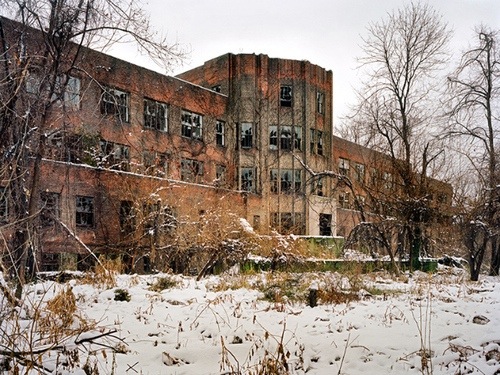
North Brother Island is a 20-acre patch of land with a history so dark, so saturated with tragedy and human misery, that it feels cursed. For over 50 years, it has been abandoned. Forbidden. Left to crumble as nature wages a slow, relentless war against its decaying buildings.
But this isn’t just a story of urban decay. It’s a story of shipwrecks, plagues, forced isolation, and failed utopias. It’s the story of a place that New York City tried to use for its unwanted, its sick, and its broken… and then tried to forget altogether. What really happened on that island? And what secrets are the crumbling walls still holding?

A Baptism by Fire: The General Slocum Disaster
Before North Brother Island was a place of quarantine, it became a witness to hell on Earth. Its modern history doesn’t begin with a quiet groundbreaking. It begins with screams.
Picture it. June 15, 1904. A beautiful summer day. The St. Mark’s Evangelical Lutheran Church, a community of German immigrants from Manhattan’s Lower East Side, chartered a steamship for their 17th annual picnic. The ship was the *General Slocum*, a grand, three-decked paddle steamer. For over 1,300 people, mostly women and children dressed in their Sunday best, it was a day of celebration.
It would be the last day of their lives.
As the ship steamed up the East River, a fire broke out in a forward cabin, a room filled with paint, oil, and straw. The flames exploded. Panic erupted. But the horror was just beginning. The ship’s safety equipment was a tragic joke. The fire hoses were rotten, bursting under the pressure. The life preservers, stored for years in the open air, had been filled with cheap cork dust that turned to heavy, useless mush when wet. They were painted to look new, a fatal lie. Some accounts say they were weighted down with iron bars to meet regulations. They dragged people under the water instead of saving them.
The ship’s captain, in a disastrous decision, chose to continue steaming forward into the wind, fanning the flames into an inferno that consumed the entire vessel. He was trying to beach the ship, and the closest land was North Brother Island. By the time the burning husk of the *General Slocum* finally ran aground, it was too late. Hundreds had been burned alive. Hundreds more, weighed down by heavy wool clothing and useless life jackets, drowned in the river. The staff of Riverside Hospital on the island could only watch in horror as bodies, many of them small children, washed up on their shores. They formed human chains, pulling victims from the water, turning the hospital for the sick into a makeshift morgue for the dead.
Over 1,021 people died. It was the deadliest disaster in New York City’s history until September 11, 2001. The island’s first role in the 20th century was not as a place of healing, but as a silent, grim witness to a floating catastrophe. Its soil was now soaked in tragedy.
America’s Most Dangerous Woman: The Exile of Typhoid Mary
If the *Slocum* disaster christened the island with fire and death, its next chapter would cement its reputation as a place of exile. A prison for one. This is where the story of Mary Mallon begins. You probably know her by another name. Typhoid Mary.
Who was she? Not a monster. Not a villain, at least not intentionally. Mary was an Irish immigrant, a cook by trade, and a very good one at that. She was strong, stubborn, and had no idea she was a walking biological weapon. She was an asymptomatic carrier of typhoid fever, a bacterial infection that was often a death sentence in the early 1900s. She could shed the bacteria in everything she touched, yet never feel a single symptom herself.
In the early 1900s, she worked for a series of wealthy New York families. And wherever Mary cooked, typhoid followed. One family, then another. The pattern was undeniable. A sanitary engineer named George Soper, a “disease detective,” was hired to investigate. His hunt led him straight to Mary Mallon.
The Capture and First Banishment
Mary refused to believe it. How could she be spreading a disease she didn’t have? When Soper confronted her, she famously chased him off with a carving fork. To her, this was an attack on her character, her profession, her very being. But the Department of Health was convinced. In 1907, they sent the police. After a chaotic chase, they found her hiding in a closet and forcibly took her away.
Her destination? North Brother Island. She was placed in a small, isolated cottage on the grounds of Riverside Hospital. The press had a field day, painting her as a monstrous “human culture tube.” For two years, she was a prisoner, forced to provide samples, watched, studied. She sued for her freedom, writing letters pleading her case. “I have never had typhoid in my life,” she wrote, “and have always been healthy. Why should I be banished like a leper?”
In 1910, a new health commissioner agreed to release her, on one condition: she must never work as a cook again. Mary agreed. She was free.
The Inevitable Return
But what could she do? Cooking was the only skill she had to earn a decent living. Low-paying jobs as a laundress weren’t enough. So she vanished. She changed her name to “Mary Brown” and went back to the one thing she knew. She went back to the kitchen.
For five years, she cooked in hotels, restaurants, and sanatoriums, leaving a trail of sickness in her wake. The final stop was Sloane Hospital for Women in Manhattan. In 1915, a devastating typhoid outbreak struck, infecting 25 people and killing two. The trail, once again, led to the cook. It was Mary.
This time, there would be no mercy. No second chances. The public was outraged. The health department acted swiftly. Mary Mallon was arrested again and sent back to North Brother Island. This time, there was no release date. This time, it was for life.
She would spend the next 23 years in that same cottage. She wasn’t a true prisoner in chains; she was given a job as a lab technician in the island’s hospital, washing bottles. A strange irony. The carrier of disease, working in the very place meant to study it. But she was never allowed to leave. She died from a stroke in 1938, having spent nearly three decades in forced isolation, a pariah on a forgotten island. A human tragedy, a public health nightmare, and the island’s most famous, and most tragic, resident.

From Quarantine to Community: The Veterans’ Haven
After World War II, the island’s purpose shifted again. The cloud of sickness and death seemed to part, if only for a moment. New York City was facing a severe housing crisis, and thousands of returning GIs were looking for a place to live with their families while they attended college on the GI Bill. Someone, somewhere, had an idea: what about North Brother Island?
The old hospital buildings, the nurses’ dormitories, and the staff housing were converted into apartments. For a brief period in the late 1940s and early 1950s, the island of pestilence became a bustling, hopeful community. Ferries ran back and forth to the mainland. Children played in the shadow of the old quarantine wards. It was a bizarre, surreal suburb, floating in the East River. A place with a dark past repurposed for a bright future.
But the problems were obvious. The buildings were old and crumbling. Isolation, once a tool for quarantine, was now just a massive inconvenience. The roar of planes from the newly expanding LaGuardia Airport was a constant nuisance. The dream was short-lived. As soon as the veterans finished their schooling and found better housing, they left. The island’s brief moment as a hopeful community faded away.

The Island’s Last Gasp: A Center for Lost Souls
In the 1950s, the island was given one final, desperate mission. It was transformed into a treatment center for adolescent drug addicts, primarily teenagers hooked on heroin. The thinking was that the isolation would be good for them, cutting them off from the temptations of the city streets. It was a novel idea, one of the first of its kind.
It was also a complete and total failure.
The young patients felt like prisoners, not patients. Reports from the time detail widespread corruption among the staff and claims of patient abuse. The kids were locked in rooms, sometimes for days. Relapses were common. Many tried to escape the island prison, some even attempting to swim the treacherous currents of the East River. By the early 1960s, the facility was deemed a failure. The cost was too high, the results too poor. In 1963, the center was shut down for good. The staff packed up and left. The last residents were ferried away.
And then… silence. The doors were locked. The power was cut. North Brother Island was officially abandoned. Forgotten.
Nature’s Revenge: The Forbidden Forest of NYC
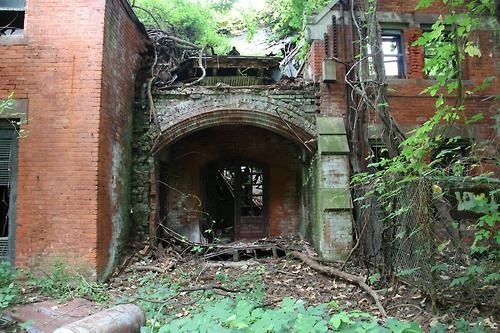
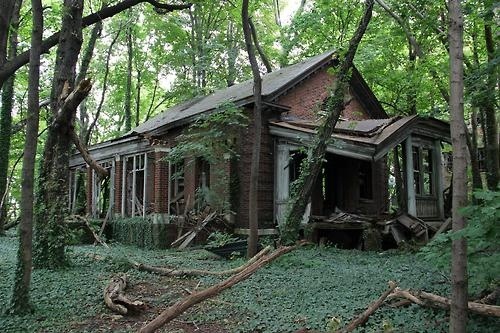
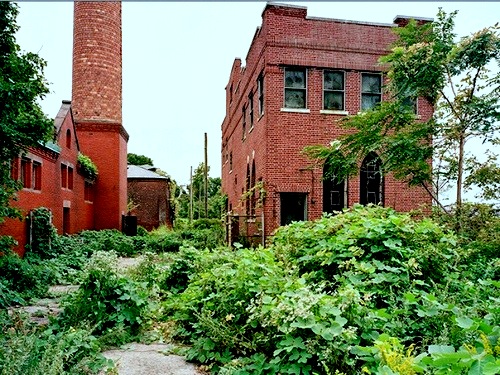
For over half a century, North Brother Island has been left to rot. And in that time, an incredible transformation has taken place. Without humans, nature has returned with a vengeance. Kudzu vines, the “vine that ate the South,” have smothered entire buildings. A dense forest has sprouted, with trees growing straight through the floors of what were once hospital wards and family apartments.
Roofs have collapsed. Walls have crumbled. The remaining structures are skeletal, ghosts of their former selves being slowly digested by the green tide. It is a stunning, eerie, and profoundly beautiful vision of a post-human world, hidden right in the middle of America’s biggest city.
Today, the island is officially a bird sanctuary, managed by the New York City Parks Department. It’s one of the area’s largest nesting grounds for the black-crowned night heron. Access is strictly forbidden. The official reason is to protect the birds and to prevent injuries from the dangerously unstable ruins. But for those who study the strange and the mysterious, you have to wonder if the city is also happy to keep its tragic, failed experiment under wraps.

Modern Rumors and The Island’s Future
So what now? For years, ideas have been floated. The old 2013 rumor of an architecture school planning a campus for autistic children never went anywhere. The costs of cleanup, asbestos removal, and new construction on an island with no infrastructure are astronomical. The noise from LaGuardia is still a deal-breaker for any residential project.
The island’s forbidden status has, of course, turned it into a holy grail for urban explorers. Despite the risks and the patrols, a handful have made the journey, paddling over in kayaks under the cover of darkness. Their photos and videos are all over the internet, offering haunting glimpses into the decay: patient files scattered on the floor of a collapsing office, rusted bed frames in a forgotten ward, a lone schoolbook decaying on a desk.
And, of course, there are the ghost stories. How could there not be? Fishermen on the East River have reported strange lights and faint sounds coming from the island at night. Explorers who have snuck ashore speak of an overwhelming sense of sadness, of being watched. Are the spirits of the *Slocum* victims still lingering? Does the lonely, angry ghost of Mary Mallon still wander the grounds of her lifelong prison?
Perhaps North Brother Island’s future is to have no future. Perhaps its purpose now is to be a monument. A silent, crumbling memorial to the people it housed, the tragedies it witnessed, and the uncomfortable parts of our history we’d rather pave over. It’s a place that reminds us that even in the heart of our gleaming, modern world, there are pockets where the past is never truly dead. It just waits, covered in vines, for someone to remember.