Thursday, May 7, 2026
HomeFilms & DocumentariesThe Mystery of the Sphinx - Documentary

The Mystery of the Sphinx – Documentary

The Sphinx Isn’t What You Think. It’s Older. Much Older.

Forget what you learned in school. Seriously. Tear out that page in your history book about the Great Sphinx of Giza. The one that tells you it was built by the Pharaoh Khafre around 2,500 BC. It’s a nice, neat story. Simple. Tidy. And it’s almost certainly wrong.

The truth is etched into the very limestone of the monument itself. It’s a story not of sand and wind, but of water. A story of rain. Torrential, relentless rain, in a place that has been a bone-dry desert for nearly ten thousand years.

What if the greatest monument on Earth isn’t a tribute to a long-dead pharaoh? What if it’s a message? A warning. A relic from a time before our time, a civilization so ancient it has been completely wiped from our memory. They left behind a single, silent sentinel, its eyes fixed on the horizon, guarding a secret that could rewrite everything we know about human history.

And we might be on the verge of finding it.

The Official Story: A House of Cards on the Sand

Mainstream Egyptology has a comfortable narrative. They tell us the Sphinx was carved during Egypt’s 4th Dynasty. They point to the Pharaoh Khafre, the builder of the second-largest pyramid at Giza, and say, “He did it.” The face of the Sphinx, they claim, is his face.

But what’s their proof? A single, ambiguous statue found nearby? A vague reference on a stone tablet that could mean a dozen different things? Here’s the bombshell. There isn’t a single, solitary inscription from the Old Kingdom—not one—that mentions Khafre building the Sphinx. Zero. The people who supposedly built the most iconic statue on the planet never bothered to write it down. Does that make any sense?

The entire Khafre theory is an assumption. An educated guess that has been repeated so many times it’s mistaken for fact. It’s a fragile house of cards, and one stubborn geologist came along and threatened to blow the whole thing down.

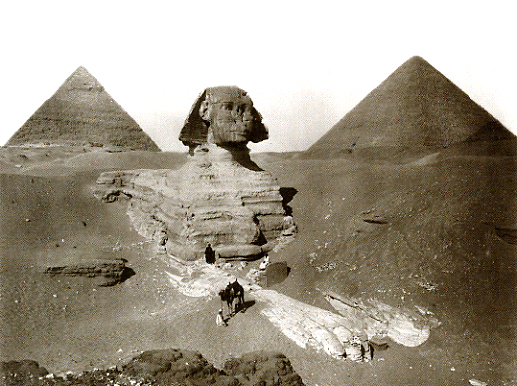
The Great Sphinx of Giza

A Story Written in Water

Enter John Anthony West. An author, a rogue Egyptologist, and a man obsessed with the idea that Egyptian civilization was far older and more profound than we believed. In the late 1980s, he noticed something obvious, yet completely overlooked by the experts. The erosion on the body of the Sphinx was… different.

It didn’t look like the other monuments on the Giza plateau. It wasn’t the smooth, wind-blasted look you’d expect from 4,500 years of sandstorms. No. The body of the Sphinx, and more importantly, the walls of the enclosure from which it was carved, were covered in deep, vertical fissures. Rounded, rolling patterns.

West knew he wasn’t a geologist, so he did something radical. He found one.

Professor Robert Schoch, a geologist and geophysicist from Boston University, came to Giza at West’s request. He was a tenured academic, not a conspiracy theorist. He came to Egypt fully expecting to debunk West’s wild ideas in about five minutes. Then he saw the rock.

Deep Dive: Wind vs. Water Erosion

Let’s get simple. Think about how things wear away. Wind erosion, especially wind carrying sand, acts like a sandblaster. It scours surfaces, creating sharp, horizontal layers. You see it all over the Giza plateau on the tombs and pyramids. It’s a clear, unmistakable pattern.

Water erosion is totally different. Rain falling for centuries, for millennia, seeps into the stone. It runs down the sides, carving deep vertical channels. It creates rounded, undulating profiles. Think of the cliffs of a coastline, battered by rain and sea. That’s water erosion.

Schoch took one look at the Sphinx enclosure and was stunned. The weathering wasn’t from wind and sand. It was classic, textbook precipitation-induced erosion. Water. Lots and lots of water, falling from the sky over an immense period of time.

There was just one, gigantic problem.

The Sahara Desert hasn’t seen that kind of rainfall since before the last Ice Age ended. You have to go back to a period known as the African Humid Period. A time when the Sahara was green, with lakes and rivers. A time that ended somewhere between 7,000 and 9,000 BC.

Schoch did the math. He looked at the data. His conclusion was explosive: The Great Sphinx had to be at least 9,000 years old. Maybe even 12,000 years old. It was carved not by dynastic Egyptians, but by a culture that thrived thousands of years before them. A culture that simply shouldn’t exist according to our history books.

The Case of the Shrunken Head

Once you see the water erosion, you can’t unsee it. But the rabbit hole goes deeper. Look at the Sphinx again. Really look at it. Does something seem… off?

The head. It’s tiny. Comically small in proportion to the massive, lion-like body. No ancient Egyptian artist, masters of symmetry and proportion, would have ever made such a glaring error. It’s an artistic impossibility.

Unless the head wasn’t the original head.

The evidence suggests that the Sphinx was originally a complete lion, or perhaps a different jackal-headed god like Anubis, with a head that was properly proportioned to its body. Millennia later, a pharaoh—perhaps Khafre, this is where he might fit in—came along and found this impossibly ancient monument already sitting there, battered by ancient rains. To claim it as his own, he had his stonemasons re-carve the eroded, ancient head into his own likeness. Since the original head was already worn down, the new, re-carved head had to be smaller.

The Sphinx isn’t a portrait of Khafre. It’s an ancient monument he vandalized.

Whispers from the Sleeping Prophet: The Hall of Records

The story takes an even stranger turn. We leave the world of geology and enter the realm of prophecy. In the early 20th century, a man named Edgar Cayce, known as the “Sleeping Prophet,” gave thousands of psychic readings while in a trance state. In these readings, he spoke of a lost continent. Atlantis.

Cayce claimed that the survivors of the great Atlantean cataclysm traveled to ancient Egypt. And before their civilization vanished, they gathered all their knowledge—their history, their science, their prophecies—and stored it in a hidden chamber. A place he called the Hall of Records.

And where did Cayce say this chamber was located? He was very specific. He said an entrance would be found in the bedrock, under the right paw of the Great Sphinx.

For decades, this was just a fantastic tale, a piece of metaphysical folklore. But in 1991, John Anthony West and Robert Schoch brought their scientific equipment back to Giza. They weren’t just looking at the surface anymore. They were about to look underneath.

Science Meets Prophecy: The Anomaly Under the Paw

Using seismographs, the team began to map the bedrock beneath the Sphinx. They used a “thumper,” a device that sends sound waves deep into the ground. By reading the echoes, they could detect cavities, tunnels, or anything that wasn’t solid rock.

They scanned the area around the monument. They found some minor fissures and anomalies. Nothing major. Then they placed their sensors around the right forepaw.

The results were electrifying. Directly beneath the paw, several feet down, the seismic equipment detected a large, empty space. A chamber. And it was no natural formation. The data showed a perfectly rectangular, man-made cavity, approximately 12 meters by 9 meters. It was exactly where the Sleeping Prophet said it would be.

West and his team had found it. The scientific data pointed to a hidden room right out of prophecy. They were on the brink of the greatest discovery in human history. They applied for a permit to drill a small hole, to put a tiny fiber-optic camera into the void.

And then the authorities stepped in. The Egyptian government, under the notoriously protective Dr. Zahi Hawass, immediately shut down the project. West and Schoch had their permits revoked and were kicked off the plateau. Since that day, all requests for further investigation into the anomaly have been denied.

The question is, why? Why would you block a scientific investigation that could prove the existence of something so extraordinary? Unless, of course, you already know what’s down there. Unless you’re trying to hide something.

What If It’s All True? A Lost World Before Our Own

Let’s just stop and think for a second. What if West is right? What if Schoch is right? What if Cayce was right? What does it all mean?

It means that 12,000 years ago, when mainstream archaeology tells us our ancestors were hunter-gatherers living in caves, someone on this planet had the knowledge, the technology, and the organization to carve a 240-foot-long monument out of solid bedrock. A monument that dwarfs anything the dynastic Egyptians ever built.

This points to a lost civilization. A predecessor culture, highly advanced, that existed deep in the fog of the last Ice Age. A civilization that was wiped out by a global cataclysm, a great flood, or a cosmic impact, leaving behind only tantalizing clues—like the Sphinx, and perhaps Göbekli Tepe in Turkey, another site dated to be 12,000 years old.

Our history is a lie. Not a malicious lie, perhaps, but a lie of omission. We are a species with amnesia. We’ve forgotten a massive chapter of our own story. A chapter that might contain secrets about who we are and where we come from. Secrets of advanced science and consciousness that were stored for safekeeping in a chamber, waiting for a future generation to be ready.

Are we that generation?

The Digital Battlefield and the Final Frontier

Today, the fight for the truth about the Sphinx is raging online. YouTube documentaries, podcasts, and internet forums keep the theories alive, dissecting every piece of evidence. New technologies like ground-penetrating radar (GPR) and muon tomography (using cosmic rays to scan inside stone) could non-invasively map the entire Giza plateau. We could see inside every void, every chamber, without drilling a single hole.

Yet, the official blockade remains. The doors are closed. The mystery is protected.

The Great Sphinx sits as it has for millennia, its eroded body a testament to an impossible amount of rain, its tiny head a sign of a later revision. It stares east, watching the sun rise, just as it did 12,000 years ago. It holds its secrets close. Just beneath its paws, a perfectly shaped room remains unexplored, a scientific anomaly that aligns with a psychic’s prophecy.

Is it the fabled Hall of Records? Does it contain the lost history of Atlantis? Or is it something else entirely?

There’s only one way to find out. The truth isn’t buried in a library. It’s buried in the sand.

And they won’t let us dig.

Amit Ghosh
Amit Ghoshhttps://coolinterestingnews.com
Aloha, I'm Amit Ghosh, a web entrepreneur and avid blogger. Bitten by entrepreneurial bug, I got kicked out from college and ended up being millionaire and running a digital media company named Aeron7 headquartered at Lithuania.
RELATED ARTICLES
- Advertisment -

Most Popular

Recent Comments

Warren Pan Abbott on The legend of the Devil Monkey !
chris davies on The McPherson Tape Mystery
Reed Reedly on ET has Internet!
Bea Houseoffashion on Proof Of Time Travellers – Gallery
Marcus2012 on ET has Internet!
Reed Reedly on ET has Internet!
LaughsAtConspiracyNuts on The 9/11 Conspiracy – Myths and Facts
Alex Sliverman on Did the ancients fly?
Doctor Wholigan on Time Traveler in 1938 film
chris davies on The McPherson Tape Mystery
Archie1954 on 10 secret UFO hideouts
chris davies on Ghosts of flight 401
Marcus2012 on ET has Internet!
jason Macdonald on Proof of Time Travel? – China
chris davies on Long-Lost Pyramids Found?
Reed Reedly on ET has Internet!
Milkman on Connected Universe
Tenmiles on Baigong Pipes Mystery
Simon Foster on Sirius – The Documentary
From the 1st April on 2013 – Alien Contact date ?
SkyWatcher on Is ET ignoring us?
I Come From The Future on Obama to make UFO Alien disclouser soon ?
Just another person on 2013 – Alien Contact date ?
Malcolm Windowcleaner on The strange case of Rudolph Fentz
Mason Servio on Strange Things on Mars
Marke Wisdom Seeker on What will we find as arctic melts?
Andrea A Elisabeth Levyne on Aliens Captured in Varginha, Brazil
Mitch Grouyeki on Amazing Space Shuttle pictures