The Lunar Far Side: What Are They Hiding From Us?
You see it almost every night. A silent, glowing sentinel hanging in the velvet black of space. The Moon. It’s been the subject of poetry, the driver of tides, the goal of nations. It feels familiar. Like an old friend.
But you’ve only ever seen half of it.
Think about that. Really let it sink in. For all of human history, we have only ever been shown one face of the Moon. The other side, the so-called “dark side,” is permanently, perfectly, and perhaps… deliberately… turned away from us. Always.
The official story is neat and tidy. They call it “tidal locking.” A gravitational handshake between the Earth and Moon that slowed its rotation over billions of years until it fell into a perfect 1:1 sync. A cosmic ballet. A beautiful, harmless coincidence.
Or is it?
What if it’s not a coincidence? What if it’s the most perfect hiding place in the entire solar system? A cosmic veil, drawn across a stage we are not meant to see. For decades, we could only wonder. But now, thanks to robotic probes and a growing chorus of whistleblowers and internet sleuths, the curtain is starting to tear. And what’s being revealed is far stranger, more shocking, and more terrifying than you can imagine.
The Perfect Cosmic Coincidence? Or Something More?
Let’s get the textbook explanation out of the way first, because we have to know the official story to see the holes in it. The Earth’s gravity has the Moon in a cosmic headlock. Over eons, our planet’s gravitational pull created a slight bulge in the Moon. This bulge acted like a brake, slowing the Moon’s spin until it reached a point of equilibrium—the point where its rotation on its axis takes the exact same amount of time as its orbit around Earth. About 27.3 days.
The result? The same hemisphere always faces us. We call it the near side. The other side, the far side, is forever hidden from Earth-based telescopes. Now, let’s be clear about one thing. The term “dark side” is a total misnomer. A clever bit of accidental misdirection, maybe? The far side gets just as much sunlight as the near side. It has its own day and night cycle. Its proper name is the far side. But “dark side” sounds so much more… mysterious. It implies a place of secrets. A place of shadows.
And maybe that’s closer to the truth.
For centuries, it was a total blank on the map. A place of pure speculation. Then, in 1959, the Cold War space race blasted the mystery wide open.
Peeking Behind the Curtain: The Soviet Revelation
The year is 1959. Tensions are at a fever pitch. The Soviet Union, in a stunning feat of rocketry, sends the Luna 3 probe on a daring slingshot maneuver around the Moon. Its mission: to do what no human had ever done. To photograph the far side.
The world held its breath. When the images finally came back—grainy, ethereal, and utterly alien—they sent a shockwave through the scientific community. This was not just the other side of the Moon. It was another world entirely.
The familiar, gentle face of the “man in the moon,” with its vast, dark volcanic plains called “maria” or seas, was gone. In its place was a brutal, chaotic, and savagely scarred landscape. A face that had been pummeled by celestial bombardments for billions of years without mercy. It was almost completely covered in craters, overlapping craters, craters inside of craters.
It was a warzone. And it raised a terrifying question. Why was it so different?

A Tale of Two Faces
The stark difference between the near and far sides is one of the Moon’s most profound puzzles. The near side, the one we see, is covered in those huge, dark splotches—the Sea of Tranquility, the Ocean of Storms. These are not water, of course, but massive, hardened lakes of ancient lava that flowed out to smooth over the older craters.
The far side has almost none of these. Why?
The going theory is that the crust on the far side is significantly thicker. Much thicker. When asteroids and comets smashed into the young Moon, the impacts on the near side were violent enough to crack the thinner crust, letting magma well up and flood the basins. On the far side, the crust was too robust. It would get hit, a crater would form, but it wouldn’t break. The wounds never healed.
But *why* is the crust thicker? Scientists propose that when the Moon first formed, it was still molten and locked to a much hotter, younger Earth. The radiant heat from Earth essentially cooked the near side, keeping it molten longer, while the far side, facing away into the cold of space, cooled faster, allowing a thicker crust to form. A neat explanation. Almost *too* neat.
Because it doesn’t prepare you for the sheer violence etched into the far side’s face. And it certainly doesn’t explain the biggest, most terrifying feature of all.
The Giant That Shouldn’t Exist
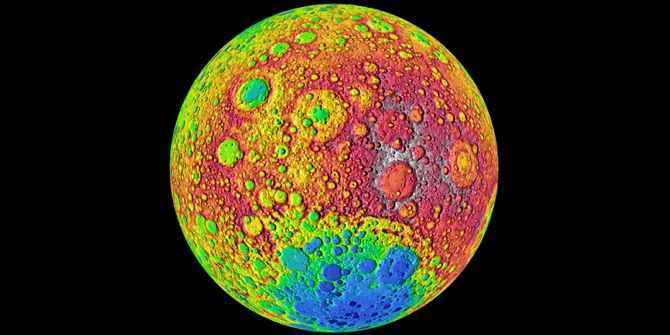
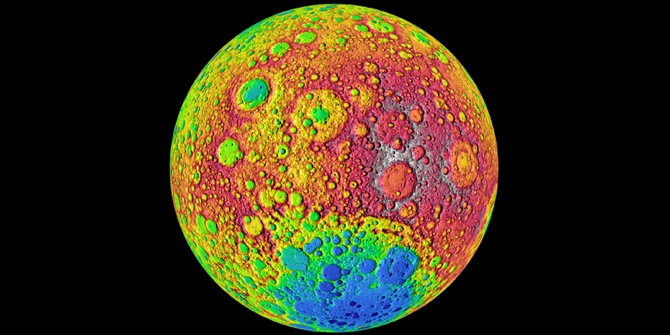
Stare at a topographical map of the far side, and you can’t miss it. A colossal, dark purple and blue splotch dominating the southern hemisphere. This is the South Pole-Aitken Basin.
And it is a monster.
At roughly 1,600 miles (2,500 kilometers) across and more than 8 miles (13 kilometers) deep, it is one of the largest and oldest recognized impact craters in the entire solar system. The impact that created this thing was so cataclysmic, so mind-bogglingly powerful, it’s a miracle the Moon wasn’t shattered into a billion pieces. The energy released would make the dinosaur-killing asteroid look like a firecracker.
Modern probes, like NASA’s Lunar Reconnaissance Orbiter (LRO), have mapped this basin in stunning detail. The image you see here, with its dramatic reds and blues, shows the extreme highs and lows. The red peaks soar to heights greater than 20,000 feet, while the blue depths plunge to impossible lows.
But the real mystery isn’t on the surface. It’s what’s buried underneath. In 2019, scientists studying gravity-mapping data of the basin found something… extra. A massive, unbelievably dense blob of metallic material, five times the size of the Big Island of Hawaii, lodged in the mantle. The official story? It’s likely the metallic core of the giant asteroid that formed the basin, still embedded in the Moon’s flesh like a piece of cosmic shrapnel. But what if it isn’t the asteroid?
What if it’s something else? Something manufactured?
Are We Alone? Not If You Look at the Moon.
This is where we leave the comfortable world of peer-reviewed science and enter the shadows. For decades, a persistent theory has been whispered in books, on late-night radio shows, and now, across the far corners of the internet. The theory that the far side of the Moon is occupied.
That it’s the home of an alien moon base.
Think about it. It’s the perfect listening post. The perfect staging ground. It’s close to Earth, but completely shielded from our prying eyes and, more importantly, our radio signals. The bulk of the Moon itself blocks all transmissions from Earth, creating a zone of absolute radio silence. The perfect cover.
The Veil of Radio Silence
Every Apollo mission that orbited the Moon experienced this phenomenon. As their command module slipped behind the lunar limb, all contact with Houston went dead. For over 40 minutes, the astronauts were the most isolated human beings in history. Completely, utterly alone. Or were they?
There are persistent, unconfirmed rumors of what the astronauts saw and heard during those periods of blackout. Strange transmissions. “Music” on frequencies that should have been silent. Coded messages. Even visual sightings of craft that were not their own.
Apollo 11 astronaut Michael Collins, while orbiting alone as Armstrong and Aldrin walked below, noted a strange, “eerie” sound in his headset, a sort of woo-woo whistling. NASA chalked it up to radio interference. Case closed. But the stories refuse to die. Did they see something they were ordered never to speak about? Was the radio silence not a bug, but a feature—a time when another party could communicate with them without Earth listening in?
“Anomalies” in the Images
If there are structures on the far side, surely we’d have pictures, right? Well, that’s what thousands of anomaly hunters spend their lives looking for. They pore over high-resolution images released by NASA, JAXA (the Japanese space agency), and now China, pixel by pixel. And they claim the evidence is everywhere, hiding in plain sight.
They point to things that just don’t look natural.
- Perfectly geometric shapes: Squares, triangles, and straight lines in a landscape that should be nothing but random curves.
- The “Tower”: A strange, spire-like object several miles high that casts a long, impossible shadow across the crater floor.
- The “Shard”: Another towering anomaly, a massive, reflective object that looks like a sliver of glass jutting out of the ground.
- “Tracks”: Uncanny lines that look for all the world like vehicle tracks, snaking for miles across the surface, sometimes disappearing into the mouths of caves.
Are these just tricks of light and shadow, a phenomenon called pareidolia where our brains see patterns in randomness? That’s what the debunkers say. But can every single one be explained away so easily? When you see a 90-degree angle on a world with no natural right angles, you have to ask questions.
China Lifts the Veil… Or Do They?
For decades, the far side was the exclusive domain of unmanned orbiters. Then, in January 2019, everything changed. China’s Chang’e 4 probe became the first spacecraft in history to perform a soft landing on the lunar far side. They landed right inside the Von Kármán crater, which is itself inside the monstrous South Pole-Aitken Basin.
They deployed the Yutu-2 rover, which began trundling across this previously untouched landscape. Suddenly, the far side wasn’t just a map. It was a place.
The mission has been dripping out fascinating, and sometimes bizarre, findings. The rover discovered a strange “gel-like substance” in a crater, which initially sparked a firestorm of online speculation before being identified as rock likely melted by a meteorite impact. More recently, it photographed a “mystery hut,” a cube-shaped object on the horizon. This, too, was later revealed to be just a strangely-shaped rock.
Or so they say.
Why China? Why now? Are they simply exploring, or are they looking for something specific? Something they know is there? Could their mission be a race to claim technology or make contact before anyone else?
Connecting the Dots: The Grand Scenarios
If something *is* on the far side, what could it be? The theories range from the plausible to the utterly mind-bending.
Scenario A: The Ancient Watchtower. The Moon isn’t just a rock; it’s a hollowed-out surveillance station. An artificial satellite placed in a perfect, tidally-locked orbit by an unimaginably ancient intelligence to observe the development of life on Earth. The base on the far side is simply the command center. They are watching us. Always.
Scenario B: The Cosmic Graveyard. The far side is the site of an ancient, forgotten war. The craters aren’t from random asteroids; they’re weapon scars. The South Pole-Aitken Basin wasn’t an impact—it was the final, terrible blast that ended a conflict. The metallic mass beneath it isn’t an asteroid core; it’s the wreckage of a massive mothership or weapon. The structures people see are the derelict ruins of a civilization we can’t comprehend.
Scenario C: The Secret Breakaway Program. Perhaps the occupants aren’t alien at all. Maybe they’re us. This theory suggests that a secret, global “breakaway civilization” with technology far beyond what the public sees has had bases on the Moon for decades. They use the far side to conduct experiments, build advanced craft, and operate completely outside the view and laws of the nations on Earth. They are the real space program.
Look at that topographic map again. The original post asked a simple question: where is the alien moon base? If you were going to build a secret installation, would you put it on the high, exposed red peaks? Or would you hide it down in the deep, sheltered, and resource-rich blue and green valleys?
The Moon keeps its secrets well. Locked away on a side we were never meant to see. For now, we are left with grainy photos, strange data points, and chilling questions.
But they are sending more and more probes. Humans are slated to return. The veil of secrecy is getting thinner every year.
The question is no longer *if* we will discover the truth of the far side. The question is, are we ready for it?
Originally posted 2016-03-17 04:28:02. Republished by Blog Post Promoter
![dark-side-of-moon[1]](https://coolinterestingnews.com/wp-content/uploads/2012/07/dark-side-of-moon1.webp)