The Cardrona Bra Fence Conspiracy: What REALLY Happened on That Lonely New Zealand Road?
Some stories start with a bang. A gunshot. A scream in the night. Others begin with a whisper. A secret. This one? This one started with lingerie.
Picture it. The road between Wānaka and Cardrona in Central Otago, New Zealand. It’s a lonely stretch of asphalt cutting through a landscape of raw, powerful beauty. Tussock grass rolling over hills that look ancient and wise. The sky is huge. The silence, even bigger. It’s the late 90s. Specifically, that strange, hazy week between Christmas 1999 and the dawn of a new millennium.
The world was holding its breath, worried about the Y2K bug, looking to the future. But on this quiet road, something utterly baffling was happening. Something that looked back to a much older kind of mystery.
Four bras appeared.
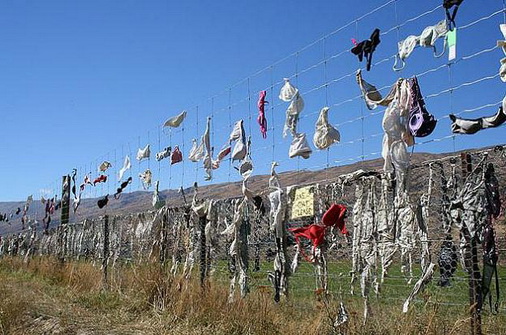
Just… there. Overnight. Hooked onto a humble wire fence, fluttering in the breeze like strange, captured birds. A silent, baffling statement against the vast, empty backdrop of the Cardrona Valley. There was no note. No explanation. No one saw a thing.
Who did it? And for God’s sake, why?
That one simple question would ignite a local legend, a bizarre culture war, and a mystery that, decades later, still has people talking, guessing, and whispering theories in the dark. The official story is one of drunken fun. A harmless prank. But as we pull on this thread, you’ll find that the simple story is almost never the whole story. What if those four bras weren’t a joke? What if they were a signal? A message? The opening act of something much, much stranger?
The Legend Explodes: From Four Bras to a Phenomenon
In the beginning, it was just confusion. A farmer doing his morning rounds. A commuter on their way to Queenstown. They’d slow their cars, squint, and wonder if they were seeing things. Bras? Here? It made no sense. It was the kind of local weirdness you’d mention at the pub later, getting a laugh and a shrug.
News travels fast in small towns. The story of the phantom bras spread not through the internet—this was 1999, remember—but through chatter. Phone calls. Gossip over a garden fence. The mystery was infectious. Who were the original four? Locals started calling them the “Four Phantom Founders.” Were they locals? Tourists celebrating the end of a trip? No one knew.
And then, the impossible happened. More bras began to appear.
At first, it was a trickle. A fifth bra. Then a sixth. Someone would drive by in the morning and see nothing new. By evening, a lacy red number would be hanging next to a sensible white one. It became a game. A silent, anonymous act of solidarity. Or was it rebellion? Women from all over, hearing the story, felt an urge. An urge to add their own offering to this strange, growing shrine. To be part of the mystery.
By the end of February 2000, just a couple of months after the first four appeared, the number had swelled to sixty. The fence was no longer a simple fence. It was a statement. A colorful, chaotic, and utterly bizarre landmark. A conversation starter. A true spectacle.
But not everyone was laughing.
The Bra Wars: A Community Divided by Underwear
For every person who saw the fence as harmless fun, there was another who saw it as an eyesore. An embarrassment. A stain on the pristine natural beauty of the valley. And one night, someone decided to do something about it.
They came in the dark. An unknown vigilante, or maybe a group of them, armed with wire cutters and a sense of righteous indignation. They snipped every last bra from the fence. All sixty of them. Vanished. Gone.
The next morning, the fence was just a fence again. Bare, silent, and boring. The magic was gone. The mystery, solved with a pair of pliers. Or so they thought.
This act of anonymous censorship was a colossal mistake. The local press, which had been treating the fence as a quirky little story, suddenly had a real conflict on its hands. “MYSTERY BRA-SNATCHER STRIKES!” the headlines might as well have screamed. The story went regional, then national. The tale of the phantom bra-busters, the “Fence Phantoms,” only added gasoline to the fire.
The response was immediate and overwhelming. In defiance of the killjoy cutters, a new wave of bras descended on the fence. Dozens turned into hundreds. This was no longer just a prank. It was a fight for the soul of that fence. A silent war fought with lingerie. One side fighting for order and tidiness, the other for spontaneity and a bit of weird fun.
By October 2000, the fence was more magnificent than ever, boasting around 200 bras. And once again, the cutters struck, clearing the fence clean. But it was too late. The legend was too powerful. The media coverage grew even wider this time. The story of the twice-slain, twice-resurrected bra fence became international news. Tourists started putting Cardrona on their maps specifically to see it—and to leave their own contribution.

The fence was now unstoppable. By early 2006, the count was close to 800. The battle lines were drawn. On one side, those who saw it as a potential hazard to drivers, a visual pollution. On the other, those who saw a beautiful, organic piece of folk art and a world-famous tourist attraction.
Deep Dive: The Psychology of a Roadside Shrine
Why do we do this? What possesses a person to hang their underwear, a shoe, or a padlock on a random public structure? The Cardrona Bra Fence isn’t an isolated incident. Think of the love-lock bridges in Paris, the shoe trees that dot desolate American highways, or the gum wall in Seattle. These are all examples of the same strange, human impulse.
It’s a desire to leave a mark. To say, “I was here.”
In a world where so much of our existence is temporary and digital, leaving a physical object behind feels real. It’s a small act of permanence. When you add a bra to that fence, you’re not just ditching old laundry. You are joining a tribe. You are becoming part of a story bigger than yourself. You connect with the thousands of anonymous people before you and the thousands who will come after. It’s a ritual without a religion, a community without a leader. It is, in its own weird way, beautiful.
The Conspiracy Theories: Unlatching the Truth
The official story? Four friends, a few drinks on New Year’s, a silly dare. It’s neat. It’s tidy. And to a mind like mine, it’s suspiciously simple. When something captures the public imagination this powerfully, you have to ask: is there more to the story? Let’s explore the shadows.
Theory 1: A Covert Marketing Stunt?
Think about it. The year is 1999. The concept of “viral marketing” is in its infancy. What if a clever advertising mind, maybe for a local pub or even a lingerie brand, decided to try something radical? Something that felt organic? You pay four young women to hang their bras on a fence and let human nature do the rest. The initial investment is tiny—the cost of four bras and a few beers. The potential payoff? A global phenomenon that gets your location’s name in newspapers around the world. The Cardrona Hotel is a famous historic pub just down the road. Did they see a drop in business? Did they cook up a scheme to literally put their valley on the map? There’s no proof. Zero. But the lack of evidence is exactly what would make it a brilliant campaign.
Theory 2: The Witches of Cardrona?
Now, stay with me here. The Otago region is steeped in history, a place of gold rushes and rugged pioneers. But what about older histories? Before the settlers, there was the Maori, and their own rich traditions. And even older than that, the land itself. Some corners of the internet whisper a different tale. One of a ritual. A pre-millennial ceremony performed by a local coven to honor a feminine deity or the power of the land itself. The bras, a symbol of femininity and liberation, weren’t a prank; they were an offering. A spell for freedom or fertility cast on the eve of a new age. The subsequent additions weren’t copycats; they were people subconsciously tapping into the energy of the place. And the men who kept cutting them down? They weren’t just tidy-kiwis; they were men afraid of this raw, feminine power. Far-fetched? Absolutely. But is it any more unbelievable than thousands of people spontaneously deciding to hang their underwear on a fence?
Theory 3: An Act of Radical Protest?
What if the bras were a message? A silent protest. But against what? In the late 90s, feminist conversations were evolving. Perhaps it was a statement against the restrictive nature of society, with the bra as the ultimate symbol of conformity. Tossing it off and hanging it in public was a declaration of freedom. A message to the world. Perhaps it was a more personal protest, related to an event no one knew about. A quiet rebellion against a local injustice. The four women weren’t drunk; they were angry. And their anger, hung on a wire fence, resonated with thousands of others who felt the same way but didn’t know how to express it. The fence became their voice.
Bradrona is Born: From Chaos to Charity
As the years went on and the number of bras climbed into the thousands, the debate reached a fever pitch. The fence was on a main road, and officials cited traffic safety concerns as people slowed down or stopped to take pictures. The constant removals were a drain on resources. The prank had outgrown its home.
In 2015, a decision was made. The bras were cleared from the original fence one last time. But this wasn’t the end. It was a rebirth.
The attraction was moved to a new, official location: the driveway leading to the Cardrona Distillery and the Cardrona Hotel. It was officially christened “Bradrona.”
Something amazing happened. The fence, now sanctioned and safe, found a new purpose. It shed some of its rebellious edge and gained a heart. A pink sign was installed, and donation boxes appeared. The goal? To raise money for the New Zealand Breast Cancer Foundation. The symbol of feminine freedom now became a symbol of survival, support, and hope.
The transformation was profound. What began as a baffling mystery, evolved into a public nuisance, and finally blossomed into a powerful fundraising tool. In 2006, an attempt was made at the world’s longest bra chain. While it fell short of the record, the event raised over $10,000 for charity. Bradrona continues this legacy, turning gawking tourists into donors and a weird joke into a force for good.
The Unanswered Questions That Still Haunt Us
Even with its new, respectable identity, the core mystery of the Cardrona Bra Fence remains. The questions are what keep the legend alive.
Who were the “Bra Busters”? Were they really just a few grumpy locals? Or was it a more organized effort? Competing tourism operators from a rival town? It’s a fascinating thought—a secret war of tourism fought under the cover of darkness with wire cutters.
And the biggest question of all: the original four. Have they ever come forward? Have they ever been definitively identified? The answer is no. Over the years, a few people have claimed to be them, but nothing has ever been proven. They remain phantoms. Ghosts in the machine they created.
Can you imagine what that must be like? To be one of those four women? To watch your silly, spontaneous act morph into a global news story, a source of conflict, and ultimately, a symbol of hope and charity. To drive past it and know, “I started that.” It must be the strangest feeling in the world. They hold the one true answer, and their silence is what makes the story so powerful.
The simple explanation—that it was just a prank—feels too easy. It doesn’t explain the raw, magnetic power the fence had from day one. It doesn’t explain why it survived repeated attacks. It doesn’t explain why thousands of people from every corner of the globe felt compelled to add to it.
The fence is more than just a fence. It’s a testament to spontaneity. It’s a monument to a secret. It’s a canvas where thousands of people have painted their own small act of rebellion, memory, or joy.
So the next time you see something odd on the side of the road—a single shoe, a child’s toy, a strange carving in a tree—don’t just dismiss it. Pause for a second. It might just be the start of a legend. A legend held together by hooks, clasps, and a secret that has never been… unfastened.
Originally posted 2016-04-12 08:28:00. Republished by Blog Post Promoter