The Bosnian Sphere: Proof of a Lost Super-Civilization or Just a Big Rock?
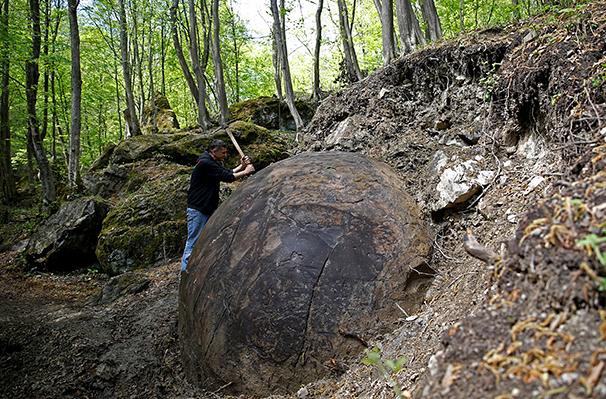
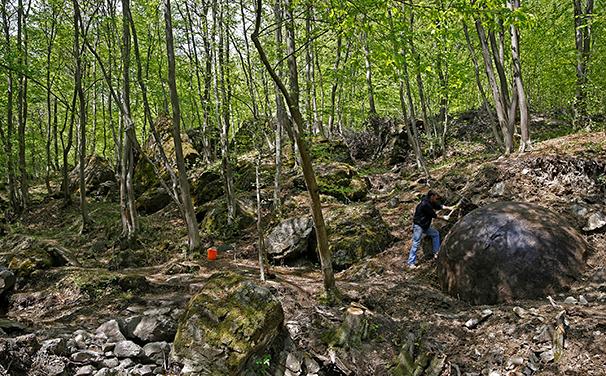
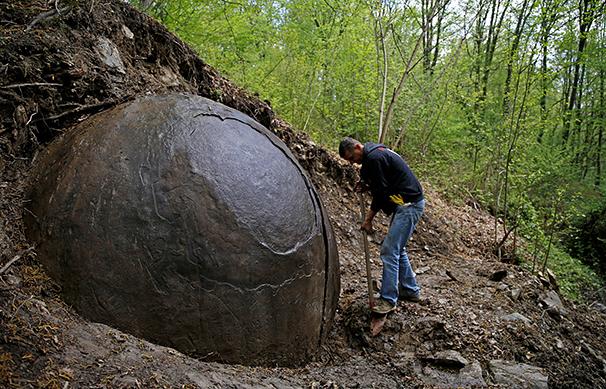
Deep in the forests of Bosnia, something sleeps. Something ancient. In 2016, the world got a glimpse of it. A team, hacking through the undergrowth near the town of Zavidovići, stumbled upon a sight that sent shockwaves through the worlds of archaeology and alternative history. It was a sphere. A massive stone sphere, half-buried in the earth like a forgotten god’s marble.
And it wasn’t just a big, round rock. It was… perfect. Or damn near close. This wasn’t some random boulder shaped by a river. This felt different. This felt *made*. Instantly, a question ignited a firestorm of debate that rages to this day: Are we looking at a fluke of nature, or the calling card of a civilization so old, it’s been completely erased from our history books?
Forget what you learned in school. Forget the neat, tidy timelines. The story of the Bosnian sphere is a rabbit hole that leads to pyramids in Europe, forgotten technologies, and a profound question about our own past. Is humanity older, and smarter, than we’ve ever been told?
Let’s dig in.
A Discovery That Defies Explanation
Imagine the scene. The Podubravlje forest. Damp earth, thick trees, the smell of moss and time. Then, this. A colossal, reddish-brown orb breaking through the soil. The man who brought this discovery to the world was Dr. Semir “Sam” Osmanagich, a figure who is no stranger to controversy. To his supporters, he’s a visionary, an Indiana Jones for the modern age, daring to challenge the dusty status quo. To his detractors, he’s a pseudoscientist chasing fantasies.
But no one could deny the sheer presence of the sphere.
Initial estimates were staggering. A diameter of up to 1.5 meters. A weight of over 30 tons. That’s heavier than six large elephants. Its distinct reddish-brown color hinted at a high iron content, a fact that would become a key point of contention. Osmanagich and his team began clearing the earth around it, revealing more of its impossible roundness.
For Osmanagich, this wasn’t just an artifact. It was a message. “It would be further proof that southern Europe, the Balkans and Bosnia in particular, were home to advanced civilisations from the distant past,” he proclaimed. He believes we are looking at the handiwork of a people who possessed a technology we can’t comprehend. They understood energy. They understood geometry. They understood the power of shapes.
The Pyramid Connection: A Landscape of Lost Energy?
You can’t talk about Sam Osmanagich and the Bosnian sphere without talking about the Bosnian Pyramids. This is the theory that truly put him on the map. Just a short distance from where the sphere was found, near the town of Visoko, lies a series of hills. Hills that Osmanagich insists are not hills at all.
He claims they are man-made pyramids. The largest and oldest on the planet.
According to his research, these structures, which he has named the Pyramid of the Sun and the Pyramid of the Moon, are geometrically precise and aligned with the cardinal directions. He points to excavated sections revealing what look like blocks of ancient concrete, and a vast network of underground tunnels he calls the “Ravne Tunnels.”
So where does the giant stone sphere fit in? In Osmanagich’s grand vision, the sphere is not an isolated object. It’s part of a system. A vast energy network built by this forgotten civilization. He argues that pyramids and spheres are powerful geometric forms that can harness and amplify natural energy from the Earth—so-called “torsion fields” or “ley lines.”
Could this sphere have been a node? A capacitor? A resonator in a planetary power grid that we are only just beginning to rediscover? It sounds like science fiction. But then you look at the globe, and you realize something strange.
Bosnia isn’t the only place with giant, mysterious stone balls.
A Global Phenomenon: The Stone Balls of Earth
This is where the story gets really weird. The Bosnian discovery echoes other, even more famous mysteries from around the world.
- The DiquÃs Spheres of Costa Rica: These are the most famous examples. Hundreds of perfectly carved stone spheres, ranging from a few centimeters to over two meters in diameter. They are undeniably man-made, crafted by the DiquÃs culture sometime between 600 and 1500 AD. They are so perfect, so numerous, and their purpose so unknown, that they are a designated UNESCO World Heritage site. How did they achieve such precision with primitive tools? Why?
- The Volcanic Spheres of Mexico: In western Mexico, similar giant stone spheres have been found, attributed to the ancient Olmec civilization. Again, their purpose is a complete mystery.
- Easter Island’s “Navels of the World”: Even on the most remote island on Earth, strange, carefully shaped spherical stones have been found, often associated with the famous Moai statues.
Osmanagich has studied these sites for years. He sees a pattern. A global culture of sphere-builders. A lost chapter of human history. He believes the Bosnian sphere is the largest and oldest of them all, pushing the timeline of advanced civilization back thousands of years before Sumeria or Egypt.

Are we looking at a worldwide interconnected culture? A “fingerprint” left by a single, ancient society that seeded humanity with knowledge? Or is it just a coincidence? Is it possible that different cultures, at different times, all decided to carve big rocks into balls for their own separate reasons?
Before you decide, you have to hear the other side of the story. The side that says this sphere isn’t a message from the past. It’s a trick of geology.
Geology Strikes Back: The Case for a Natural Wonder
The mainstream scientific community was, to put it mildly, skeptical. Geologists looked at the photos, read the reports, and collectively sighed. To them, this wasn’t a profound mystery. It was a textbook example of a natural process.
Mandy Edwards, a lecturer at the University of Manchester’s School of Earth, Atmospheric and Environmental Sciences, was one of the first to throw cold water on the excitement. She suggested the sphere was likely an example of “concretion.” Experts from the Geological Society agreed, adding that it could also be a product of “spheroidal weathering.”
These aren’t made-up terms to dismiss the discovery. They are well-documented geological phenomena that create strange and wonderful shapes all over the world. So what are they?
Deep Dive: The Slow Magic of Concretion
Think of how a pearl forms. A tiny grain of sand or some other irritant gets inside an oyster, and the oyster coats it with layer after layer of nacre, creating a perfect sphere over time. Concretion is a similar process, but it happens inside sedimentary rock with minerals instead of nacre.
It starts with a bit of organic material—a leaf, a shell, a bone fragment—buried in sediment like sand or mud. Over millions of years, water seeps through the sediment, carrying dissolved minerals like calcite or iron oxide. These minerals are attracted to the central piece of organic matter and begin to precipitate, or crystallize, around it. Layer after layer after layer builds up, cementing the surrounding sediment into a hard, dense mass. Because this process happens outwards in all directions from a central point, the resulting shape is often a sphere or an ellipsoid. What you’re left with is a rock that is much harder than the softer rock around it. When that softer rock erodes away, the hard, spherical concretion is left behind.
This process explains the high iron content. The reddish color comes from iron oxide, which is one of the most common “cements” in the concretion process.
Deep Dive: The Power of Spheroidal Weathering
The other possibility is spheroidal weathering. This happens to solid bedrock, not loose sediment. Imagine a big cube of rock buried underground. Water seeps into cracks in the rock, called joints. This water contains weak acids that begin to chemically break down the rock’s surface. The weathering attacks the cube from all sides. But it attacks the corners and edges fastest, because they have more surface area exposed. Over eons, the process rounds off the corners, then the edges, until the cube is slowly transformed into a sphere, like a bar of soap used over and over again. It peels away in layers, like an onion.
Geologists argue that either of these processes could have formed the Bosnian sphere. They say there are probably many more, of varying sizes, still buried in the same forest.
Analyzing the “Evidence”: A Battle of Narratives
So we have two completely different stories. One is an epic tale of lost civilizations and cosmic energy. The other is a slow, quiet story of minerals, water, and time. How do we decide? Let’s break down the evidence.

- The “Perfect” Shape: Is the sphere truly a perfect, man-made orb? Photographs suggest it’s not. While impressively round, it has irregularities, bumps, and a somewhat uneven shape, which is more consistent with a natural formation than a precisely engineered artifact. The DiquÃs spheres of Costa Rica, by contrast, are often uncannily perfect.
- The Composition: Osmanagich points to the high iron content as evidence of advanced metallurgy or at least specific material selection. Geologists counter that this is exactly what you’d expect from a ferruginous sandstone concretion. The iron isn’t proof of manufacturing; it’s the glue that made the rock in the first place.
- The Context (or Lack Thereof): This is the biggest problem for the ancient civilization theory. Where is the rest of it? If a culture could create and move a 30-ton sphere, where are their cities? Their tools? Their quarries? Their burial sites? The sphere was found in isolation. Archaeology is about context. An artifact without context is just an object. So far, no other supporting evidence of this advanced Bosnian super-culture has been found and verified by mainstream science.
Modern Theories and Internet Rabbit Holes
Since its discovery in 2016, the Bosnian sphere has become a legend on the internet. It’s a favorite topic on alternative history forums, YouTube channels, and late-night Reddit threads. The theories have only gotten wilder. Some suggest it wasn’t made by humans at all, but is an alien probe or marker. Others believe it’s a “thunderstone” or a remnant of some ancient sonic technology, capable of levitation or energy healing.
The narrative has taken on a life of its own, fueled by a deep-seated distrust of “official” explanations and a desire for our past to be more magical and mysterious than the history books tell us. The sphere has become a symbol for all the world’s “out-of-place artifacts”—objects that just don’t seem to fit the accepted timeline of human history.
Every new photo, every amateur analysis, adds another layer to the myth. It’s no longer just a rock in a forest. It’s an idea. A possibility. A “what if” that people can cling to.
A Mystery Carved in Stone, Or Time Itself?
So what is the truth? Is the Bosnian sphere the last remnant of a glorious, forgotten age? A piece of a puzzle that could rewrite everything we know about who we are and where we come from?
Or is it a beautiful, humbling example of the power of our own planet? A silent sculpture carved not by human hands, but by the patient, invisible forces of pressure, water, and millions upon millions of years?
Perhaps the real power of the sphere isn’t in its origin, but in the questions it forces us to ask. It makes us look at a simple hill and wonder if it’s a pyramid. It makes us look at a round rock and wonder if it’s a message. It ignites our imagination and challenges us to look beyond the obvious.
Whether it’s a geological masterpiece or an artifact from a lost world, one thing is certain. The great stone ball of Bosnia remains, half-buried in the forest floor, keeping its secrets. For now.