Monday, May 11, 2026
HomeWeird WorldStrange PlacesStrange Object - South Africa

Strange Object – South Africa

Imagine driving down a lonely stretch of road in South Africa. The dust kicks up behind your tires. The sun beats down on the KwaZulu-Natal midlands. It looks like just another empty landscape. But then, off to the side, you see something strange. Something that shouldn’t be there.

Jagged metal teeth sticking out of the ground.

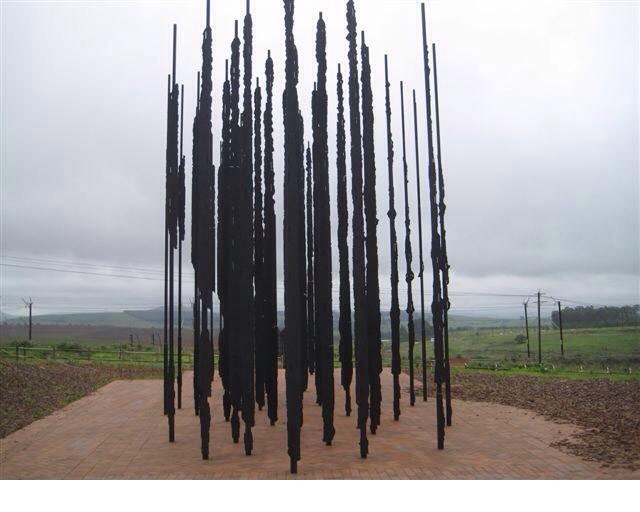
At first glance, it looks like a mistake. A construction project gone wrong? A collection of random steel beams abandoned by a negligent crew? It looks chaotic. Messy. It makes zero sense to the human eye. You keep walking, confused. The closer you get, the more random it seems. Just fifty massive spikes of laser-cut steel jutting into the sky, terrifying and beautiful all at once.

But then, you hit the sweet spot.

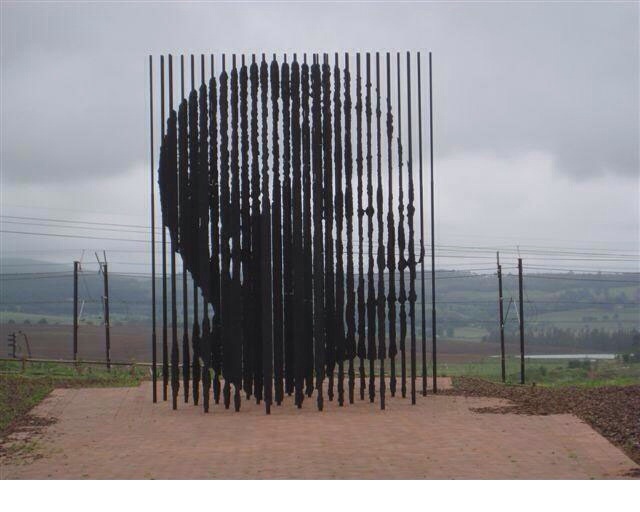
You step onto a designated path—35 meters away—and the world snaps into focus. The chaos vanishes. The random beams align with mathematical perfection. And suddenly, staring back at you from the void, is the face of Nelson Mandela.

South Africa

This isn’t just art. This is a glitch in the matrix made of steel. This is the Mandela Capture Site sculpture, and it is easily one of the most mind-bending tributes ever constructed. Created by the visionary artist Marco Cianfanelli in 2012, this masterpiece does more than just honor a man. It challenges your entire perception of reality.

The Day the Timeline Split

Why here? Why this specific, dusty corner of the world? To understand the steel, you have to understand the ghosts haunting this soil.

Let’s rewind. August 5, 1962. A day that changed history forever. Or, if you subscribe to certain theories, the day the timeline began to fracture.

Nelson Mandela wasn’t the globally recognized saint of peace back then. He was the “Black Pimpernel.” He was the most wanted man in South Africa. He was a ghost, slipping through police nets, using disguises, and moving in the shadows to dismantle the Apartheid regime. On this specific day, he was posing as a chauffeur. He was driving a seemingly ordinary Austin Westminster, wearing a stark white dustcoat. He looked like just another driver.

But someone knew.

This is where the history books get dark. This wasn’t just bad luck. This was a setup. A betrayal of the highest order. As Mandela drove along the R103 road, armed police blocked his path. They knew exactly who was in that car. They knew exactly when he would be there.

For decades, rumors swirled. Who tipped them off? Was it a mole? Was it a neighbor? Modern declassified documents and deathbed confessions have pointed a finger at a terrifying culprit: The CIA. That’s right. Reports suggest an American operative, Donald Rickard, tipped off the South African authorities. The geopolitical chess game of the Cold War reached out and crushed a man on a lonely road in KwaZulu-Natal.

That arrest led to 27 years of darkness. 27 years in a concrete box. And it all started right where those steel columns now stand.

50 Columns. 50 Years. Infinite Meaning.

Cianfanelli didn’t just throw up a statue. A standard bronze statue? Boring. Predictable. It wouldn’t capture the fragmentation of a man’s life. Instead, he built a puzzle.

The sculpture consists of 50 steel columns. Why 50? Because in 2012, when this beast was unveiled, exactly 50 years had passed since that fateful arrest in 1962. One column for every year of the “Long Walk to Freedom.”

Each column is roughly 10 meters (32 feet) high. These aren’t small. They are monoliths. They loom over you. When you walk among them, you feel small. You feel the weight of the steel. It mimics the feeling of incarceration. Being surrounded by bars. The air feels heavy between the plates.

But there is a twist.

Cianfanelli said, “The 50 columns represent the 50 years since his capture, but they also suggest the idea of many making the whole; of solidarity.”

Think about that. “Many making the whole.” One steel bar is just a piece of metal. It’s useless on its own. It’s vulnerable. But stand 50 of them together? You create an icon. You create a force that cannot be moved. It’s a physical manifestation of the resistance movement itself. No single person ended Apartheid. It took the collective alignment of millions of people to create the image of freedom.

It also points to a savage irony. The government thought that by arresting Mandela—by putting him behind bars—they would erase him. They thought they could make him invisible. Instead? The incarceration did the exact opposite. It turned a man into a myth. It cemented his status as the global icon of struggle. The bars didn’t hide him; they framed him for the world to see.

The Optical Illusion: A Glitch or a Message?

Let’s get into the weird stuff. The physics of this thing are mind-blowing. This is called anamorphic art, but I like to call it “reality hacking.”

The columns are laser-cut with extreme precision. We are talking about engineering that tolerates zero errors. If one column is off by an inch, the face melts. The illusion breaks.

As you walk around the site, the sculpture essentially shapeshifts. From the side, it looks like a barcode for a giant. From the back, it looks like a jagged forest. The sculpture interacts with the sun, the clouds, and the surrounding grass. It is never the same sculpture twice. The shadows lengthen and shorten, changing the mood of Mandela’s face from stern to sorrowful to hopeful.

It visually shifts throughout the day, impacted by the changing light and atmosphere behind and around it. It’s alive.
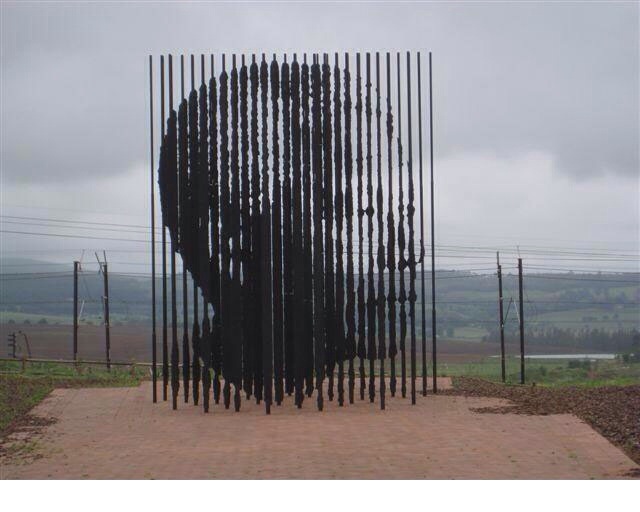
And then there is the “Focal Point.” This is where the magic happens. You have to stand exactly 35 meters back. Why? Because perspective is everything. This is a philosophical sledgehammer hitting you right in the face. The artist is telling us that reality depends entirely on where you stand.

If you stand in the place of the oppressor, you see chaos. You see noise. You don’t understand what you are looking at. But if you stand in the place of history—if you align yourself with the truth—the picture becomes clear.

The Mandela Effect Connection

We cannot talk about Nelson Mandela on a conspiracy blog without addressing the elephant in the room. The phenomenon is literally named after him: The Mandela Effect.

Millions of people around the world share a distinct, vivid memory of Nelson Mandela dying in prison in the 1980s. They remember the funeral on TV. They remember the eulogies. They remember the mourning. And yet, in this timeline—our current reality—he survived prison, became President, and lived until 2013.

This sculpture was built in 2012. One year before his death in *this* timeline.

Is it possible that this site acts as an anchor? A grounding rod for reality? The sculpture itself deals with the concept of presence and absence. The face is there, but it’s mostly empty space. It is made of air as much as it is made of steel. It is a ghost image.

When you stare at it, are you looking at the man who lived? Or are you looking at the memory of the man who died in the other timeline? The fragmented nature of the sculpture fits the theory too perfectly. It represents a fractured reality coming together to form a single, coherent image. But step to the left, and it falls apart again.

Is Cianfanelli just an artist, or did he tap into something subconscious? Did he build a monument to the glitch itself?

The Landscape of Resistance

The location itself adds to the eerie power of the piece. This isn’t a museum in a busy city center. It’s out in the open. The KwaZulu-Natal midlands are stunning, but they are quiet. There is a silence here that screams.

The path to the sculpture is symbolic. It’s a “Long Walk to Freedom” in literal form. As you walk down the path towards the sculpture, you are physically re-enacting the journey. You start far away, where things are unclear and confusing (the chaos of the columns). As you persist, as you keep walking, things begin to make sense. Clarity comes with distance and time.

The sculpture becomes part of the surrounding landscape. It doesn’t block the view; it incorporates it. The hills behind Mandela’s head become his thoughts. The sky becomes his mind. He is not separate from South Africa; he *is* South Africa.

South Africa

Why You Need to Visit (Before It Changes?)

If you are a hunter of the strange, the beautiful, and the historically significant, this needs to be on your bucket list. Photos—even the ones here—do not do it justice. A 2D image cannot capture the sensation of the parallax effect. You need to move your head. You need to see the steel bars slide past each other.

There is a vibration at the site. Call it residual energy from the arrest. Call it the collective emotion of millions of visitors. Or call it the hum of a timeline trying to hold itself together. Whatever it is, you feel it in your chest.

The capture site has been upgraded over the years. It now includes a world-class museum that digs into the gritty details of the apartheid struggle. But the main event remains those 50 columns.

So, here is the question you have to ask yourself: Do we shape history, or does history shape us? When you look at those columns, are you seeing a man? Or are you seeing a mirror reflecting the broken, jagged pieces of our own society, asking us to find the right perspective to make it whole again?

Next time you find yourself in South Africa, take the drive. Find the spot. Stand on the mark. And look the ghost of history in the eye.

Quick Facts for the Truth Seekers:

  • Location: R103, Howick, KwaZulu-Natal, South Africa.
  • Artist: Marco Cianfanelli (commissioned by Culture Mechanics).
  • Materials: Laser-cut mild steel, galvanized and painted.
  • Height: Up to 9.5 meters.
  • The Coincidence: 50 years. 50 columns.
  • The Feeling: Unsettling awe.

History is never a straight line. Sometimes, it’s a jagged array of steel waiting for you to find the right angle. Keep your eyes open.

Amit Ghosh
Amit Ghoshhttps://coolinterestingnews.com
Aloha, I'm Amit Ghosh, a web entrepreneur and avid blogger. Bitten by entrepreneurial bug, I got kicked out from college and ended up being millionaire and running a digital media company named Aeron7 headquartered at Lithuania.
RELATED ARTICLES
- Advertisment -

Most Popular

Recent Comments

Warren Pan Abbott on The legend of the Devil Monkey !
chris davies on The McPherson Tape Mystery
Reed Reedly on ET has Internet!
Bea Houseoffashion on Proof Of Time Travellers – Gallery
Marcus2012 on ET has Internet!
Reed Reedly on ET has Internet!
LaughsAtConspiracyNuts on The 9/11 Conspiracy – Myths and Facts
Alex Sliverman on Did the ancients fly?
Doctor Wholigan on Time Traveler in 1938 film
chris davies on The McPherson Tape Mystery
Archie1954 on 10 secret UFO hideouts
chris davies on Ghosts of flight 401
Marcus2012 on ET has Internet!
jason Macdonald on Proof of Time Travel? – China
chris davies on Long-Lost Pyramids Found?
Reed Reedly on ET has Internet!
Milkman on Connected Universe
Tenmiles on Baigong Pipes Mystery
Simon Foster on Sirius – The Documentary
From the 1st April on 2013 – Alien Contact date ?
SkyWatcher on Is ET ignoring us?
I Come From The Future on Obama to make UFO Alien disclouser soon ?
Just another person on 2013 – Alien Contact date ?
Malcolm Windowcleaner on The strange case of Rudolph Fentz
Mason Servio on Strange Things on Mars
Marke Wisdom Seeker on What will we find as arctic melts?
Andrea A Elisabeth Levyne on Aliens Captured in Varginha, Brazil
Mitch Grouyeki on Amazing Space Shuttle pictures