1.
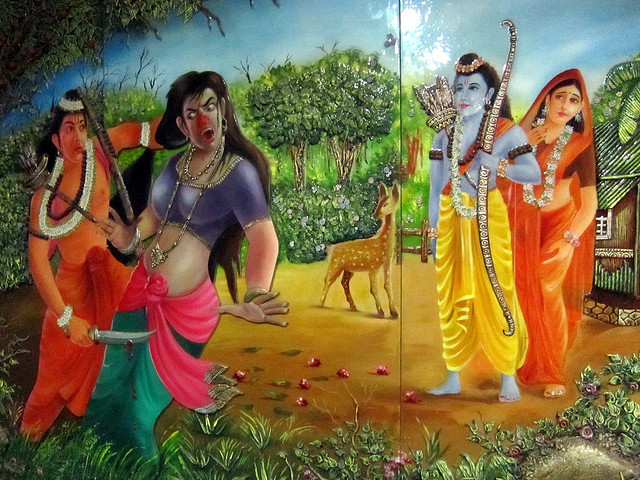
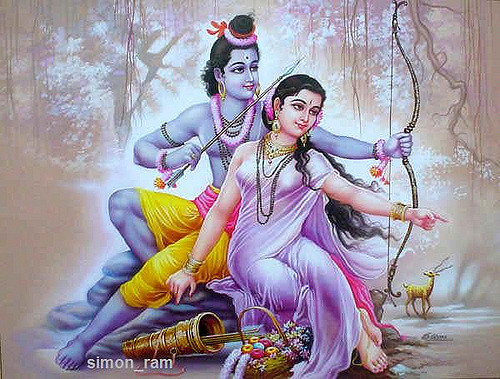
1. All of us know of the incident from the famous epic Ramayan, when Surpanakha had met Lord Rama asking him to marry her. However, she was insulted and only returned Lanka with her nose cut crying in anger and in pain. It was after this insult of Surpanakha, when Raavan, her brother, had decided to take revenge from Rama. However, things took another turn and Raavan was killed by Rama. This whole episode had let Rama take the decision of abandoning Sita as she had spent some time in Ashok Vatika in Raavan’s kingdom in Lanka. She was left in the forests by Lakshman after Rama’s order. And this is where Sita had met Surpanakha.
2.
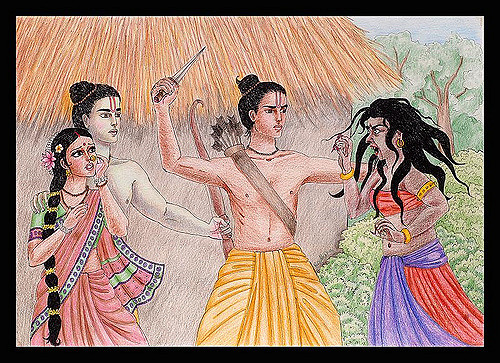
2. Sita being abandoned by Rama had created a change.The darkness of the forest gave way to a harsh sunlight. The trees were weeping. The birds were howling. The serpents were wailing. Rama has banished Sita, they all cried. Ayodhya did not think she was good enough for it. Sita, however, calmed the trees and the birds and the serpents and explained that Rama is locked by rules, unable to breathe free in the palace. I am back in the forest, where I can do whatever I please, whenever I please. I am no longer anyone’s wife; I am now a woman with child. Gauri is not bound to bow her head and watch her step anymore; I am now Kali. I can swim in the river and eat Shabari’s berries. And here under the berry tree, Sita found Surpanakha, full of hate and rage, gloating.
3.
3. When Surpanakha saw Sita, she thought of making fun of her and therefore told her that she has been rejected by Rama just like the way he rejected her. She told Sita that she would now suffer like her and that she was stripped of status as Surpanakha was stripped of beauty.
4.
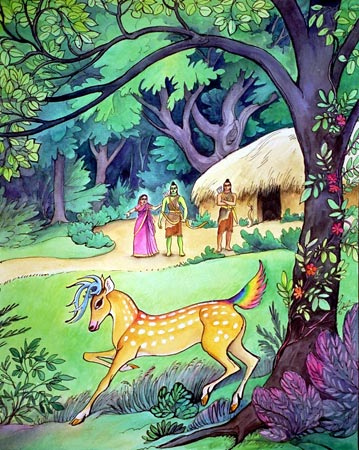
4. Sita smiled, and offered Surpanakha a berry. While offering the berries, Sita told Surpanakha that these are really sweet, as sweet as the berries in Mandodari’s garden. Surpanakha was surprised. She had expected to derive pleasure from Sita’s pain. But Sita was not in pain. Instead, she told Surpanakha, how long will she expect those around her to love her as she loves them? Find the Shakti within yourself to love the other even when the other does not love you. Outgrow your hunger by unconditionally feeding the other.
5.
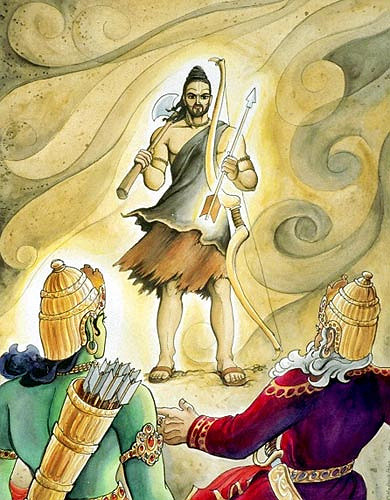
5. But, Surpanakha asked for justice. Sita explained her further that her culprits have already been punished. She told her that ever since the sons of Dashratha disfigured her, they have known no peace. Yet Surpanakha rave and rant relentlessly. Humans are never satisfied with justice. Animals never ask for justice.
6.
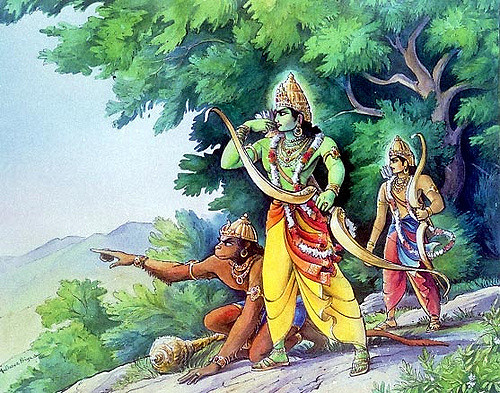
6. Surpanakha replied that she was no animal and therefore, can’t be treated as one. Sita asked her to be human then. She advised her let go and move on. They who hurt her cannot expand their mind. But surely she can.
7.
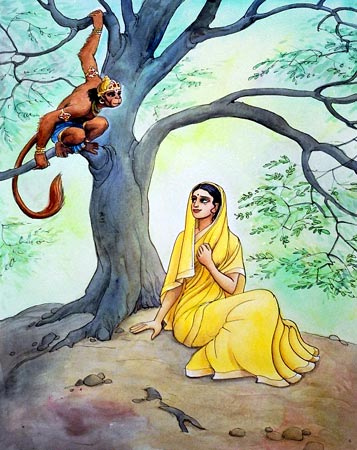
7. Sita explained her that Surpanakha had trapped herself in her own victimhood. And like this she will only be like Raavan. Sita asked her to stand upright while her brothers die, her sons die and her kingdom burns, imagining her own nobility. Sita said that cultures come and go. Rama and Raavan come and go. Nature continues. I would rather enjoy nature.
8.
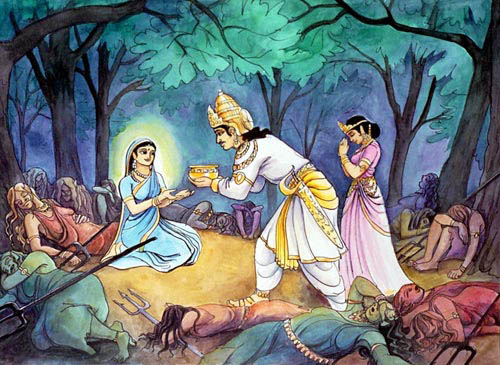
8. Surpanakha picked up the berry offered by Sita. It was indeed sweet, sweeter than any lover’s impatient, lustful gaze. She ate another berry, smiled, and said that from now on she would race with Sita to the river. Surpanakha giggled as she jumped into the waters. Once again, she felt beautiful.
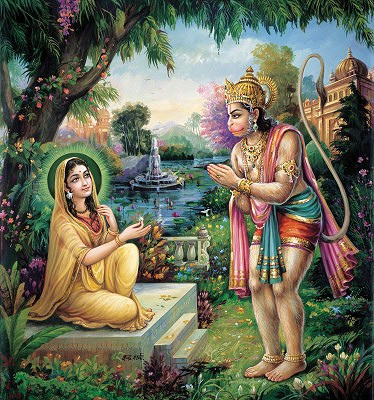
9.
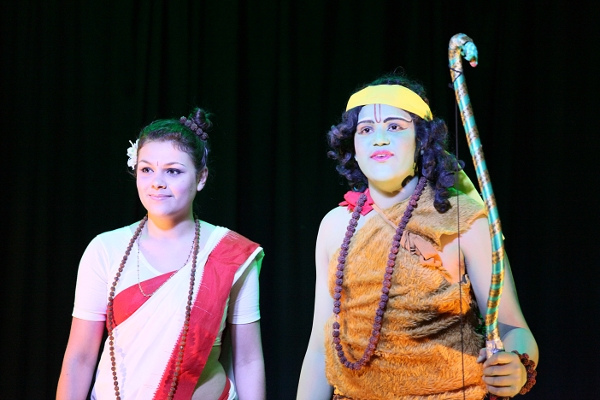
9. Urmila (Laxman’s wife and Sita’s sister) slept on behalf of her husband as well as herself – she slept for all of 14 years! This way Lakshman could stay awake for 14 years during exile protecting Ram and Seeta. Lakshmana is also called “Gudakesh” for this reason – the one who defeated sleep. Precisely why he was able to kill Meghnad, blessed to be defeated only by a person who hadn’t slept for 14 years.
10.
10. Dasharatha had more than 300 wives though only 3 are well-known. Kaikeyi was the last one. He was cursed that he would suffer just like Sharavan Kumar’s parents. Fate took its turn and Ram went into exile at the age of 27. When his father died in agony, Rama saw this in a dream where his father wore black robes.
11.
11. Jay and Vijay were gate keepers of Vishnu’s world and they were cursed by Bramha’s sons to be born on earth. They pleaded to Vishnu and the Lord said they could be born as his devotees 7 times or his enemies thrice. In order to be back with the lord sooner, they agreed to the latter and were born as Hiranyaksha & Hiranyakashapa in Sat Yuga, Ravana and Kumbhakarna in Treta Yuga, Dantavakra and Shishupala in Dwapara Yuga.
12.
12. Vishnu magically coaxed Ravan into asking for Parvati’s hand in marriage from Shiva and Shiva granted his wish. Parvati was furious and she cursed that Vishnu would also lose his mate on earth. Bali’s wife also uttered the same curse when her husband was slain by Ram. That is why, Sita was abducted in the Ramayana!
13.
13. Hanuman once battled Lord Ram with nothing more than the chant of Lord Ram’s name. Ram’s arrows could not hurt Hanuman and Yayati was saved.
14.
14. Hanuman would not allow Yamraj to enter Ayodhya to claim Lord Rama’s life. To divert his attention, Ram asked Hanuman to retrieve his ring that he had dropped into a crack in the floor. Hanuman reached the serpent world and asked for Rama’s ring. The king there said that there was a vault full of Rama’s rings that he used to divert Hanumana each time his life on earth was over.
15.
15. The concept of Lakshman Rekha is a myth. The Valmiki Ramayan doesn’t mention a thing about it. That Ram broke Shiva’s bow in Sita’s swayamvar is also not described in the Valmiki Ramayana.
16.
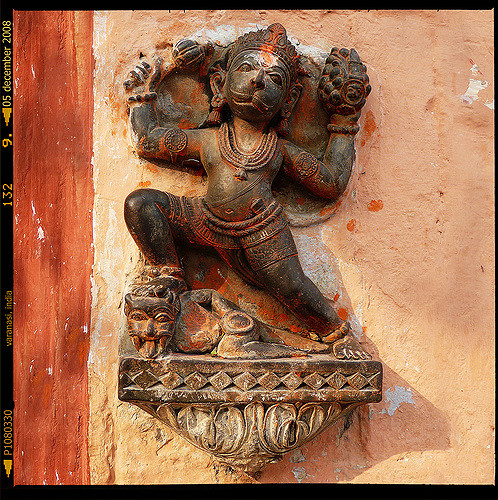
16. Sita was putting sindoor in her hair and on being quizzed, she told Hanuman that she did it for her lord’s long life and well-being. On hearing this, Hanuman started applying sindoor to his entire body! He loved Lord Ram more than anything else in the world.
17.
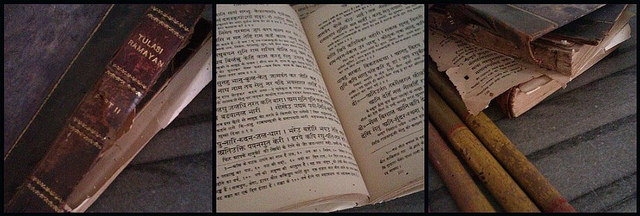
17. Rama is the 7th incarnation of Lord Vishnu and the Ramayana has 7 Kand’s or parts.
18.
 na could not be killed by animals or gods, spirits or demons. He thought mortal men could not harm him and thus, Ram was born human to destroy Raavan.
19.
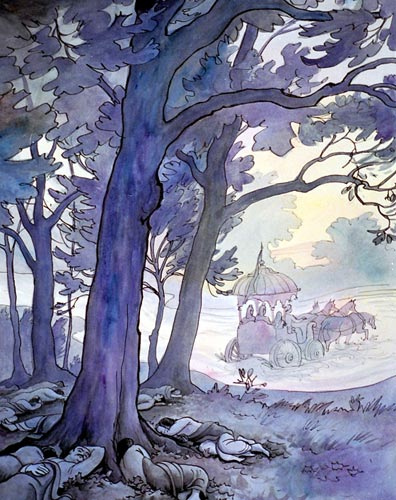
19. Rama left the earth by taking Jala samadhi in the Sarayu River.
The seven kandas (books):-
The epic is traditionally divided into several major kāndās (books), which deal chronologically with the major events in the life of Rama.[12] The division into 7 kāndās is as follows:
| Kanda/Book | Title | Contents |
|---|---|---|
| 1 | Bāla Kāṇḍa(Book of childhood) | The origins and childhood of Rama, born to king Dasharatha of Ayodhya and destined to fight demons. Sita’s swayamvara and subsequent wedding to Rama.[27] |
| 2 | Ayodhya Kāṇḍa(Book of Ayodhya) | The preparations for Rama’s coronation in the city of Ayodhya, his exile into the forest, and the regency of Bharata.[27] |
| 3 | Araṇya Kāṇḍa(Book of the forest) | The forest life of Rama with Sita and Lakshmana, his constant companion. The kidnapping of Sita by the demon king Ravana.[27] |
| 4 | Kishkindha Kāṇḍa(Book of the monkey kingdom) | Rama meets Hanuman and helps destroy the monkey people’s king, Vali, making Vali’s younger brother, Sugriva, king of Kishkindha instead.[27] |
| 5 | Sundara Kāṇḍa(Book of beauty) | Detailed accounts of Hanuman’s adventures, including his meeting with Sita. Traditionally read first when reading the Ramayana, this book’s name derives from the fond name given to Hanuman by his mother.[27] |
| 6 | Yuddha Kāṇḍa(Book of war, also known asLanka Kanda) | The battle in Lanka between the monkey and the demon armies of Rama and Ravana, respectively. After Ravana is defeated, Sita undergoes the test of fire, completes exile with Rama, and they return to Ayodhya to reign over the ideal state.[27] |
| 7 | Uttara Kāṇḍa(Last book) | The detailed story of Ravana’s life, his encounter with Lord Shiva , Vali, Sugreeva’s brother and Kartha Veera Arjuna and many others until Shurpanakha’s humiliation in the Aranya Khanda is retold by sage Vashishta to Rama and Sita. Rumors of impurity lead to Sita’s banishment, during which she gives birth to and raises Lava and Kusha.Later, in course of time Sita disappears into the earth. The twin boys of Sita later ascend the throne of Ayodhya, after which Rama reaches vaikuntha upon requests from the gods. People of Ayodhya who followed Rama were offered santhanika lokas. |
Characters
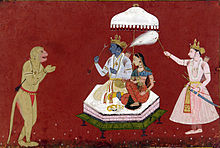
Rama seated with Sita, fanned byLakshmana, while Hanuman pays his respects.
- Rama is one of the protagonists of the tale. Portrayed as the seventh avatar of the god Vishnu, he is the eldest and favorite son of Dasharatha—the king of Ayodhya (current day Ayodhya, India)—and his Queen, Kausalya. He is portrayed as the epitome of virtue. Dasharatha is forced by Kaikeyi, one of his wives, to command Rama to relinquish his right to the throne for fourteen years and go into exile.
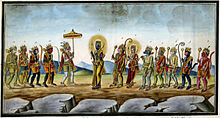
Rama and the monkey chiefs.
- Sita is another of the tale’s protagonists. She is King Janak’s daughter, and Rama’s beloved wife. Rama went to Mithila (located in Janakpur, Nepal), and got a chance to marry her by fracturing the Shiv Dhanush (bow) while trying to tie knot to it in a competition organized by King Janaka of Nepal in Dhanusa. The competition was to find the most suitable husband for Sita, and many princes from different states competed to win her. Sita is the avatara of goddessLakshmi, the consort of Vishnu. Sita is portrayed as the epitome of female purity and virtue. She follows her husband into exile and is abducted by Ravana. She is imprisoned on the island of Lanka, until Rama rescues her by defeating the demon king Ravana. Later, she gives birth to Lava and Kusha.
- Hanuman is a vanara belonging to the kingdom of Kishkindha. In some versions (other than Valmiki’s), he is portrayed as the eleventh avatar of Shiva (he is also called rudra) and an ideal bhakta of Rama. He is born as the son of Kesari, a Vanara king, and the goddess Anjana. He plays an important part in locating Sita and in the ensuing battle. He is believed to live until our modern world.
- Lakshmana, the younger brother of Rama, who chose to go into exile with him. He is the son of King Dasaratha and Queen Sumitra, and twin of Shatrughna. Lakshmana is portrayed as an avatar of the Shesha, the nāga associated with the god Vishnu. He spends his time protecting Sita and Rama during which he fought the demoness Surpanakha. He is forced to leave Sita, who was deceived by the demon Maricha into believing that Rama was in trouble. Sita is abducted by Ravana upon him leaving her. He was married to Sita’s younger sister Urmila.
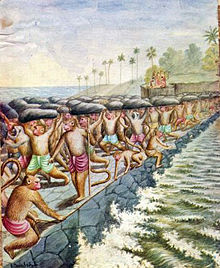
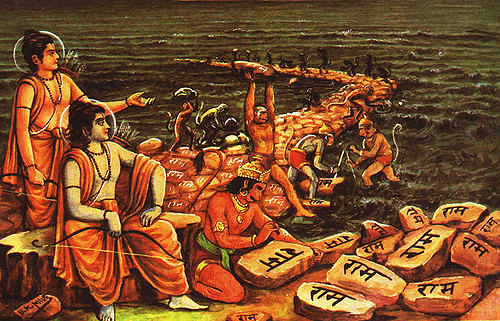
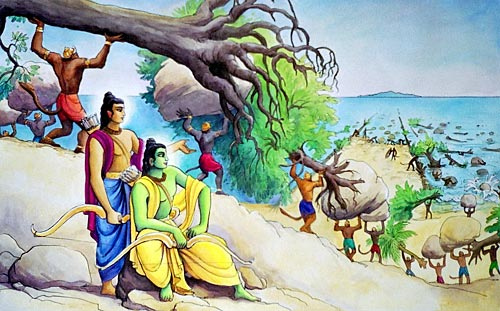
Building a Rama Setu Bridge toLanka.
- Ravana, a rakshasa, is the king of Lanka. After performing severe penance for ten thousand years he received a boon from the creator-god Brahma: he could henceforth not be killed by gods, demons,or spirits. He is portrayed as a powerful demon king who disturbs the penances of rishis. Vishnu incarnates as the human Rama to defeat him, thus circumventing the boon given by Brahma.
- Jatayu,the son of Aruṇa and nephew of Garuda. A demi-god who has the form of an vulture that tries to rescue Sita from Ravana. Jatayu fought valiantly with Ravana, but as Jatayu was very old, Ravana soon got the better of him. As Rama and Lakshmana chanced upon the stricken and dying Jatayu in their search for Sita, he informs them of the direction in which Ravana had gone.
- Dasharatha is the king of Ayodhya and the father of Rama. He has three queens, Kausalya, Kaikeyi and Sumitra, and three other sons: Bharata,Lakshmana and Shatrughna. Kaikeyi, Dasharatha’s favourite queen, forces him to make his son Bharata crown prince and send Rama into exile. Dasharatha dies heartbroken after Rama goes into exile.
- Bharata is the son of Dasharatha and Queen Kaikeyi. When he learns that his mother Kaikeyi had forced Rama into exile and caused Dasharatha to die brokenhearted, he storms out of the palace and goes in search of Rama in the forest. When Rama refuses to return from his exile to assume the throne, Bharata obtains Rama’s sandals, and places them on the throne as a gesture that Rama is the true king. Bharata then rules Ayodhya as the regent of Rama for the next fourteen years. He was married to Mandavi.
- Shatrughna is the son of Dasharatha and his second wife Queen Sumitra. He is the youngest brother of Rama and also the twin brother of Lakshmana. He was married to Shrutakirti.
- Sugriva, a vanara king who helped Rama regain Sita from Ravana. He had an agreement with Rama through which Vaali – Sugriva’s brother and king of Kishkindha – would be killed by Rama in exchange for Sugriva’s help in finding Sita. Sugriva ultimately ascends the throne of Kishkindha after the slaying of Vaali, and fulfills his promise by putting the Vanara forces at Rama’s disposal[28]
- Indrajit, a son of Ravana who twice defeated Lakshmana in battle, before succumbing to him the third time. An adept of the magical arts,he coupled his supreme fighting skills with various stratagems to inflict heavy losses on the Vanara army before his death.[28]
- Kumbhakarna, a brother of Ravana, famous for his eating and sleeping. He would sleep for months at a time and would be extremely ravenous upon waking up, consuming anything set before him. His monstrous size and loyalty made him an important part of Ravana’s army. During the war he decimated the Vanara army before Rama cut off his limbs and head.[28]
- Surpanakha, Ravana’s demoness sister who fell in love with Rama and had the magical power to take any form she wanted.
- Vibhishana, a younger brother of Ravana. He was against the kidnapping of Sita, and joined the forces of Rama when Ravana refused to return her. His intricate knowledge of Lanka was vital in the war, and he was crowned king after the fall of Ravana.[28]